


BBA vs BCom After 12th: Which Course is Better in 2026?
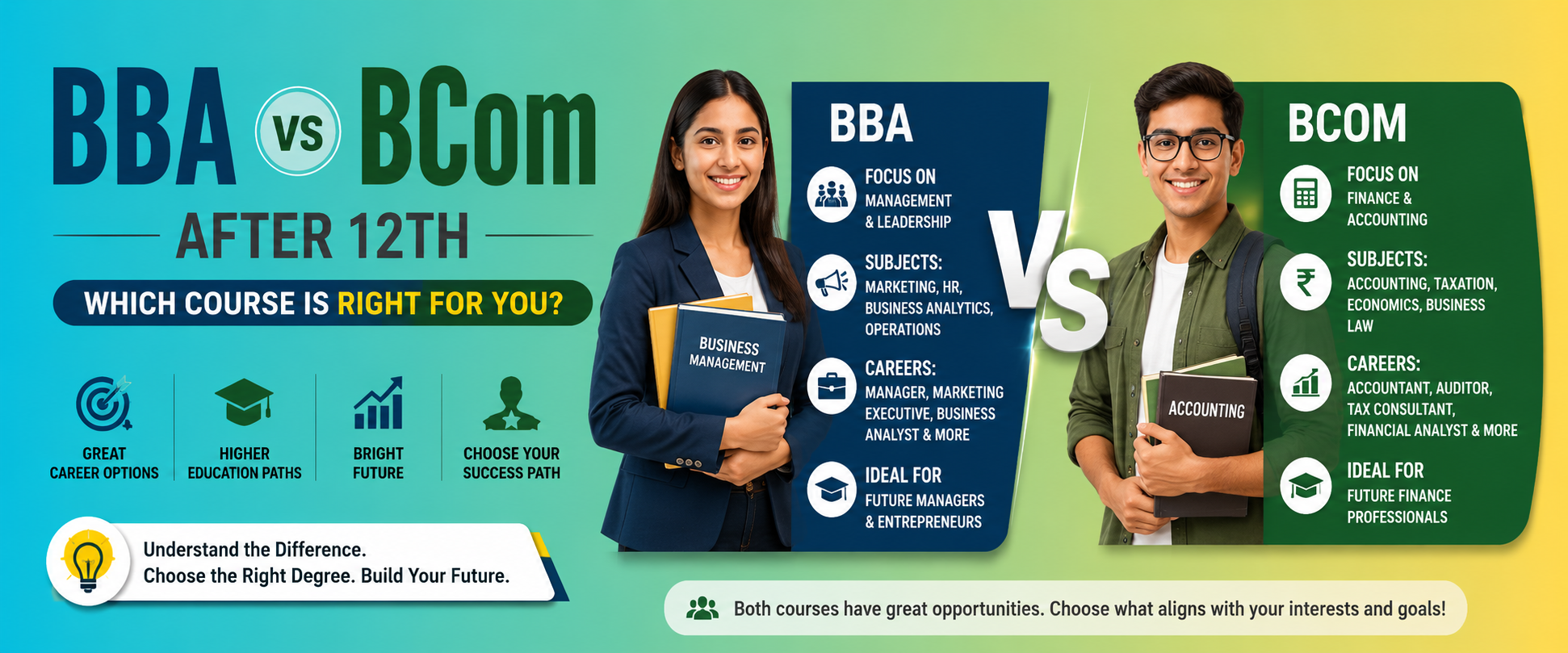
Choosing the right undergraduate course after Class 12 is one of the most important decisions in a student's academic journey. Commerce students often find themselves confused between Bachelor of Business Administration (BBA) and Bachelor of Commerce (BCom). Both are highly respected degree programs that open doors to rewarding careers in business, finance, management, banking, accounting, and entrepreneurship.
However, neither BBA nor BCom is universally better. The right choice depends entirely on your interests, strengths, and long-term career aspirations.
If you enjoy business management, leadership, marketing, and entrepreneurship, BBA may be the ideal option. On the other hand, if you have an interest in accounting, taxation, auditing, finance, and economics, BCom can provide a stronger foundation.
This detailed guide compares BBA vs BCom based on course structure, eligibility, subjects, higher education opportunities, career prospects, job roles, similarities, differences, and factors that should influence your decision.
What is BBA?
Bachelor of Business Administration (BBA) is a three-year undergraduate degree that focuses on developing business management and leadership skills. The course prepares students for managerial positions across industries by combining classroom learning with practical exposure through internships, case studies, industrial visits, and projects.
The curriculum introduces students to the core functions of business, helping them understand how organizations operate and grow.
BBA Highlights
- Duration: 3 Years (6 Semesters)
- Focus: Business Management
- Learning Style: Practical and Skill-Oriented
- Best For:
- Future Managers
- Entrepreneurs
- Marketing Professionals
- Business Consultants
- MBA Aspirants
Major BBA Subjects
- Principles of Management
- Marketing Management
- Human Resource Management
- Financial Management
- Business Communication
- Organizational Behaviour
- Business Analytics
- Operations Management
- Strategic Management
- Entrepreneurship
What is BCom?
Bachelor of Commerce (BCom) is a three-year undergraduate degree designed to provide a solid foundation in commerce, finance, accounting, taxation, economics, and business law.
The course is more theory-oriented than BBA and is ideal for students planning careers in accounting, banking, taxation, auditing, investment analysis, or financial management.
Many Chartered Accountancy (CA), CMA, and CS aspirants pursue BCom alongside their professional certifications.
BCom Highlights
- Duration: 3 Years (6 Semesters)
- Focus: Accounting and Finance
- Learning Style: Concept-Based
- Best For:
- Accountants
- Auditors
- Tax Consultants
- Financial Analysts
- Banking Professionals
Major BCom Subjects
- Financial Accounting
- Corporate Accounting
- Cost Accounting
- Business Economics
- Taxation
- Auditing
- Business Mathematics
- Business Law
- Corporate Law
- Financial Management
BBA vs BCom: Course Comparison
| Aspect | BBA | BCom |
|---|---|---|
| Full Form | Bachelor of Business Administration | Bachelor of Commerce |
| Duration | 3 Years | 3 Years |
| Learning Approach | Practical, Internship-Based | Theory-Oriented |
| Focus Area | Business Management | Accounting & Finance |
| Best For | Leadership & Entrepreneurship | Commerce & Finance |
| Core Subjects | HR, Marketing, Business Analytics | Taxation, Economics, Accounting |
| Career Focus | Corporate Management | Finance & Commerce |
| Specializations | Marketing, Aviation, HR, International Business | Accounting, Banking, Finance |
| Higher Studies | MBA, PGDM | MCom, CA, CMA, CS, MBA |
BBA vs BCom: Eligibility Criteria
Both courses can be pursued immediately after Class 12.
| Criteria | BBA | BCom |
|---|---|---|
| Qualification | Class 12 (Any Stream) | Class 12 (Commerce preferred) |
| Minimum Marks | 45–50% | Around 50% |
| Entrance Exam | Depends on University | Depends on University |
Some universities admit students based on merit, while others conduct entrance examinations.
BBA vs BCom: Course Focus
Although both programs belong to the commerce field, they differ significantly in teaching methodology.
BBA Focuses On
- Leadership
- Team Management
- Entrepreneurship
- Business Strategy
- Marketing
- Human Resources
- Corporate Communication
Students gain practical knowledge through projects, internships, presentations, and case studies.
BCom Focuses On
- Accounting
- Taxation
- Auditing
- Economics
- Corporate Finance
- Banking
- Business Laws
Students develop analytical and financial problem-solving skills.
BBA vs BCom: Higher Education Opportunities
Undergraduate education lays the foundation for advanced studies.
Higher Education After BBA
Students commonly pursue:
- Master of Business Administration (MBA)
- Post Graduate Diploma in Management (PGDM)
- Master of Management Studies (MMS)
- Masters in Finance Management
- PG Diploma in Banking
- LLB
- MCom
An MBA is the most popular progression after BBA, allowing students to specialize in Marketing, Finance, Human Resources, Business Analytics, Operations, or International Business.
Higher Education After BCom
BCom graduates have multiple professional pathways, including:
- Chartered Accountancy (CA)
- Cost and Management Accountancy (CMA)
- Company Secretary (CS)
- Chartered Financial Analyst (CFA)
- Master of Commerce (MCom)
- MBA
- Actuarial Science
These qualifications can significantly enhance career prospects in finance, taxation, and corporate governance.
BBA vs BCom: Career Opportunities
Both degrees provide access to banking, insurance, finance, consulting, and corporate sectors.
Jobs After BBA
Graduates can work as:
- Business Development Executive
- Marketing Executive
- Human Resource Associate
- Operations Executive
- Business Analyst
- Financial Analyst
- Executive Assistant
- Project Coordinator
- Sales Manager
- Operations Manager
Jobs After BCom
Career opportunities include:
- Accountant
- Auditor
- Tax Consultant
- Financial Analyst
- Investment Analyst
- Banking Officer
- Finance Executive
- Accounts Executive
- Personal Financial Consultant
- Financial Controller
Top Recruiters
Both BBA and BCom graduates are hired by leading multinational companies.
Some of the top recruiters include:
- Deloitte
- PwC
- KPMG
- Accenture
- Morgan Stanley
- BCG
- EY
- ICICI Bank
- HDFC Bank
- Axis Bank
- Infosys
- Wipro
- TCS
Fresh graduates generally begin with entry-level roles and can advance rapidly with experience and higher qualifications.
Similarities Between BBA and BCom
Although different in approach, both degrees share several similarities.
- Three-year undergraduate programs
- Six-semester curriculum
- Eligibility after Class 12
- Opportunities in banking and finance
- Corporate employment opportunities
- Foundation for postgraduate education
- Industry-recognized degrees
Both courses prepare students for successful careers in commerce and business.
Differences Between BBA and BCom
| Feature | BBA | BCom |
|---|---|---|
| Primary Focus | Management | Commerce & Finance |
| Teaching Style | Practical | Theoretical |
| Internship Exposure | High | Moderate |
| Leadership Development | Extensive | Limited |
| Accounting Depth | Basic | Advanced |
| Entrepreneurship | Strong Focus | Limited |
| Best PG Option | MBA | CA, CMA, CS, MCom, MBA |
Factors to Consider Before Choosing Between BBA and BCom
Several factors should influence your decision:
1. Career Goals
Choose BBA if you aspire to become a manager, entrepreneur, or marketing professional. Choose BCom if you want a career in finance, accounting, auditing, or taxation.
2. Interests
Students who enjoy leadership and communication may prefer BBA, while those who enjoy numbers and financial analysis may find BCom more suitable.
3. Preferred Learning Style
BBA emphasizes practical learning, presentations, and internships. BCom focuses more on theoretical concepts and financial principles.
4. College and University
Compare curriculum, placement opportunities, accreditation, and faculty before making your decision.
5. Entrance Exam and Academic Performance
Some universities consider Class 12 marks, while others conduct entrance examinations.
6. Future Scope
Research industry demand and future career growth before selecting a course.
Which Course Should You Choose?
Choose BBA if you:
- Want to become a manager
- Dream of starting your own business
- Enjoy leadership and teamwork
- Prefer practical learning
- Plan to pursue an MBA
Choose BCom if you:
- Enjoy accounting and finance
- Want to become a CA, CMA, or CS
- Prefer analytical and theoretical subjects
- Plan to work in banking, taxation, or auditing
- Are interested in financial management
Conclusion
Both BBA and BCom are excellent undergraduate programs with strong career prospects. The decision should not be based on which course is "better" but on which course aligns with your personal interests and long-term goals.
If your passion lies in business leadership, management, and entrepreneurship, BBA is likely the right fit. If you are drawn to accounting, taxation, finance, and commerce, BCom provides a stronger academic and professional foundation.
Regardless of your choice, both degrees offer opportunities to pursue higher education, earn professional certifications, and build successful careers in today's competitive business environment. Carefully evaluate your strengths, career aspirations, and preferred learning style before making your decision, and choose the path that best supports your future ambitions.