


Government vs Private Nursing Colleges in India: Which is Better for Your Nursing Career in 2026?
Nursing is one of the fastest-growing and most respected healthcare professions in India. With increasing demand for qualified nurses in hospitals, clinics, rehabilitation centers, and international healthcare systems, selecting the right nursing college has become more important than ever.
One of the most common questions among students is: Should I choose a Government Nursing College or a Private Nursing College?
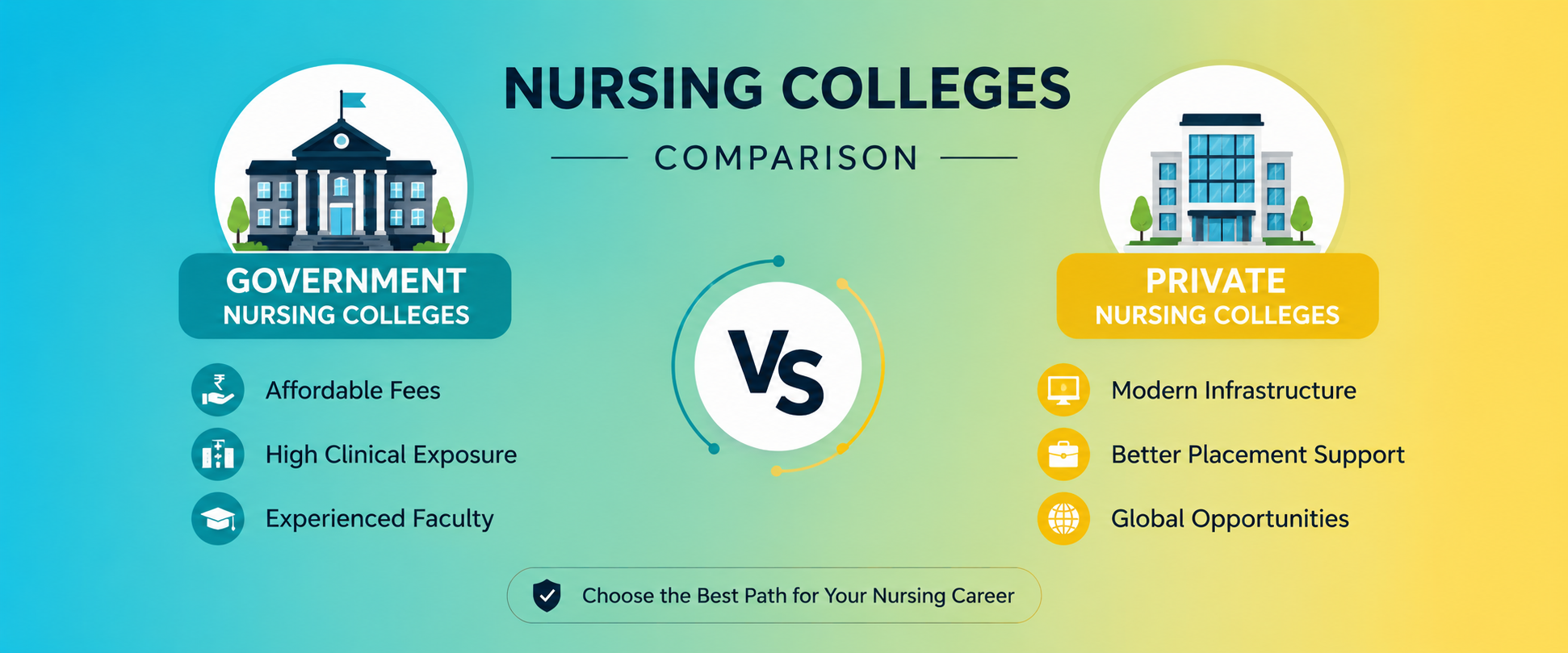
The answer depends on several factors, including budget, academic performance, career goals, location preferences, and learning expectations. While government nursing colleges are known for affordability and extensive clinical exposure, private nursing colleges often provide modern facilities, advanced learning environments, and strong placement support.
This detailed guide explores every important aspect of government and private nursing colleges to help students make an informed decision.
Understanding Government Nursing Colleges
Government nursing colleges are funded and managed by either state governments or the central government. Most are attached to government hospitals, medical colleges, or teaching institutions that serve a large number of patients daily.
Admission to government nursing colleges is typically based on merit through NEET scores, state-level counseling processes, or qualifying examination marks. Due to limited seat availability and affordable fees, competition for admission is often extremely high.
Advantages of Government Nursing Colleges
Affordable Education
One of the biggest advantages is the low fee structure. Government institutions receive financial support from the government, significantly reducing tuition costs for students.
The total cost of a four-year B.Sc Nursing program can range from approximately ₹60,000 to ₹1,40,000, making it accessible to students from various economic backgrounds.
Extensive Clinical Exposure
Government hospitals handle thousands of patients every day. Nursing students gain hands-on experience with a wide variety of medical conditions, emergency cases, and specialized treatments.
This exposure helps students develop practical skills and confidence early in their careers.
Experienced Faculty
Many government colleges employ highly qualified professors and nursing educators with decades of teaching and clinical experience.
Students benefit from strong academic foundations and evidence-based nursing education.
Strong Recognition
Government nursing colleges often enjoy strong credibility among healthcare employers and educational institutions.
Graduates are widely accepted for higher studies and government recruitment opportunities.
Better Research Opportunities
Government institutions frequently receive public funding for research projects, allowing students to participate in healthcare studies and evidence-based nursing practices.
Challenges of Government Nursing Colleges
Highly Competitive Admissions
Government nursing seats are limited. In states like Kerala, Tamil Nadu, Karnataka, and Maharashtra, securing admission often requires excellent academic performance and competitive entrance exam scores.
Older Infrastructure
Some government institutions operate from older campuses that may require modernization. Laboratories, hostels, and classroom facilities can vary significantly.
Limited Placement Assistance
Although graduates are highly employable, government colleges often have fewer campus recruitment drives compared to leading private institutions.
Students may need to actively pursue job opportunities independently.
Understanding Private Nursing Colleges
Private nursing colleges are managed by educational trusts, charitable organizations, universities, or private educational groups. They have expanded significantly across India over the past two decades.
These institutions often focus on delivering modern nursing education through updated facilities and industry partnerships.
Advantages of Private Nursing Colleges
Easier Accessibility
Private colleges offer a larger number of seats, making admission more accessible for students who may not secure government college admissions.
Many institutions conduct their own counseling or admission processes.
Modern Infrastructure
Private colleges frequently invest in:
- Smart classrooms
- Advanced nursing laboratories
- Simulation centers
- Digital libraries
- Modern hostel facilities
These resources create an enhanced learning environment.
Dedicated Placement Support
Many leading private nursing colleges maintain active placement cells that collaborate with healthcare organizations such as:
- Apollo Hospitals
- Fortis Healthcare
- Manipal Hospitals
- Aster Hospitals
- Narayana Health
These partnerships help students secure employment soon after graduation.
International Career Opportunities
Several private colleges actively support students pursuing careers abroad.
Many have alumni working in:
- United Kingdom
- Australia
- Canada
- United Arab Emirates
- New Zealand
Some institutions even collaborate with international recruitment agencies.
Flexible Location Options
Private nursing colleges are available across metropolitan cities, semi-urban regions, and tier-2 towns, offering students greater flexibility in choosing study locations.
Challenges of Private Nursing Colleges
Higher Fees
Private nursing education is significantly more expensive than government education.
The total four-year program cost can range between ₹2.5 lakh and ₹8 lakh or more depending on the institution.
Quality Differences
Not all private nursing colleges offer the same standards.
Students must carefully evaluate:
- Accreditation
- Faculty qualifications
- Hospital affiliations
- Placement records
before taking admission.
Variable Clinical Exposure
Some private colleges are affiliated with smaller hospitals that may not provide the same patient volume as government hospitals.
This can impact practical learning experiences.
Cost Comparison: Government vs Private Nursing Colleges
| Factor | Government Nursing College | Private Nursing College |
|---|---|---|
| Tuition Fees | Low | High |
| Hostel Charges | Usually Affordable | Moderate to High |
| Scholarships | Widely Available | Limited but Available |
| Total Course Cost | ₹60,000 – ₹1.4 Lakhs | ₹2.5 Lakhs – ₹8 Lakhs+ |
| Return on Investment | Excellent | Depends on Institution |
Students should always calculate the total course cost, including tuition fees, hostel expenses, examination fees, uniforms, books, and transportation.
Clinical Training and Practical Learning
Clinical exposure is one of the most critical aspects of nursing education.
Government Nursing Colleges
Students typically train in:
- District Hospitals
- Medical College Hospitals
- Government Specialty Hospitals
Benefits include:
- Higher patient volume
- Diverse medical conditions
- Exposure to emergency care
- Community healthcare experience
Private Nursing Colleges
Students often train in:
- Corporate Hospitals
- Multi-speciality Hospitals
- Private Healthcare Networks
Benefits include:
- Modern equipment
- Organized departments
- Exposure to advanced technologies
- Professional hospital management systems
Career Opportunities After Nursing Graduation
Graduates from both government and private colleges can pursue careers in:
Clinical Nursing
- Staff Nurse
- ICU Nurse
- OT Nurse
- Emergency Nurse
- Pediatric Nurse
Specialized Nursing
- Oncology Nursing
- Dialysis Nursing
- Critical Care Nursing
- Psychiatric Nursing
Education and Research
- Nursing Tutor
- Clinical Instructor
- Research Assistant
International Opportunities
Nurses can pursue overseas careers after completing licensing requirements such as:
- NCLEX (USA)
- CBT and OSCE (UK)
- AHPRA Registration (Australia)
Employers focus more on skills, experience, and licensure rather than whether the degree was obtained from a government or private institution.
How to Evaluate a Nursing College
Before taking admission, students should ask the following questions:
Is the College INC Approved?
Approval from the Indian Nursing Council (INC) is mandatory.
What is the NAAC Accreditation Grade?
Institutions with NAAC grades A or A+ generally maintain better academic standards.
Which Hospital Provides Clinical Training?
Check:
- Hospital bed strength
- Patient inflow
- Specialty departments
What Are the Placement Statistics?
Review:
- Placement percentage
- Recruiters
- International placements
- Alumni success stories
What Is the Total Cost?
Calculate the complete four-year expenditure, including:
- Tuition fees
- Hostel fees
- Examination fees
- Uniform expenses
- Clinical training charges
Government Nursing College vs Private Nursing College: Which Is Better?
There is no universal answer because every student has different priorities.
Choose a Government Nursing College if you want:
- Lower educational expenses
- Extensive clinical exposure
- Strong academic reputation
- Government job preparation
Choose a Private Nursing College if you want:
- Modern infrastructure
- Flexible admissions
- Dedicated placement support
- International career guidance
The best nursing college is the one that aligns with your financial situation, academic profile, and long-term career objectives.
Conclusion
The debate between government and private nursing colleges continues because both offer valuable opportunities for aspiring healthcare professionals. Government nursing colleges excel in affordability, academic rigor, and clinical exposure, while private nursing colleges stand out for modern facilities, placement assistance, and international career support.
Students should carefully evaluate accreditation, faculty quality, hospital affiliations, placement records, and total educational costs before making a decision. Rather than choosing based solely on reputation or popularity, focus on finding a nursing college that matches your personal goals and professional ambitions.
A well-informed decision today can lead to a successful and rewarding nursing career in India and abroad.