


Top High-Paying Degrees in Germany 2026–27: Complete Career & Salary Guide
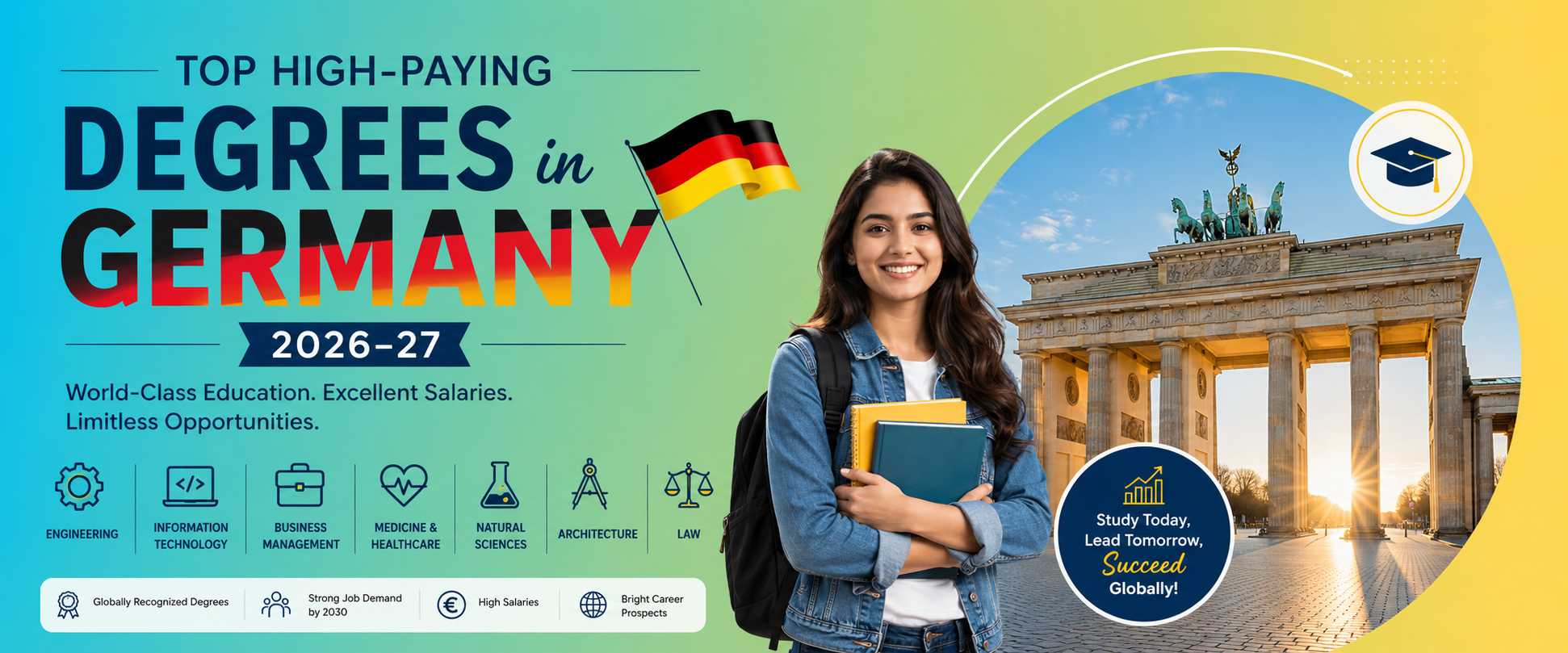
Germany has firmly established itself as one of the world's leading destinations for international education. While many traditional study-abroad destinations have introduced stricter immigration policies, rising tuition fees, and changing visa regulations, Germany continues to attract thousands of students every year with its high-quality education system, affordable universities, excellent research facilities, and outstanding employment opportunities. For students planning to study abroad in 2026–27, Germany offers one of the best combinations of academic excellence, career growth, and return on investment.
One of the first questions every student asks before selecting a study destination is, "How much can I earn after graduation?" This is an important consideration because the value of a degree is often measured by the career opportunities and salary it provides. Germany consistently ranks among the strongest economies in the world and has become one of Europe's most attractive destinations for skilled professionals. Graduates from German universities are highly respected because they graduate with practical knowledge, technical expertise, research experience, and industry-oriented skills that employers actively seek.
Why Germany is an Ideal Study Destination
Germany is the largest economy in the European Union and one of the world's leading industrial and technological nations. It is home to globally recognized companies such as BMW, Mercedes-Benz, Volkswagen, Siemens, SAP, Bosch, Adidas, Bayer, DHL, Allianz, and Deutsche Bank. These multinational organizations continually recruit talented graduates from German universities, creating exceptional career opportunities across engineering, information technology, finance, healthcare, business management, logistics, renewable energy, and research sectors.
One of Germany's greatest strengths is its strong connection between universities and industries. Unlike many education systems that focus primarily on classroom learning, German universities emphasize practical education through internships, laboratory research, industrial training, project-based learning, and collaborations with leading companies. This practical approach allows students to graduate with real-world experience, making them highly competitive in both the German and international job markets.
Germany's Growing Demand for Skilled Professionals
Germany is currently experiencing a significant demographic shift that is expected to create enormous demand for qualified professionals over the coming years. According to workforce projections, the country could face a shortage of nearly five million skilled workers by 2030 due to an aging population and the retirement of the baby-boomer generation. As fewer young professionals enter the workforce, employers across multiple industries are actively seeking qualified graduates to fill critical positions.
For students beginning their Bachelor's or Master's degrees during the 2026–27 academic year, this presents an exceptional opportunity to enter the workforce at a time when demand for skilled professionals is expected to be extremely high. Engineering, Information Technology, Healthcare, Business, Law, and Natural Sciences are expected to remain among the country's highest-demand professions.
Engineering: Germany's Most Trusted Career Path
Engineering continues to be Germany's flagship field of study. The country has built its global reputation on engineering excellence, manufacturing innovation, automotive technology, and industrial production.
Universities offer specializations in Mechanical Engineering, Civil Engineering, Electrical Engineering, Automotive Engineering, Robotics, Mechatronics, Aerospace Engineering, and Renewable Energy Systems. Students receive extensive practical training through modern laboratories, industrial projects, and mandatory internships that prepare them for real-world challenges.
Engineering graduates enjoy excellent career prospects, with a median annual salary of approximately EUR 65,000, making it one of Germany's most rewarding career paths.
Information Technology & Computer Science: Powering Germany's Digital Future
Germany's rapid digital transformation has significantly increased demand for software developers, AI specialists, cybersecurity professionals, cloud engineers, and data scientists.
Universities offer English-taught programs in Software Engineering, Artificial Intelligence, Data Science, Machine Learning, Cybersecurity, Cloud Computing, and Business Analytics. Students benefit from strong industry collaborations, internships, and research opportunities in cutting-edge technologies.
Graduates often secure positions as Software Engineers, Data Scientists, Cloud Architects, AI Specialists, Cybersecurity Consultants, and IT Project Managers. With a median annual salary of approximately EUR 71,000, IT graduates are among the highest-paid professionals in Germany.
Business Management: A Gateway to Global Leadership
Germany's position as Europe's economic powerhouse makes Business Management an excellent choice for international students.
Business schools offer specialized programs in International Business, Finance, Marketing, Human Resource Management, Supply Chain Management, and Corporate Strategy. Students gain valuable exposure through internships, networking events, and collaborations with multinational companies.
Graduates frequently pursue careers as Business Analysts, Management Consultants, Project Managers, Marketing Managers, Financial Analysts, and Corporate Finance Specialists. The median annual salary for Business Management graduates is approximately EUR 73,000, with experienced professionals earning considerably higher incomes.
Medicine & Healthcare: Stable Careers with High Earning Potential
Medicine and Healthcare remain among Germany's most secure and rewarding career fields. The country's aging population and expanding healthcare system have created continuous demand for doctors, healthcare administrators, public health professionals, clinical researchers, and medical specialists.
Germany is internationally recognized for its advanced hospitals, healthcare infrastructure, and medical research institutions. Although clinical programs generally require German language proficiency, many healthcare management and public health programs are available in English.
Graduates benefit from excellent employment prospects, long-term career stability, and a median annual salary of approximately EUR 72,000.
Natural Sciences: Driving Research and Innovation
Students interested in scientific discovery often choose Natural Sciences, including Physics, Chemistry, Biotechnology, Environmental Science, Pharmaceutical Sciences, and Biological Sciences.
Germany invests heavily in scientific research through internationally renowned organizations such as the Max Planck Society and Fraunhofer Institutes. Universities provide access to advanced laboratories, international research collaborations, and innovative scientific projects.
Natural Science graduates work as Research Scientists, Laboratory Specialists, Environmental Consultants, Pharmaceutical Researchers, and Biotechnology Professionals, earning a median annual salary of approximately EUR 55,000.
Architecture: Building the Sustainable Cities of Tomorrow
Architecture combines creativity with engineering and sustainability. Germany has become a leader in green construction, smart cities, energy-efficient buildings, and environmentally responsible urban planning.
Universities emphasize practical architectural design, Building Information Modeling (BIM), digital construction technologies, and sustainable development practices.
Graduates pursue careers as Architects, Urban Planners, BIM Specialists, Construction Project Managers, and Design Consultants. Architecture professionals enjoy stable employment across Germany and Europe, with median annual salaries around EUR 50,000.
Law: One of Germany's Highest-Paying Professions
German universities increasingly offer English-taught programs in International Business Law, European Union Law, Intellectual Property Law, and Corporate Law, making legal education accessible to international students.
Graduates work as Legal Advisors, Corporate Counsel, Compliance Officers, Intellectual Property Specialists, International Business Lawyers, and Corporate Legal Consultants.
Law remains one of Germany's highest-paying professions, with median annual salaries reaching approximately EUR 80,000, while experienced legal professionals earn substantially more.
Why Germany Offers Excellent Return on Investment
One of the biggest advantages of studying in Germany is its excellent return on investment (ROI). Many public universities offer high-quality education at low tuition costs while maintaining internationally recognized academic standards.
Students benefit from:
- Globally recognized degrees
- Affordable education
- Practical industry experience
- Strong graduate employability
- High starting salaries
- Access to multinational employers
- Research opportunities
- Long-term career growth
These advantages enable graduates to recover their educational investment relatively quickly while building successful international careers.
Career Opportunities After Graduation
Germany's thriving economy creates opportunities across numerous sectors, including:
- Automotive Manufacturing
- Artificial Intelligence
- Information Technology
- Healthcare
- Banking & Finance
- Renewable Energy
- Logistics & Supply Chain
- Construction
- Biotechnology
- Research & Development
- Consulting
- Corporate Law
With employers actively seeking skilled professionals, graduates can expect strong employment prospects and competitive salary packages.
Conclusion
Choosing the right degree is one of the most important decisions a student will ever make. While personal interests and career aspirations should always guide this choice, understanding industry demand and salary potential helps students make informed decisions about their future.
For students planning to study abroad in 2026–27, Germany offers an outstanding combination of world-class education, affordable tuition, practical learning, international recognition, and exceptional career opportunities. Whether your goal is to become an engineer, software developer, business leader, healthcare professional, architect, scientist, or legal expert, Germany provides the education, infrastructure, and employment ecosystem needed to build a successful global career.
With a growing shortage of skilled professionals, one of Europe's strongest economies, internationally respected universities, and excellent salary prospects, Germany continues to be one of the best destinations for students seeking both academic excellence and long-term professional success.