


IELTS vs PTE vs TOEFL 2026: Which English Test Is Best for Studying Abroad?
If you are planning to study abroad from India in 2026, one of the first and most important decisions you will make is choosing the right English language proficiency test. Most universities require proof of English proficiency before offering admission, and many countries also consider these scores during the student visa process.
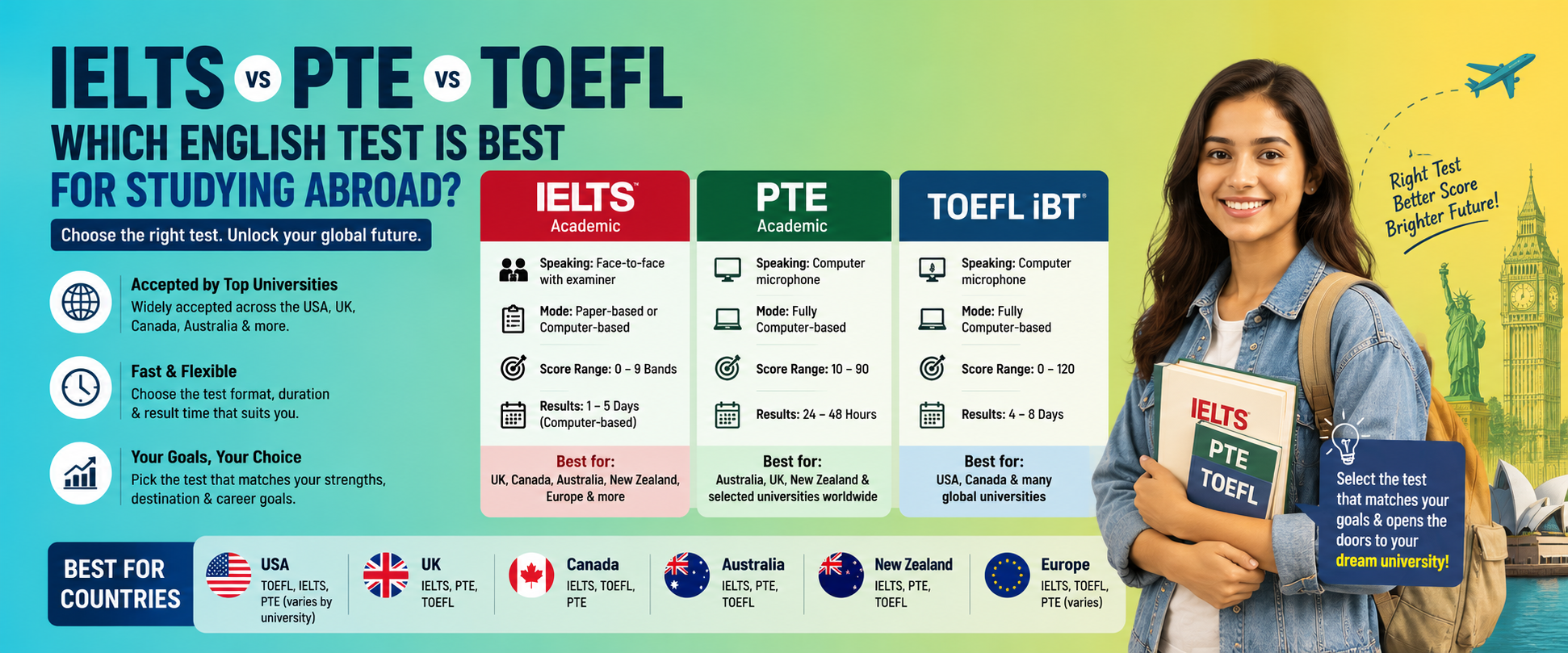
The three most popular English language tests are IELTS Academic, PTE Academic, and TOEFL iBT. All three are accepted by thousands of universities worldwide, but the best choice depends on your preferred destination, university requirements, course, visa regulations, and personal comfort with the test format.
In simple terms, IELTS offers the widest global acceptance, PTE is ideal for students looking for a fully computer-based exam with faster results, and TOEFL is especially popular among students applying to universities in the United States and Canada.
This guide compares IELTS, PTE, and TOEFL in detail to help you make the right choice for your study abroad journey in 2026.
What Are IELTS, PTE, and TOEFL?
IELTS, PTE, and TOEFL are internationally recognised English language proficiency tests designed to assess your ability to study in an English-speaking academic environment.
Each exam evaluates four essential language skills:
- Listening
- Reading
- Writing
- Speaking
Universities use these scores to determine whether applicants possess the English communication skills necessary for higher education. Many immigration authorities also require valid English test scores for student visa applications.
IELTS vs PTE vs TOEFL: Quick Comparison
| Feature | IELTS Academic | PTE Academic | TOEFL iBT |
|---|---|---|---|
| Full Form | International English Language Testing System | Pearson Test of English | Test of English as a Foreign Language |
| Test Mode | Paper-based or Computer-based | Fully Computer-based | Computer-based |
| Speaking Test | Face-to-face or video call with examiner | Computer microphone | Computer microphone |
| Score Range | 0–9 Bands | 10–90 | 0–120 |
| Test Duration | Around 2 hours 45 minutes | Around 2 hours | Around 2 hours |
| Result Time | Usually 1–5 days (computer-based), longer for paper-based | Usually within 24–48 hours | Usually 4–8 days |
| Best For | UK, Canada, Australia, New Zealand, Europe | Australia, UK, New Zealand, selected global universities | USA, Canada and many international universities |
| Difficulty | Moderate | Moderate | Moderate to High Academic Focus |
IELTS: Best for Global Acceptance
IELTS remains one of the most trusted English language tests for international education. It is accepted by universities across the UK, Canada, Australia, New Zealand, Europe, and the USA.
Why Choose IELTS?
IELTS is a suitable option if you:
- Want maximum global university acceptance.
- Plan to study in the UK, Canada, Australia, or New Zealand.
- Feel comfortable speaking with a real examiner.
- Prefer a traditional examination format.
- Need IELTS because your chosen university specifically requires it.
IELTS Test Sections
The IELTS Academic test consists of four sections:
- Listening
- Reading
- Writing
- Speaking
The speaking test is conducted separately with a certified examiner, either face-to-face or through an approved video format.
IELTS Score Requirements
Typical university requirements include:
- Undergraduate programmes: IELTS 6.0–6.5
- Postgraduate programmes: IELTS 6.5–7.0
- Healthcare, Law and Teaching: IELTS 7.0 or above
Score requirements vary depending on the institution and programme.
PTE Academic: Best for Fast Results
PTE Academic has become increasingly popular among Indian students because of its AI-based evaluation system and quick result processing.
Why Choose PTE?
PTE may be the right choice if you:
- Are comfortable using computers.
- Type quickly and accurately.
- Need faster results.
- Prefer AI-based scoring instead of human assessment.
- Are applying to Australia, New Zealand, the UK, or universities that recognise PTE.
PTE Test Sections
The exam includes:
- Speaking and Writing
- Reading
- Listening
Many questions assess multiple language skills simultaneously, making the exam highly integrated.
PTE Score Requirements
Typical university requirements include:
- Undergraduate programmes: PTE 50–60
- Postgraduate programmes: PTE 58–65
- Competitive programmes: PTE 65+
Students should always verify the required score with their chosen university.
TOEFL iBT: Best for USA-Focused Applications
TOEFL iBT is particularly popular among universities in the United States and Canada, although it is also accepted in Europe, Australia, the UK, and several other countries.
Why Choose TOEFL?
TOEFL is suitable if you:
- Primarily wish to study in the USA.
- Are comfortable with academic English.
- Can confidently speak into a computer microphone.
- Your university specifically recommends TOEFL.
- Are comfortable listening to academic lectures and taking notes.
TOEFL Test Sections
TOEFL consists of:
- Reading
- Listening
- Speaking
- Writing
The exam focuses heavily on university-level communication and academic English.
TOEFL Score Requirements
Typical university requirements include:
- Undergraduate programmes: 75–90
- Postgraduate programmes: 85–100
- Top-ranked universities: 100 or above
Score requirements differ between universities and courses.
Which Test Is Easier?
There is no universal answer. The easiest English language test depends on your individual strengths.
Choose IELTS if:
- You prefer speaking with a human examiner.
- You enjoy traditional reading and writing tasks.
- You want the widest global acceptance.
Choose PTE if:
- You are comfortable with computer-based exams.
- You want quick results.
- You type efficiently.
- You are confident with microphone-based speaking.
- You perform well using structured practice templates.
Choose TOEFL if:
- Your primary destination is the USA.
- You enjoy academic English.
- You are comfortable listening to lectures and taking notes.
- You prefer a fully computer-based examination.
Country-Wise Test Preference
Different countries accept multiple English proficiency tests, although preferences may vary.
| Country | Recommended Tests |
|---|---|
| USA | TOEFL, IELTS, PTE (depending on university) |
| UK | IELTS, PTE, TOEFL |
| Canada | IELTS, TOEFL, PTE |
| Australia | IELTS, PTE, TOEFL |
| New Zealand | IELTS, PTE, TOEFL |
| Germany | IELTS and TOEFL commonly accepted; PTE accepted by selected universities |
| Ireland | IELTS, PTE, TOEFL |
Always confirm the latest admission requirements on the official university website before registering for any examination.
IELTS vs PTE vs TOEFL: Which One Should You Choose?
Choosing the right English test depends on your destination, preferred test format, and career goals.
- Choose IELTS if you want the safest and most widely accepted option across multiple countries.
- Choose PTE if you prefer a fully computer-based exam with AI scoring and faster results.
- Choose TOEFL if your primary goal is admission to universities in the United States and you are comfortable with academic English.
There is no "best" test for every student. The right choice is the one accepted by your chosen university and suited to your strengths.
Important Things to Check Before Booking Your Test
Before registering for IELTS, PTE, or TOEFL in 2026, consider the following:
- Is the exam accepted by your chosen university?
- Does it meet your student visa requirements?
- What is the minimum overall score required?
- Are there section-wise score requirements?
- How quickly do you need your results?
- Are test dates available in your city?
- Are you comfortable with computer-based speaking?
- Will you benefit from professional coaching before attempting the test?
Carefully reviewing these factors can help you avoid unnecessary delays in your admission or visa process.
Final Thoughts
Selecting the right English language proficiency test is one of the most important steps in your study abroad journey. While IELTS, PTE, and TOEFL are all internationally recognised, the ideal choice depends on your preferred study destination, university requirements, learning style, and future academic plans.
Research your university's admission criteria, understand the visa requirements for your destination country, and evaluate your own strengths before booking an exam. If you are unsure which test is right for you, seek guidance from experienced study abroad counsellors. A well-informed decision today can save time, reduce stress, and improve your chances of securing admission to your dream university in 2026.