

How to Study in Germany After B.Tech: Complete Roadmap
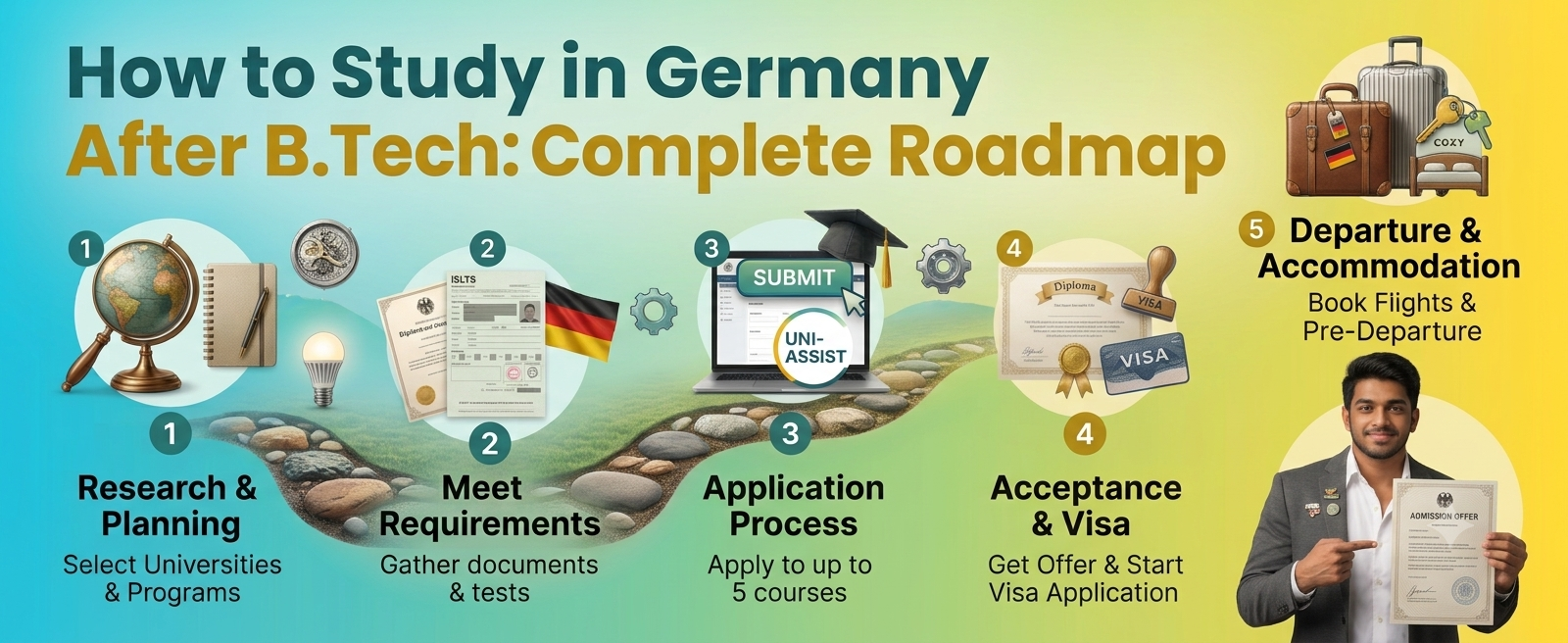
Germany has become one of the most preferred destinations for Indian engineering graduates seeking quality higher education. Every year, thousands of students choose to study in Germany after B.Tech because of its world-class universities, globally recognized degrees, affordable education, and excellent career opportunities.
Unlike many countries where tuition fees can be extremely high, most German public universities charge little to no tuition fees, making a Master's in Germany an attractive option for students looking for high-quality education without accumulating significant debt.
Whether you are in the final year of your engineering degree or have already graduated, understanding the admission process is essential. From choosing the right university to obtaining an APS certificate, applying through uni-assist, and securing a Germany student visa, every step requires careful planning.
This guide explains the complete roadmap to help Indian students successfully pursue a Master's degree in Germany.
Why Choose Germany After B.Tech?
Germany is home to some of the world's best engineering universities and is known for its innovation, research, and industrial excellence. The country offers exceptional academic opportunities while maintaining affordable education.
Here are some reasons why Germany stands out:
1. Tuition-Free Public Universities
One of the biggest advantages of choosing Germany is the availability of tuition-free universities in Germany. Most public universities only charge a semester contribution ranging from €150 to €350, which covers administrative expenses and often includes public transportation.
This makes Germany significantly more affordable than countries like the USA, UK, or Australia.
2. Globally Recognized Degrees
A Master's degree earned from a German university is respected worldwide.
Universities such as:
- Technical University of Munich (TUM)
- RWTH Aachen University
- Karlsruhe Institute of Technology
- University of Stuttgart
- TU Dresden
are internationally recognized for excellence in engineering and technology.
Graduates enjoy excellent employment opportunities both within Germany and internationally.
3. Strong Job Market
Germany has one of Europe's strongest economies and is home to global companies such as:
- BMW
- Mercedes-Benz
- Bosch
- Siemens
- SAP
- Volkswagen
- Continental
These organizations actively recruit skilled engineering graduates.
Students also benefit from internship opportunities during their studies and can apply for an 18-month post-study job-seeking residence permit after graduation.
4. High Quality of Life
Germany consistently ranks among the best countries for:
- Safety
- Healthcare
- Public transportation
- Research opportunities
- Work-life balance
International students enjoy excellent infrastructure and multicultural campuses.
5. English-Taught Master's Programs
Many students worry about learning German before applying.
Fortunately, hundreds of Master's programs in Germany are taught entirely in English, particularly in fields such as:
- Computer Science
- Artificial Intelligence
- Data Science
- Mechanical Engineering
- Electrical Engineering
- Civil Engineering
- Robotics
- Automotive Engineering
- Industrial Engineering
- Biotechnology
Learning German is still highly recommended because it improves everyday communication and increases employment opportunities after graduation.
Can You Study in Germany After B.Tech?
Absolutely.
Indian students with a four-year Bachelor's degree in Engineering (B.Tech or B.E.) are generally eligible to apply for a Master's in Germany.
However, admission depends on several factors.
Universities evaluate:
- Academic performance (CGPA or percentage)
- Relevance of previous subjects
- English language proficiency
- Course prerequisites
- Statement of Purpose (SOP)
- Letters of Recommendation (LOR)
- Work or internship experience (if required)
Each university has its own admission criteria, so it is important to check the official requirements before applying.
Eligibility Requirements
To study in Germany after B.Tech, you should generally meet the following requirements.
Bachelor's Degree
Applicants must have completed a recognized four-year engineering degree from an accredited university.
The degree should match the Master's specialization.
For example:
| B.Tech Degree | Suitable Master's Programs |
|---|---|
| Computer Science | Computer Science, AI, Data Science, Cybersecurity |
| Mechanical Engineering | Mechanical Engineering, Robotics, Automotive Engineering |
| Civil Engineering | Structural Engineering, Construction Management |
| Electronics | Embedded Systems, Electrical Engineering |
| Information Technology | Software Engineering, Information Systems |
Changing to an entirely unrelated discipline may not be accepted unless you have relevant academic background or work experience.
Academic Performance
There is no universal minimum CGPA requirement.
However, most universities prefer applicants with:
- 70% and above
- CGPA above 7.0/10
- German Grade between 1.5 and 2.5
Students with lower grades can still receive admission by applying to universities with flexible admission criteria and presenting a strong SOP, relevant internships, projects, or work experience.
English Language Requirements
Most English-taught Master's programs require proof of English proficiency.
Accepted tests include:
- IELTS Academic
- TOEFL iBT
- PTE Academic (accepted by some universities)
Typical IELTS requirements range from 6.5 to 7.0 overall, although some universities accept a score of 6.0.
A few universities may waive the language requirement if your previous education was entirely in English and they accept a valid Medium of Instruction (MOI) certificate.
APS Certificate
The APS certificate is mandatory for most Indian students applying to German universities.
It verifies the authenticity of your academic qualifications before your application is processed.
Without an APS certificate, many universities will not consider your application.
You should apply for APS as early as possible because processing can take several weeks.
Step 1: Choose the Right Master's Program
The first and most important step to study in Germany after B.Tech is selecting a Master's program that aligns with your academic background and career aspirations.
Unlike some countries where students can easily switch fields, German public universities generally expect applicants to have studied relevant subjects during their Bachelor's degree. Universities evaluate your transcripts to ensure you meet the required academic prerequisites.
For example:
| B.Tech Background | Suitable Master's Programs |
|---|---|
| Computer Science | Computer Science, Artificial Intelligence, Data Science, Cybersecurity, Software Engineering |
| Mechanical Engineering | Mechanical Engineering, Robotics, Automotive Engineering, Mechatronics |
| Civil Engineering | Structural Engineering, Construction Management, Transportation Engineering |
| Electrical Engineering | Embedded Systems, Electrical Engineering, Renewable Energy |
| Electronics & Communication | Communication Engineering, Automation, Embedded Systems |
| Biotechnology | Biotechnology, Bioinformatics, Biomedical Engineering |
Pro Tip: Carefully review the module handbook of your desired Master's program. Many universities compare your undergraduate coursework with their prerequisites before making an admission decision.
Step 2: Find the Right German Public University
Germany has more than 400 higher education institutions, including universities, universities of applied sciences, and private universities.
If you're looking for affordable education, prioritize German public universities, as most charge no tuition fees (except a small semester contribution).
Some of the top universities for engineering and technology include:
- Technical University of Munich (TUM)
- RWTH Aachen University
- TU Berlin
- TU Dresden
- Karlsruhe Institute of Technology (KIT)
- University of Stuttgart
- FAU Erlangen-Nürnberg
- University of Duisburg-Essen
- Otto von Guericke University Magdeburg
- University of Paderborn
Don't focus only on rankings. Many mid-ranked public universities offer excellent teaching, research opportunities, and higher chances of admission for international students.
When selecting universities, compare:
- Course curriculum
- Specializations
- Language of instruction
- Internship opportunities
- Research facilities
- Admission requirements
- City-wise cost of living
- Industry collaborations
Step 3: Check the Admission Requirements
Every university publishes detailed admission requirements on its official website.
Before applying, verify the following:
Academic Eligibility
- Relevant Bachelor's degree
- Required subjects completed
- Minimum CGPA or percentage
Language Requirements
For English-taught programs, universities usually accept:
- IELTS Academic
- TOEFL iBT
- PTE Academic (selected universities)
Some institutions also accept a Medium of Instruction (MOI) certificate, but policies vary.
Additional Requirements
Some Master's programs may require:
- GRE (rare, but common for certain technical programs)
- Portfolio (for design-related courses)
- Work experience (for MBA or specialized professional programs)
- Entrance interview
- Motivation letter
Always read the university's admission page carefully to avoid missing mandatory requirements.
Step 4: Understand ECTS Requirements
One of the most overlooked aspects of applying for a Master's in Germany is the ECTS (European Credit Transfer and Accumulation System) requirement.
Most German universities expect applicants to have completed 180–210 ECTS during their Bachelor's degree.
Indian B.Tech graduates generally satisfy this requirement because a four-year engineering degree is usually equivalent to 240 ECTS.
However, universities also evaluate whether you've studied specific subjects such as:
- Mathematics
- Programming
- Algorithms
- Data Structures
- Engineering Mathematics
- Physics
- Electronics
- Machine Learning (for AI-related programs)
If important prerequisite subjects are missing, your application may be rejected even if you have excellent grades.
Step 5: Prepare Your Application Documents
A complete application significantly improves your chances of admission.
The typical document checklist includes:
Academic Documents
- Bachelor's degree certificate (or provisional certificate)
- Semester-wise transcripts
- Consolidated mark sheet
Identity Documents
- Valid passport
- Passport-sized photographs
Language Documents
- IELTS/TOEFL/PTE scorecard
- MOI certificate (if accepted)
Mandatory Application Documents
- APS Certificate
- Updated Curriculum Vitae (CV)
- Statement of Purpose (SOP)
- Letters of Recommendation (LORs)
Additional Documents (if applicable)
- Internship certificates
- Work experience certificates
- Research publications
- Project reports
- Portfolio (for design courses)
Ensure that all scanned documents are clear, complete, and in PDF format if submitting online.
Step 6: uni-assist vs Direct University Application
One of the most common questions among students planning to study in Germany after B.Tech is whether they need to apply through uni-assist or directly to the university.
What is uni-assist?
uni-assist is a centralized application portal used by many German universities to evaluate international applications.
Its role includes:
- Verifying academic documents
- Checking eligibility
- Converting grades
- Forwarding eligible applications to universities
If your chosen university uses uni-assist, you must submit your documents there before they are sent to the university.
Direct Application
Some universities accept applications directly through:
- Their own online portal
- CAMPUS systems
- Mobility Online
- University-specific application platforms
Always check the official admissions page to confirm the correct application method.
Winter Intake vs Summer Intake
Germany generally offers two admission cycles each year.
Winter Intake
- Applications usually open: April–May
- Deadlines: May to July (varies by university)
- Classes begin: September or October
This is the primary intake and offers the largest number of Master's programs.
Summer Intake
- Applications usually open: October–November
- Deadlines: November to January
- Classes begin: March or April
Not all universities offer Summer Intake, so check program availability in advance.
Shortlist Universities Strategically
Instead of applying only to highly competitive universities, create a balanced application list.
A smart strategy is:
- Dream Universities (20%) – Highly competitive institutions where admission is challenging.
- Target Universities (50%) – Universities where your profile closely matches the admission requirements.
- Safe Universities (30%) – Universities with comparatively flexible admission criteria and a higher probability of acceptance.
Applying to a mix of universities increases your chances of receiving at least one admission offer.
Common Mistakes to Avoid
Many applicants lose admission opportunities because of avoidable errors.
Some common mistakes include:
- Applying to programs unrelated to your Bachelor's degree.
- Ignoring prerequisite subject requirements.
- Submitting incomplete documents.
- Writing a generic Statement of Purpose (SOP) for every university.
- Waiting until the last week before the application deadline.
- Delaying the APS certificate application.
- Not checking whether the university uses uni-assist or direct applications.
- Failing to verify IELTS or English language requirements.
Planning ahead and carefully following each university's guidelines can make your application much stronger.
Step 7: Write a Strong Statement of Purpose (SOP)
Your Statement of Purpose (SOP) is one of the most important documents in your application. It allows the admissions committee to understand your academic background, career goals, and motivation for choosing a specific program.
A strong SOP should include:
- Introduction about yourself
- Academic background and achievements
- Relevant projects and internships
- Why you chose the particular university and course
- Career goals
- Why Germany is the ideal destination
- A strong conclusion
Avoid These Mistakes
- Copying SOPs from the internet
- Using the same SOP for every university
- Writing unnecessary personal stories
- Grammatical errors and spelling mistakes
- Exceeding the recommended word limit
Your SOP should clearly explain why you want to study in Germany after B.Tech and how the chosen program aligns with your future career plans.
Step 8: Obtain Strong Letters of Recommendation (LORs)
Most German universities require one or two Letters of Recommendation from professors or employers.
An effective LOR should highlight:
- Academic performance
- Technical knowledge
- Research ability
- Problem-solving skills
- Teamwork
- Communication skills
- Overall potential for graduate studies
Request your recommendations well in advance, as professors may need time to prepare them.
Step 9: Scholarships for Indian Students
Although German public universities are largely tuition-free, scholarships can help cover your living expenses.
Popular scholarship options include:
DAAD Scholarships
The German Academic Exchange Service (DAAD) offers scholarships for selected Master's programs and research opportunities.
Deutschlandstipendium
This merit-based scholarship supports high-performing students enrolled at participating universities.
Erasmus+
Students participating in exchange or joint programs may be eligible for Erasmus+ funding.
University Scholarships
Many universities provide scholarships based on academic excellence, research achievements, or financial need. Always check the official university website for available opportunities.
Cost of Studying in Germany
One of the biggest reasons students choose Germany is its affordability.
Tuition Fees
Most tuition-free universities in Germany do not charge tuition fees for Master's programs. Students usually pay only a semester contribution of approximately €150–€350, which often includes public transportation and student services.
Monthly Living Expenses
The average monthly cost of living varies depending on the city:
| Expense | Estimated Cost |
|---|---|
| Accommodation | €350–€700 |
| Food | €180–€250 |
| Health Insurance | €140–€150 |
| Transportation | Included in many semester tickets |
| Internet & Mobile | €30–€50 |
| Personal Expenses | €100–€200 |
Overall, students should budget around €900–€1,200 per month.
Cities such as Munich and Frankfurt are more expensive, while Leipzig, Magdeburg, Chemnitz, and Kaiserslautern are comparatively affordable.
Blocked Account Requirement
To obtain a Germany student visa, international students generally need to demonstrate sufficient financial resources.
This is commonly done through a blocked account, where a prescribed amount is deposited before travelling to Germany. Students can then withdraw a limited monthly amount after arrival to cover living expenses.
The required amount is reviewed periodically by German authorities, so always verify the latest requirement before opening your account.
Step 10: Germany Student Visa Process
Once you receive your admission letter, you can begin the Germany student visa application process.
Documents Required
- Valid passport
- University admission letter
- APS certificate
- Academic documents
- IELTS/TOEFL score (if applicable)
- Proof of financial resources (such as a blocked account)
- Health insurance
- Visa application form
- Passport-size photographs
Visa Interview Tips
- Be confident and honest.
- Clearly explain your study plans.
- Demonstrate knowledge of your chosen course and university.
- Show how your studies align with your career goals.
- Keep all original documents organized.
Health Insurance
Health insurance is mandatory for all international students in Germany.
Students under a certain age usually qualify for public student health insurance, while others may need private insurance depending on their circumstances.
Without valid health insurance, you cannot complete university enrollment.
Accommodation Options
Finding accommodation early is important because student housing is highly competitive.
Common options include:
Student Dormitories
- Most affordable option
- Managed by student services
- Limited availability
Shared Apartments (WG)
Sharing an apartment with other students is very popular and helps reduce living costs.
Private Apartments
Suitable for students seeking more privacy, though generally more expensive.
Apply for accommodation as soon as you receive your admission offer.
Part-Time Jobs in Germany
International students are allowed to work part-time while studying, subject to German regulations.
Common student jobs include:
- Research assistant
- University assistant
- Retail associate
- Restaurant staff
- Delivery services
- IT support
- Tutoring
- Customer service
These jobs can help students gain practical experience and contribute toward living expenses.
Career Opportunities After Graduation
Germany has a strong demand for skilled professionals, particularly in engineering, technology, healthcare, and manufacturing.
Popular industries include:
- Automotive Engineering
- Artificial Intelligence
- Software Development
- Data Science
- Cybersecurity
- Mechanical Engineering
- Renewable Energy
- Electronics
- Biotechnology
After completing a Master's degree, graduates can apply for an extended residence permit to search for qualified employment. Once employed in a relevant position, they may become eligible for longer-term residence options under German immigration rules.
Tips to Increase Your Admission Chances
To improve your chances of admission to a Master's in Germany, consider the following:
- Maintain a strong academic record.
- Score well in IELTS or another accepted English proficiency test.
- Apply to multiple universities.
- Prepare a customized SOP for each application.
- Gain internship or project experience related to your field.
- Apply before deadlines.
- Complete your APS process early.
- Ensure all documents are accurate and complete.
Frequently Asked Questions (FAQs)
1. Can I study in Germany after B.Tech without IELTS?
Some universities may accept a Medium of Instruction (MOI) certificate instead of IELTS, but many English-taught programs still require proof of English proficiency. Always check the specific university's admission requirements.
2. Is Germany good for engineering students?
Yes. Germany is one of the world's leading destinations for engineering education, offering high-quality programs, advanced research opportunities, and strong industry connections.
3. Is GRE required for Germany?
Most German universities do not require the GRE. However, a few specialized or competitive programs may ask for it.
4. Can I study at tuition-free universities in Germany?
Yes. Most public universities charge no tuition fees for many Master's programs. Students are generally required to pay only a semester contribution.
5. How much CGPA is required?
There is no universal requirement. Many universities prefer applicants with a CGPA of 7.0/10 or higher, but admission also depends on prerequisites, SOP, and the overall profile.
6. Can I get a job after completing my Master's in Germany?
Yes. Germany offers excellent career opportunities, especially in engineering and technology sectors. Graduates can apply for a post-study residence permit to search for employment.
Final Thoughts
Choosing to study in Germany after B.Tech is a valuable investment in your future. With tuition-free public universities, globally recognized degrees, modern research facilities, and excellent employment opportunities, Germany continues to be one of the top destinations for Indian engineering graduates.
Success depends on careful planning. Start by selecting a relevant Master's in Germany, preparing your documents, obtaining your APS certificate, applying through uni-assist or directly to universities, and completing the Germany student visa process on time.
If you stay organized and apply strategically, your dream of studying in Germany can become a reality.
Ready to Start Your Study Abroad Journey?
Edu Masters has been helping students achieve their international education goals through expert guidance and personalized support.
Our Services
- ✔ University & Course Selection
- ✔ Profile Evaluation
- ✔ APS Certificate Guidance
- ✔ SOP & LOR Assistance
- ✔ University Applications
- ✔ Germany Student Visa Support
- ✔ IELTS & German Language Training
- ✔ Pre-Departure Assistance
Contact Edu Masters today for a free consultation and take the first step toward studying in Germany!