





Introduction
BA Admission 2026 is an excellent opportunity for students who wish to pursue higher education in humanities, social sciences, languages, and related disciplines. The Bachelor of Arts (BA) programme is one of the most popular undergraduate courses in India, offering a strong academic foundation along with flexibility in choosing specializations based on individual interests and career goals.
With the implementation of the National Education Policy (NEP) 2020 and the Choice Based Credit System (CBCS), many universities now offer BA programmes with an optional fourth year leading to an Honours or Honours with Research degree. Admissions for the 2026–27 academic session are underway in several universities through merit-based selection and entrance examinations such as CUET UG.
This guide provides complete information about BA Admission 2026, including eligibility criteria, course duration, curriculum, admission process, entrance exams, required documents, specializations, fees, and career opportunities.
What is a BA Course?
Bachelor of Arts (BA) is an undergraduate degree programme that focuses on humanities, social sciences, languages, and liberal arts. The programme enables students to develop analytical thinking, communication skills, creativity, research abilities, and problem-solving skills.
Students can choose from a wide range of disciplines according to their interests and career aspirations. The curriculum combines theoretical learning with practical assignments, seminars, workshops, projects, and research-based learning.
BA graduates can pursue careers in government organizations, private companies, media, education, civil services, research, and higher education.
BA Course Duration
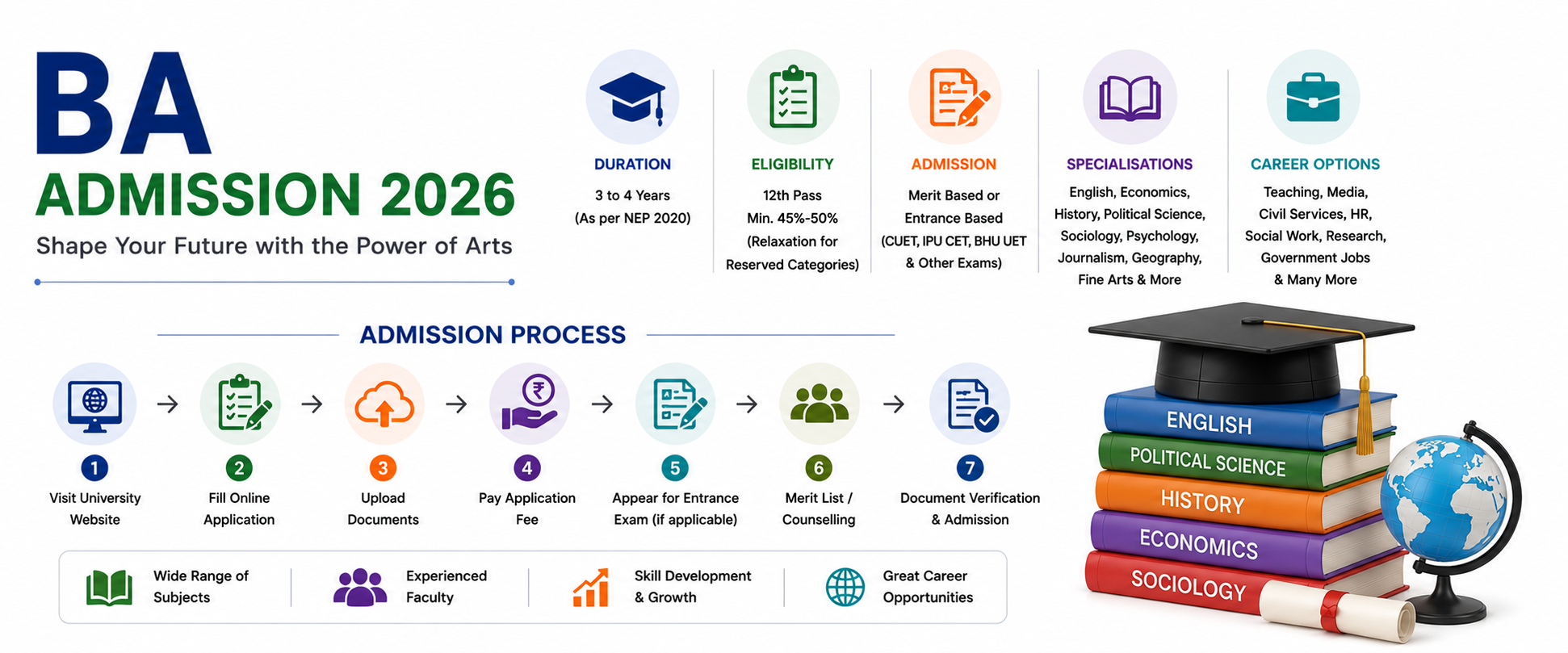
Traditionally, the BA programme is a 3-year undergraduate course. However, under the National Education Policy (NEP) 2020 and CBCS framework, many universities now offer a 4-year programme, allowing students to graduate with an Honours or Honours with Research degree.
The programme consists of core subjects, elective papers, interdisciplinary courses, skill enhancement courses, practical assignments, seminars, tutorials, workshops, and independent research projects.
BA Admission 2026 Eligibility Criteria
Candidates applying for BA Admission 2026 must satisfy the eligibility requirements prescribed by the respective university.
The general eligibility criteria include:
- Candidates must have passed Class 12 (10+2) or an equivalent examination from a recognized board.
- A minimum aggregate of 45% to 50% marks is generally required, depending on the university.
- Reserved category candidates usually receive a relaxation of up to 5% in the qualifying marks.
- There is generally no upper age limit for admission to BA programmes.
Some universities also conduct admissions based on CUET UG scores or other university-level entrance examinations.
BA Specializations
One of the biggest advantages of pursuing a BA degree is the wide variety of specialization options available.
Some of the most popular BA specializations include:
- BA English focuses on literature, poetry, grammar, linguistics, and communication skills.
- BA Economics covers microeconomics, macroeconomics, public finance, development economics, and international trade.
- BA History explores ancient, medieval, and modern history while developing research and analytical skills.
- BA Sociology studies society, culture, social institutions, human relationships, and social change.
- BA Psychology focuses on human behaviour, mental processes, counselling, and cognitive psychology.
- BA Political Science includes constitutional studies, political theory, governance, public administration, international relations, and human rights.
- BA Journalism and Mass Communication prepares students for careers in print media, digital media, broadcasting, advertising, and public relations.
- BA Geography studies physical geography, human geography, environmental studies, and geographic information systems.
- BA Fine Arts focuses on painting, sculpture, illustration, visual arts, design, and creative expression.
BA Admission Process 2026
The admission process generally follows a simple sequence.
- Candidates should first visit the official website of the preferred university and carefully review the eligibility criteria and admission schedule.
- Applicants must then complete the online application form with accurate academic and personal information.
- The next step is to upload the required documents, including educational certificates, photographs, signatures, and identity proof.
- Candidates should pay the prescribed application fee through the available online payment methods.
- If the university conducts an entrance examination such as CUET UG, candidates must appear for the examination.
- After the declaration of results, universities publish merit lists or conduct counselling sessions for seat allocation.
- Selected candidates must complete document verification, pay the admission fees, and confirm their admission within the specified deadline.
BA Entrance Examinations 2026
Admissions to BA programmes are offered through both merit-based and entrance-based selection processes.
Some of the commonly accepted entrance examinations include:
- CUET UG (Common University Entrance Test) conducted by the National Testing Agency is accepted by many central and participating universities.
- IPU CET is conducted by Guru Gobind Singh Indraprastha University for selected undergraduate programmes.
- BHU UET is conducted by Banaras Hindu University for admissions to selected undergraduate courses.
Many state universities and private institutions also conduct their own entrance examinations depending on their admission policies.
Documents Required for BA Admission 2026
Candidates should keep all required documents ready before applying.
The commonly required documents include:
- Class 10 Mark Sheet and Certificate
- Class 12 Mark Sheet and Certificate
- Passport-size Photographs
- Aadhaar Card or other Government-issued Identity Proof
- Signature
- Caste Certificate (if applicable)
- Disability Certificate (if applicable)
- Migration Certificate (where required)
BA Course Fees
The annual tuition fee for BA programmes varies depending on the institution.
In most government and private colleges, the average yearly fee generally ranges between ₹10,000 and ₹30,000, although fees may vary based on the university, specialization, and facilities offered.
Career Opportunities After BA
A BA degree opens the door to numerous career opportunities across various industries.
Graduates can pursue careers in:
- Teaching and Education
- Journalism and Media
- Advertising and Public Relations
- Human Resources
- Social Work and NGOs
- Civil Services
- Government Jobs
- Banking and Insurance
- Content Writing
- Research and Academia
- Corporate Communications
- Digital Marketing
Students can also pursue higher education such as MA, MBA, LLB, MSW, M.Ed, Journalism, Public Administration, and various professional certification programmes to enhance their career prospects.
Why Choose BA in 2026?
A BA degree offers flexibility, diverse specialization options, and strong career opportunities. It helps students build communication, analytical, leadership, and research skills that are highly valued across industries. With increasing opportunities in education, media, government services, corporate sectors, and civil services, BA remains one of the most versatile undergraduate programmes. The introduction of the four-year honours and research pathway under NEP 2020 further enhances academic and career prospects for students.
Conclusion
BA Admission 2026 provides students with an excellent opportunity to build a strong academic foundation in humanities, social sciences, and languages while preparing for diverse career paths. With admissions available through both merit-based selection and entrance examinations such as CUET UG, students should carefully review the eligibility criteria, application deadlines, and admission procedures of their preferred universities. By selecting the right specialization and completing the admission process on time, candidates can begin a rewarding educational journey that opens doors to higher studies, competitive examinations, government services, and successful careers across multiple sectors.