





Introduction
The Bachelor of Education (B.Ed) is one of the most popular professional degree programmes for students who aspire to build a career in teaching and education. It prepares graduates with the knowledge, teaching methodologies, classroom management skills, and educational psychology required to become effective educators at schools and educational institutions.
With continuous improvements in teacher education, the B.Ed programme now focuses on practical teaching experience, modern instructional methods, digital learning, curriculum planning, inclusive education, and student-centered teaching strategies. The programme enables future teachers to develop the professional skills needed to inspire, educate, and guide students across different levels of education.
Whether you aim to teach in government schools, private schools, international schools, or pursue higher education in teaching, a B.Ed degree serves as an essential qualification for a successful teaching career.
What is a B.Ed Programme?
Bachelor of Education is a professional teacher training programme designed to prepare graduates for careers in education. The course combines theoretical knowledge with practical teaching experience, helping students understand learning methods, child psychology, educational technology, curriculum development, and classroom management.
The programme includes both academic learning and supervised teaching practice in schools, allowing students to gain real classroom experience before entering the teaching profession.
B.Ed Admission Eligibility
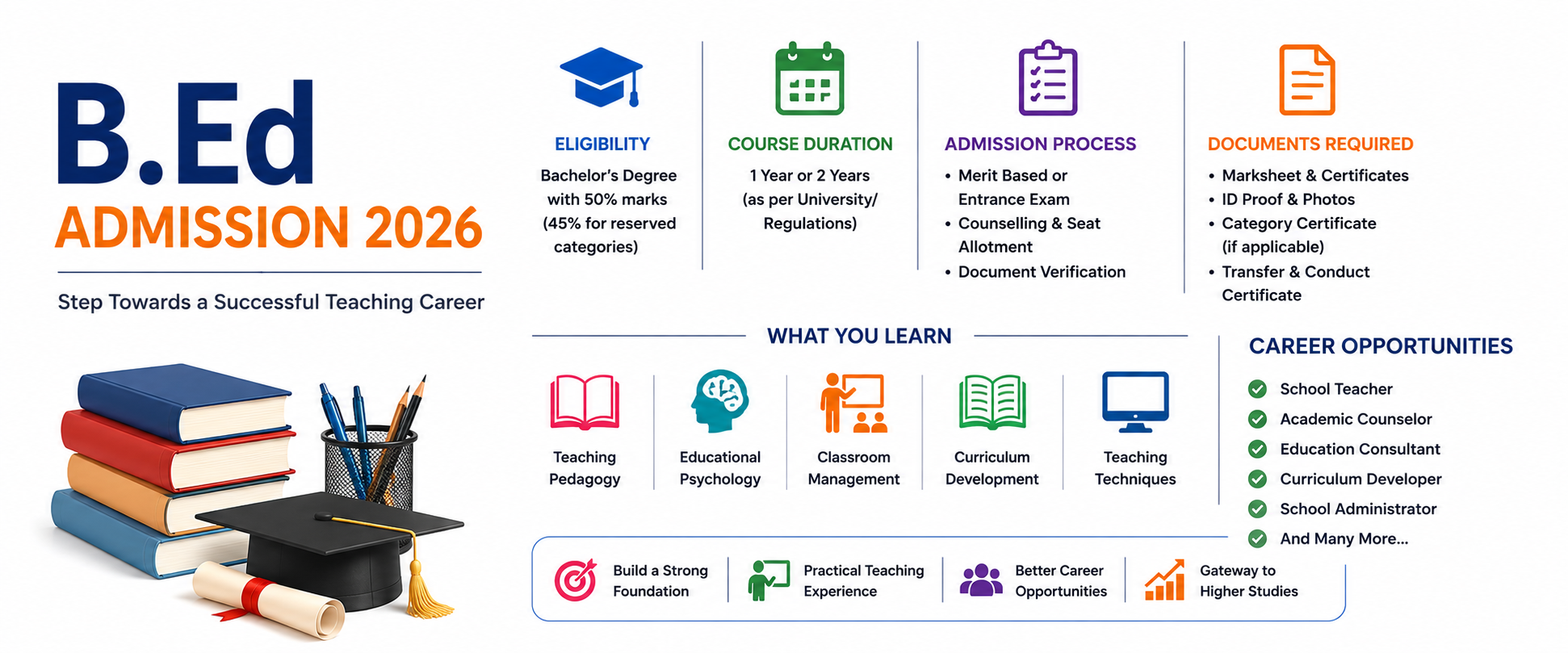
Students seeking admission to a B.Ed programme must satisfy the eligibility criteria prescribed by the respective university or state authority.
The general eligibility requirements include:
- A Bachelor's degree (BA, BSc, BCom, or equivalent) from a recognised university.
- Minimum 50% aggregate marks in the qualifying degree for general category candidates.
- Relaxation in minimum marks for reserved category candidates as per government regulations.
- Some universities may prescribe subject-specific eligibility depending on the teaching specialisation selected.
- Several states and universities conduct entrance examinations, while others provide admission based on academic merit.
Candidates are advised to verify the admission guidelines issued by their preferred university before applying.
Course Duration
The duration of the B.Ed programme varies depending on the admission pathway and university regulations.
Traditional B.Ed programmes generally extend over two academic years. In recent regulatory updates, one-year B.Ed programmes have been introduced for eligible postgraduate candidates in selected institutions, while integrated teacher education programmes are also being implemented in several universities.
The course combines classroom instruction with practical teaching experience to ensure comprehensive professional training.
Admission Process
The admission process differs across universities and states.
Many universities conduct admissions through Centralised Allotment Processes (CAP), where seats are allotted based on academic merit or entrance examination scores.
The admission process generally includes:
- Online registration
- Submission of application forms
- Uploading required documents
- Preparation of merit or rank lists
- Counselling and seat allotment
- Verification of certificates
- Payment of admission fees
- Final confirmation of admission
Some institutions admit students based entirely on qualifying degree marks, while others require candidates to appear for state-level or university entrance examinations.
Regional Admission Updates
Several universities conduct their own counselling and admission procedures.
Calicut University conducts B.Ed admissions through its online admission portal, including notifications regarding vacant seats, late registrations, and special education programmes.
Kerala University releases rank lists, conducts counselling, and manages admissions through centralised procedures, including category-based and sports quota admissions.
Mahatma Gandhi University (MG University) manages admissions through the Centralised Allotment Process (CAP), followed by vacancy notifications and subsequent counselling rounds.
Applicants should regularly monitor the official university websites for admission schedules, merit lists, counselling dates, and vacancy announcements.
Documents Required for Admission
Candidates should keep all required documents ready before participating in counselling or admission verification.
Commonly required documents include:
- SSLC or Class 10 certificate for proof of date of birth
- Higher Secondary certificate
- Bachelor's degree mark sheets
- Degree certificate or provisional certificate
- Transfer Certificate (TC)
- Conduct Certificate
- Community Certificate (if applicable)
- Income Certificate (for reservation or scholarship benefits)
- Passport-size photographs
- Identity proof
- Entrance examination scorecard (where applicable)
Proper documentation ensures a smooth admission process during counselling and verification.
Subjects Covered in the B.Ed Programme
The B.Ed curriculum is designed to develop both theoretical understanding and practical teaching competence.
Students study various subjects including:
- Educational Psychology
- Philosophy of Education
- Sociology of Education
- Curriculum Development
- Teaching Methodology
- Educational Technology
- Classroom Management
- Inclusive Education
- Assessment and Evaluation
- Communication Skills
- Guidance and Counselling
- School Administration
- Teaching Pedagogy
- Child Development
- Learning Theories
Students also receive subject-specific pedagogical training based on their academic background.
Teaching Methodology
The programme adopts a balanced approach combining theory with practical application.
Teaching methods commonly include:
- Classroom lectures
- Interactive workshops
- Group discussions
- Seminars
- Presentations
- Practical demonstrations
- Project work
- Assignments
- School internships
- Practice teaching under faculty supervision
This practical exposure helps students build confidence and improve classroom management skills before beginning their professional careers.
Assessment Pattern
Student performance is evaluated through continuous assessment as well as final examinations.
Assessment generally includes:
- Written examinations
- Internal assessments
- Practical teaching evaluations
- Classroom observation
- Lesson planning assignments
- Project submissions
- Teaching practice reports
- Seminar presentations
Practical teaching remains one of the most important components of the programme.
Skills Developed During the Programme
A B.Ed programme helps students develop numerous professional and interpersonal skills that are essential for successful teaching.
These include:
- Effective communication
- Classroom management
- Leadership
- Curriculum planning
- Student assessment
- Educational technology
- Problem-solving
- Critical thinking
- Time management
- Teamwork
- Emotional intelligence
- Adaptability
These competencies prepare graduates for diverse educational environments.
Career Opportunities After B.Ed
A Bachelor of Education degree opens the door to numerous career opportunities in both public and private educational institutions.
Graduates can work as:
- Primary School Teacher
- Secondary School Teacher
- Higher Secondary Teacher
- Subject Specialist
- Academic Coordinator
- Education Consultant
- Curriculum Developer
- Instructional Designer
- Educational Content Writer
- School Administrator
- Tutor
- Online Educator
Qualified candidates may also become eligible for government teaching positions after clearing the required teacher eligibility examinations.
Higher Education Opportunities
After completing a B.Ed programme, graduates can pursue advanced studies to enhance their qualifications and career prospects.
Popular higher education options include:
- Master of Education (M.Ed)
- MA in Education
- Educational Leadership Programmes
- Special Education Certifications
- Educational Psychology
- Curriculum and Instruction
- Guidance and Counselling
- Doctoral Research (Ph.D.)
Higher qualifications can lead to careers in educational administration, teacher training, research, policy development, and higher education.
Why Choose a B.Ed Programme?
A B.Ed degree is an excellent choice for individuals passionate about teaching and shaping future generations.
The programme offers:
- Professional teaching qualification
- Practical classroom experience
- Strong career stability
- Opportunities in government and private schools
- Continuous professional development
- Higher education pathways
- Leadership opportunities in education
- Contribution to society through quality education
Teaching remains one of the most respected and impactful professions, making the B.Ed programme a valuable investment for aspiring educators.
Conclusion
The Bachelor of Education programme provides aspiring teachers with the academic knowledge, practical teaching experience, and professional skills required to build successful careers in education. Through a balanced curriculum that combines educational theory, classroom practice, curriculum development, and modern teaching methodologies, students become well-equipped to meet the evolving needs of today's education system. Whether aiming to teach in schools, pursue higher education, or contribute to educational leadership, a B.Ed degree serves as a strong foundation for long-term professional growth and meaningful service in the field of education.