





Introduction
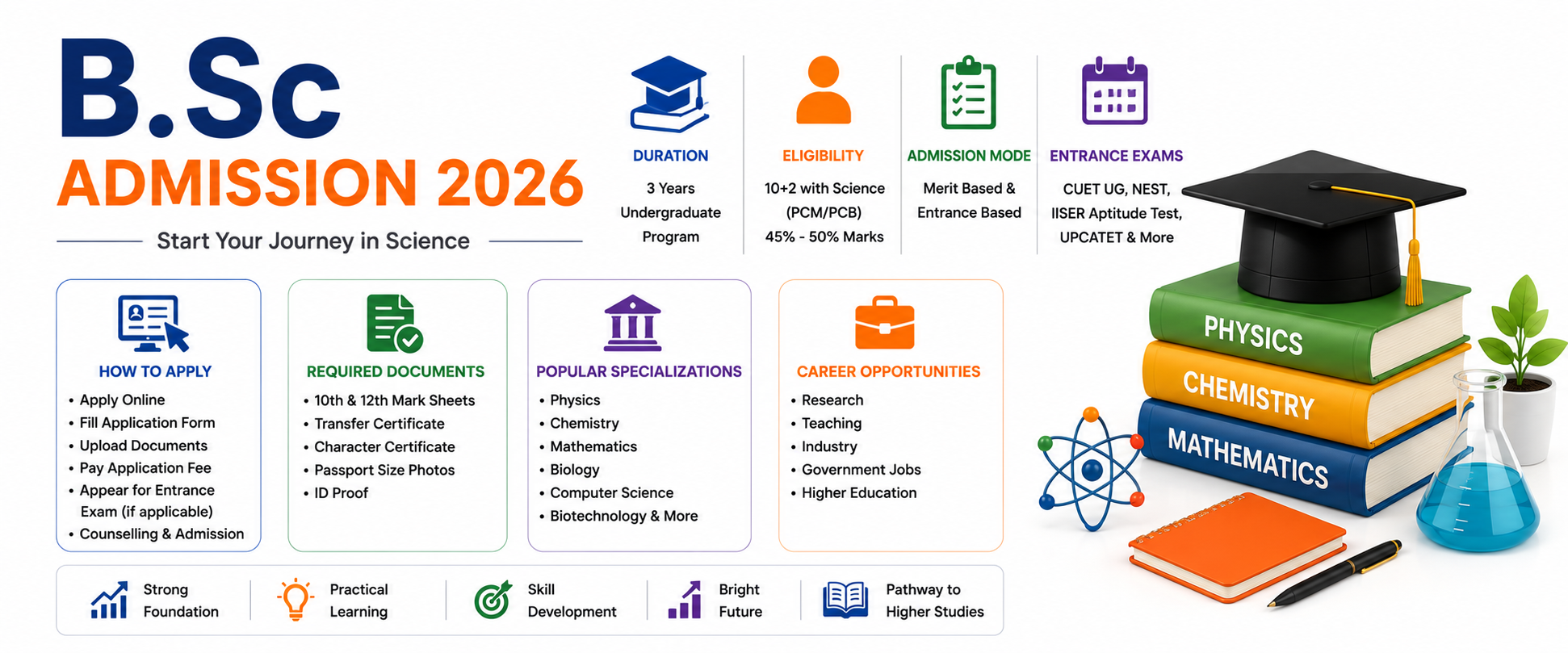
Bachelor of Science (B.Sc) Admission 2026 provides students with an opportunity to pursue undergraduate education in various science disciplines across universities and colleges in India. B.Sc is one of the most popular undergraduate degree programs for students interested in science, research, technology, healthcare, and higher education.
The program covers subjects such as Physics, Chemistry, Mathematics, Biology, Computer Science, Biotechnology, Environmental Science, and many other specializations. Students develop analytical thinking, scientific reasoning, technical expertise, and problem-solving skills that prepare them for diverse careers and postgraduate studies.
Admissions for the 2026 academic session are being conducted by central universities, state universities, private universities, and autonomous colleges through both merit-based and entrance-based admission processes.
Why Choose B.Sc in 2026?
A Bachelor of Science degree builds a strong academic foundation while opening numerous career opportunities in science, technology, healthcare, education, research, and government sectors.
Key benefits include:
- Strong foundation in scientific knowledge
- Practical laboratory and research exposure
- Multiple specialization choices
- Excellent higher education opportunities
- Growing demand across industries
- Competitive government and private sector careers
B.Sc Admission 2026 Eligibility Criteria
Eligibility requirements may vary depending on the university and specialization.
General eligibility includes:
- Passed 10+2 or equivalent examination from a recognized board.
- Science stream is mandatory.
- Minimum aggregate marks usually range between 45% and 55%, while some institutions require 50% to 60%.
- Reserved category candidates receive relaxation as per government norms.
Subject Requirements
Admission depends upon the chosen specialization.
- Physics, Mathematics, Computer Science: Physics and Mathematics are compulsory.
- Biology, Biotechnology, Microbiology, Nursing: Physics, Chemistry, and Biology are required.
- Chemistry Specialization: Physics and Chemistry are generally compulsory.
- Environmental Science: Science background with flexible subject combinations.
Students should verify the eligibility requirements of their preferred university before applying.
B.Sc Admission 2026 Process
Admission to B.Sc programs is offered through both merit-based and entrance-based procedures.
Merit-Based Admission
Many state universities and private colleges offer admission based on Class 12 marks.
The process generally includes:
- Online application
- Merit list preparation
- Counseling
- Document verification
- Fee payment
Entrance-Based Admission
Central universities and selected institutions conduct entrance examinations.
The admission process generally includes:
- Entrance examination
- Merit or rank list
- Counseling
- Seat allotment
- Document verification
- Admission confirmation
How to Apply for B.Sc Admission 2026
Students should carefully complete the admission process by following these steps:
- Visit the official admission portal of the preferred university.
- Check the eligibility criteria.
- Note important admission dates.
- Register on the admission portal.
- Fill in the online application form with accurate information.
- Upload the required documents.
- Pay the application fee online.
- Submit the application form.
- Register for entrance examinations if applicable.
- Appear for the examination.
- Participate in counseling.
- Complete document verification.
- Pay the admission fee to confirm the seat.
B.Sc Admission 2026 in Kerala
Students seeking admission to colleges in the Thrissur region and other parts of Kerala can apply through the Calicut University Centralised Admission Process (CAP) under the Four-Year Undergraduate Programme (FYUGP).
Admissions are primarily merit-based and follow university admission guidelines.
Students interested in central universities should also apply through CUET UG, which serves as the common entrance examination for many central institutions.
B.Sc Admission Modes
Universities generally offer admission through two methods.
Merit-Based Admission
- Based on Class 12 examination marks
- Common in state universities and private colleges
- Cut-offs vary depending on specialization and category
Entrance-Based Admission
- Conducted mainly by central universities
- Selection based on entrance examination scores
- Counseling and seat allocation follow the examination
B.Sc Entrance Exams 2026
Several national, state, and university-level entrance examinations are available for B.Sc admissions.
Popular entrance examinations include:
- CUET UG 2026
- NEST 2026
- IISER Aptitude Test 2026
- UPCATET 2026
- CUCET
- BHU CET
- ICAR AIEEA
- PUCET
- University-specific entrance examinations
Most entrance examinations are expected to be conducted between May and June 2026, subject to official notifications.
Registration Fee
The registration fee generally ranges between ₹500 and ₹1,000, depending on the institution.
The exact application fee varies across universities and entrance examinations.
Documents Required for B.Sc Admission 2026
Students should keep the following documents ready during admission and counseling:
- Class 10 Mark Sheet
- Class 12 Mark Sheet
- Transfer Certificate
- Migration Certificate (if applicable)
- Character Certificate
- Passport-size Photographs
- Government-approved Photo Identity Proof
- Category Certificate (if applicable)
- Income Certificate (if applicable)
Popular B.Sc Specializations
Students can choose from numerous science disciplines according to their interests and career goals.
Popular specializations include:
- Physics
- Chemistry
- Mathematics
- Biology
- Computer Science
- Biotechnology
- Microbiology
- Environmental Science
- Zoology
- Botany
- Statistics
- Electronics
- Data Science
Each specialization offers unique career opportunities and higher education pathways.
Skills Developed During B.Sc
The B.Sc curriculum helps students acquire valuable academic and professional skills.
These include:
- Critical Thinking
- Scientific Research
- Laboratory Skills
- Analytical Reasoning
- Technical Knowledge
- Problem Solving
- Communication Skills
- Data Analysis
- Observation Skills
These competencies are highly valued in both industry and academia.
Career Opportunities After B.Sc
Graduates have numerous employment opportunities across public and private sectors.
Career options include:
- Research Assistant
- Laboratory Technician
- Data Analyst
- Quality Control Officer
- Healthcare Professional
- Environmental Consultant
- Teacher
- Scientific Officer
- Government Sector Jobs
- Pharmaceutical Industry
- Biotechnology Industry
- Information Technology
Students may also prepare for competitive examinations conducted by UPSC, SSC, Banking, Railways, and State Public Service Commissions.
Higher Education After B.Sc
Many graduates continue their education to improve career prospects.
Popular higher education options include:
- M.Sc
- MCA
- MBA
- M.Tech (for eligible programs)
- B.Ed
- Integrated Ph.D.
- Research Programs
- Professional Certification Courses
Higher studies provide specialization and improve employment opportunities in research, academics, and industry.
Conclusion
B.Sc Admission 2026 offers students a strong academic foundation for successful careers in science, technology, healthcare, research, education, and industry. With admissions available through both merit and entrance examinations such as CUET UG, NEST, IISER Aptitude Test, and university-level entrance tests, students have multiple pathways to pursue their preferred specialization. By understanding the eligibility criteria, application process, required documents, and career opportunities, aspirants can confidently plan their undergraduate education and build a successful future in the field of science.