





Introduction
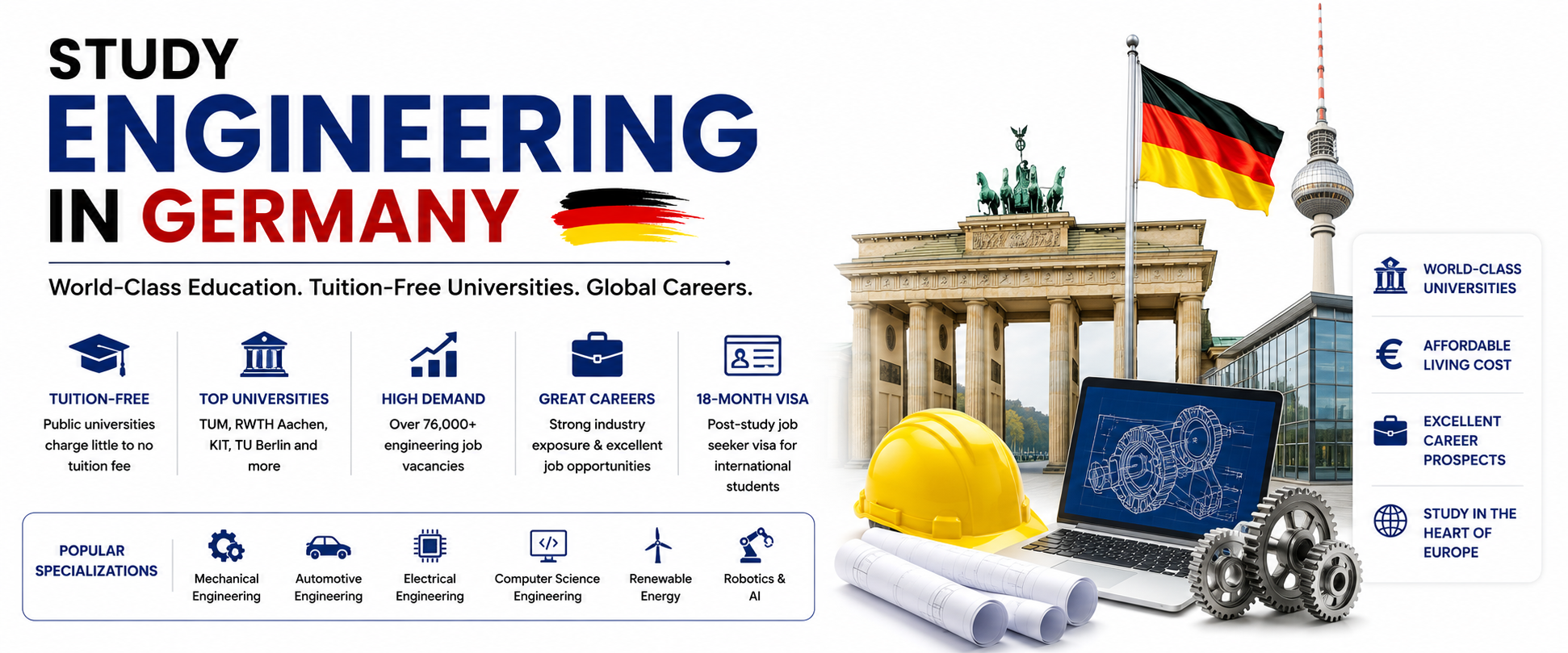
Germany is recognised worldwide as a global leader in engineering, innovation, manufacturing, and technology. The country has built its reputation through decades of excellence in automotive engineering, mechanical engineering, industrial automation, renewable energy, robotics, artificial intelligence, and advanced manufacturing. It is home to some of the world's highest-ranked technical universities and internationally respected engineering programmes.
For international students, Germany offers an ideal combination of affordable education, practical learning, cutting-edge research, and outstanding employment opportunities. Most public universities charge little or no tuition fees, making Germany one of the most cost-effective destinations to pursue higher education.
Engineering graduates from German universities are highly valued by employers across Europe and around the world due to their strong technical knowledge, research skills, and practical industry experience.
Why Study Engineering in Germany?
Germany attracts thousands of international engineering students every year because of its academic excellence and strong industrial economy.
Major advantages include:
- Globally recognised engineering degrees
- Tuition-free public universities
- World-class laboratories and research facilities
- Strong partnerships with multinational companies
- Excellent internship opportunities
- High graduate employability
- English-taught Master's programmes
- Affordable living costs compared to many Western countries
- Opportunity to work during studies
- 18-month post-study job seeker visa
- Fast-track EU Blue Card pathway for skilled professionals
Germany currently faces a shortage of more than 76,000 engineering professionals, creating excellent employment prospects for qualified graduates.
Types of Engineering Degrees in Germany
Bachelor's Degree
The Bachelor of Engineering (B.Eng.) or Bachelor of Science (B.Sc.) generally takes three to four years to complete.
Students develop strong foundations in mathematics, physics, engineering principles, design, manufacturing, and technology. Many programmes also include laboratory work, industrial training, and practical projects.
The Bachelor of Engineering focuses more on practical applications, while the Bachelor of Science places greater emphasis on theoretical and research-based learning.
Master's Degree
The Master of Engineering (M.Eng.) or Master of Science (M.Sc.) usually requires 1.5 to 2 years of study.
Master's programmes allow students to specialise in advanced engineering fields while developing technical expertise, innovation skills, and research capabilities.
Many Master's programmes are taught entirely in English, making Germany highly attractive for international students.
Doctoral Programmes
Students interested in research may pursue a Doctor of Engineering (Dr.-Ing.) or PhD, which usually takes three to five years.
These programmes prepare graduates for careers in research institutions, universities, and high-level industrial research.
Popular Engineering Specialisations
German universities offer programmes across numerous engineering disciplines, including:
- Mechanical Engineering
- Automotive Engineering
- Electrical Engineering
- Civil Engineering
- Computer Science Engineering
- Aerospace Engineering
- Robotics
- Artificial Intelligence
- Mechatronics
- Renewable Energy Engineering
- Energy Systems Engineering
- Software Engineering
- Communication Engineering
- Industrial Engineering
- Data Engineering
- Materials Engineering
- Water Resources Engineering
- Environmental Engineering
Best Engineering Universities in Germany
Technical University of Munich (TUM)
TUM is Germany's highest-ranked engineering university and one of the world's leading institutions for technology and innovation.
Popular programmes include:
- Mechanical Engineering
- Aerospace Engineering
- Electrical Engineering
- Information Technology
TUM maintains strong collaborations with leading companies including BMW, Siemens, and Airbus.
RWTH Aachen University
RWTH Aachen is Germany's largest technical university and is internationally recognised for engineering excellence.
Major strengths include:
- Mechanical Engineering
- Automotive Engineering
- Electrical Engineering
- Production Engineering
Students benefit from extensive research facilities and close industry partnerships.
Karlsruhe Institute of Technology (KIT)
KIT is renowned for advanced research in:
- Artificial Intelligence
- Robotics
- Mechanical Engineering
- Energy Engineering
- Computer Science
Located in Baden-Württemberg, KIT combines university education with national research excellence.
TU Berlin
Situated in Germany's capital city, TU Berlin is known for innovation, entrepreneurship, and engineering research.
Popular programmes include:
- Energy Engineering
- Computer Engineering
- Innovation Management
- Information Technology
Other Leading Universities
Students can also consider:
- TU Dresden
- University of Stuttgart
- Technical University of Darmstadt
- University of Freiburg
- Leibniz University Hannover
- Hamburg University of Technology
- University of Duisburg-Essen
- University of Paderborn
- South East Technological University
- University of Applied Sciences Munich
Tuition Fees
Germany is famous for its affordable education.
Most public universities charge:
- No tuition fees for most programmes
- Semester contribution of approximately €150–€400
Exceptions include:
- Baden-Württemberg public universities charge non-EU students approximately €1,500 per semester.
- TUM charges tuition fees for non-EU students on selected programmes beginning from recent academic years.
Private universities have significantly higher tuition fees.
English-Taught Engineering Programmes
Many Master's programmes are offered entirely in English.
Popular English-taught programmes include:
- Mechanical Engineering
- Automotive Engineering
- Electrical Engineering
- Aerospace Engineering
- Renewable Energy Engineering
- Computer Engineering
- Artificial Intelligence
- Information Technology
- Data Engineering
- Software Engineering
- Energy Engineering
Although English programmes are widely available, learning German significantly improves internship opportunities, daily life, and long-term employment prospects.
Admission Requirements
Bachelor's Programmes
Applicants generally require:
- Completion of higher secondary education
- Minimum academic score of approximately 55–75%
- Equivalent qualification recognised in Germany
- APS Certificate (for Indian students)
- Statement of Purpose
- Letters of Recommendation
- Passport
- Resume
- English or German language proficiency
Some applicants may also need to complete a Studienkolleg if their academic qualifications are not directly recognised.
Master's Programmes
Applicants usually require:
- Bachelor's degree in Engineering or a related field
- Strong academic performance
- Statement of Purpose
- Letters of Recommendation
- Resume
- Academic transcripts
- Passport
- Relevant work experience (preferred for some programmes)
Applications are commonly submitted through the Uni-Assist portal or directly to universities.
English Language Requirements
For English-taught programmes, universities generally require:
- IELTS: 6.0–6.5
- TOEFL iBT: 70–90
- PTE Academic: Accepted by many universities
For German-taught programmes, students typically need:
- TestDaF
- DSH
- Other recognised German language certifications
Scholarships
Germany offers several scholarships for international engineering students.
Popular options include:
- Deutschlandstipendium
- Heinrich Böll Foundation Scholarships
- TUM Scholarships
- DAAD Scholarships
- QS Undergraduate Scholarship
- Merit-based university scholarships
Many scholarships cover tuition, living expenses, research costs, or partial financial support.
Career Opportunities
Germany has one of Europe's strongest engineering job markets.
Graduates can work in industries including:
- Automotive
- Manufacturing
- Robotics
- Aerospace
- Renewable Energy
- Artificial Intelligence
- Electronics
- Telecommunications
- Construction
- Information Technology
- Industrial Automation
Leading employers include:
- BMW
- Mercedes-Benz
- Volkswagen
- Audi
- Siemens
- Bosch
- SAP
- Airbus
- Continental
Major employment hubs include Munich, Stuttgart, Berlin, Frankfurt, Hamburg, and Aachen.
Salary After Engineering in Germany
Engineering graduates enjoy competitive salaries.
Typical salary ranges include:
- Entry-level engineers: €45,000–€55,000 per year
- Experienced engineers: €60,000–€80,000 per year
- Senior professionals: Above €100,000 annually
Graduates in AI, automation, software engineering, and renewable energy often receive higher salary packages.
Post-Study Work Opportunities
International graduates receive an 18-month post-study job seeker visa to find employment after completing their degree.
Eligible graduates can later apply for the EU Blue Card, providing a pathway to long-term employment and residency in Germany.
Living Costs in Germany
International students should plan for monthly expenses such as:
- Accommodation: €300–€600
- Food and groceries: €150–€250
- Transportation: €30–€90
- Health insurance: €110–€150
- Personal expenses: €50–€200
Students must also maintain a blocked account to demonstrate sufficient financial resources for living expenses as required by German immigration authorities.
Why Choose Germany for Engineering?
Germany offers an exceptional combination of academic excellence, affordable education, practical industry experience, and outstanding career prospects. With globally ranked universities, tuition-free public education, cutting-edge research facilities, strong industry collaboration, and increasing demand for skilled engineers, Germany remains one of the best destinations for international students pursuing Bachelor's or Master's degrees in engineering.