





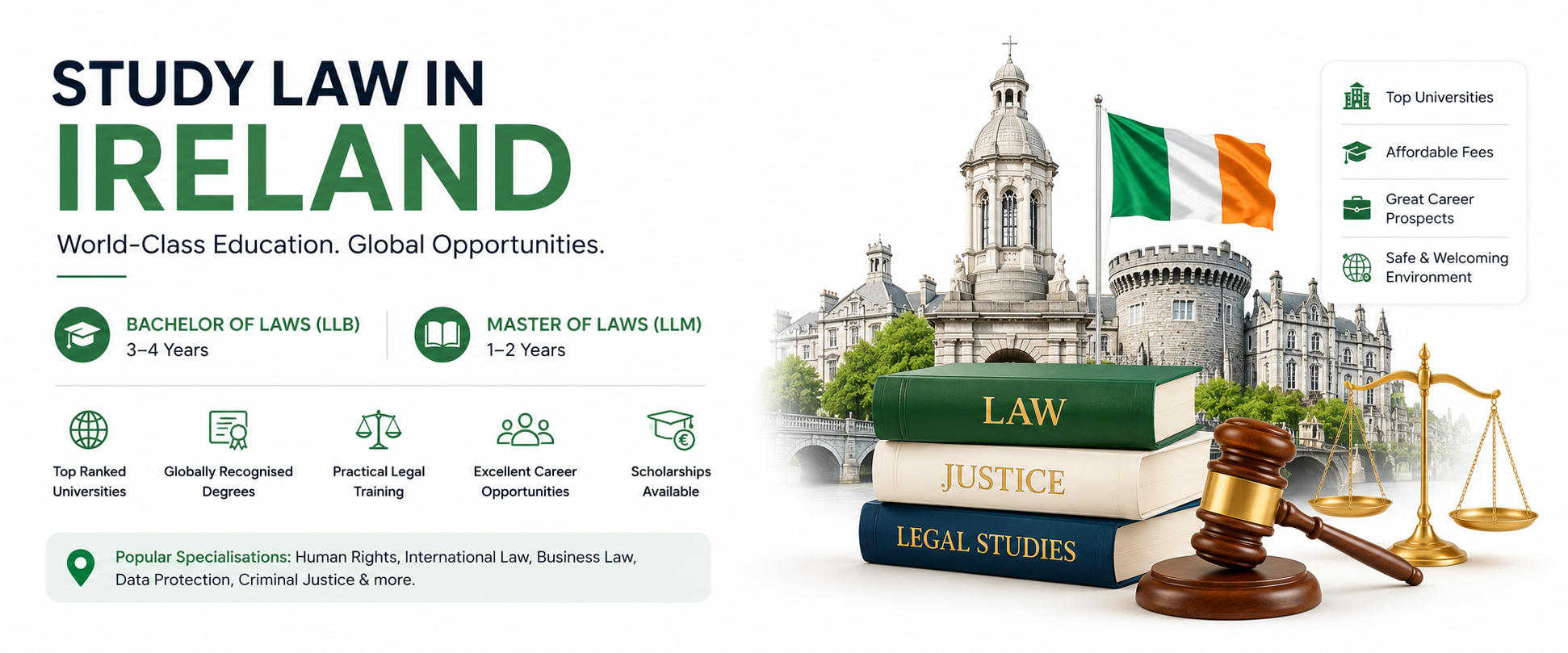
Study Law in Ireland
Ireland has established itself as one of Europe's leading destinations for legal education. Its law schools consistently rank among the world's top universities and are recognised for delivering high-quality legal education that combines academic knowledge with practical legal skills. Whether you are planning to pursue an undergraduate law degree or a specialised master's programme, Ireland offers internationally respected qualifications that open doors to legal careers across the globe.
Irish law degrees provide students with a comprehensive understanding of legal systems, political institutions, business regulations, ethics, and public policy. Students develop critical thinking, analytical reasoning, legal research, advocacy, negotiation, and communication skills that are valuable in both legal and corporate careers.
The country also offers an English-speaking learning environment, a welcoming multicultural society, globally recognised universities, and strong employment prospects after graduation.
Why Study Law in Ireland?
Ireland has become a preferred destination for international law students because of its excellent academic standards and global reputation.
Some of the major advantages include:
- Globally recognised law degrees
- Universities ranked among the world's top law schools
- English-medium education
- Strong legal research opportunities
- Practical legal training through moot courts and internships
- Study abroad and exchange programmes
- High graduate employability
- Pathways towards legal practice
- Safe and welcoming environment
- Strong presence of multinational companies and international organisations
Irish universities encourage students to combine theoretical legal knowledge with practical legal experience, preparing graduates for careers both within Ireland and internationally.
Types of Law Courses in Ireland
Bachelor's Degree in Law
The Bachelor of Laws (LLB) or Bachelor of Civil Law (BCL) usually takes three to four years to complete.
These programmes provide students with a strong foundation in:
- Constitutional Law
- Criminal Law
- Contract Law
- Tort Law
- Property Law
- European Union Law
- Company Law
- Administrative Law
- Legal Ethics
- Legal Research
- Advocacy Skills
Many universities also allow students to combine law with business, politics, economics, history, languages, or social sciences.
Several programmes include international exchange opportunities, internships, and capstone research projects.
Master's Degree in Law
The Master of Laws (LLM) generally requires one year of full-time study, although some specialised programmes may extend up to two years.
LLM programmes are designed for law graduates or legal professionals seeking advanced expertise in specialised legal fields.
Popular specialisations include:
- International Business Law
- Human Rights Law
- Commercial Law
- International Law
- Data Protection and Privacy Law
- International Financial Services Law
- Global Legal Studies
- Comparative Law
- Criminal Justice
- International Human Rights Law
- Common Law
- Criminology
Students gain advanced legal knowledge while developing research, analytical, policy-making, and professional legal skills.
Skills You Gain
A law degree in Ireland helps students build a wide range of transferable skills, including:
- Legal research
- Critical thinking
- Analytical reasoning
- Legal drafting
- Advocacy
- Negotiation
- Public speaking
- Communication
- Problem-solving
- Leadership
- Ethical decision-making
- Policy analysis
These skills are valuable across legal practice, business, government, finance, public administration, and international organisations.
Top Universities for Law in Ireland
Trinity College Dublin (TCD)
Trinity College Dublin is Ireland's oldest and one of its most prestigious law schools. Consistently ranked among the world's top 100 law schools, it offers internationally recognised undergraduate and postgraduate programmes.
Highlights:
- LLB and joint honours degrees
- Study abroad opportunities
- Final-year capstone projects
- Programmes with French and German language options
Approximate international tuition:
€21,570 per year for undergraduate programmes.
University College Dublin (UCD)
The Sutherland School of Law is one of Ireland's highest-ranked law schools and is accredited by the Bar Council of India.
Key strengths include:
- Business and Law programmes
- International exchange opportunities
- Strong industry partnerships
- Wide selection of specialised LLM programmes
Approximate tuition:
€22,600 annually.
University College Cork (UCC)
UCC's School of Law ranks among the world's leading law schools.
Students benefit from specialisations such as:
- Business Law
- Human Rights
- Maritime Law
- Family Law
- Environmental Law
- Clinical Legal Education
Approximate tuition:
€21,300 annually.
University of Galway
Established in 1849, the University of Galway is internationally recognised for legal research and the Irish Centre for Human Rights.
Students receive:
- Strong legal foundation
- Clinical legal education
- Flexible course structures
- Practical learning opportunities
Approximate tuition:
€18,500 annually.
University of Limerick
The School of Law is known for practical legal education and employability.
Features include:
- Moot court facilities
- Legal workshops
- Internship opportunities
- Criminal Justice programmes
Approximate tuition:
€16,900 annually.
Dublin City University (DCU)
DCU's School of Law and Government was recognised as Law School of the Year at the Irish Law Awards.
Students benefit from:
- Civil Law programmes
- Practical legal training
- Study abroad opportunities
- Innovative teaching methods
Approximate tuition:
€16,400 annually.
Other Universities Offering Law Programmes
Students can also consider:
- Maynooth University
- Technological University Dublin (TU Dublin)
- Griffith College Dublin
- South East Technological University
- Atlantic Technological University
- Technological University of the Shannon
These institutions offer undergraduate and postgraduate law programmes across various legal specialisations.
Popular Master's Courses in Ireland
Some of the most sought-after postgraduate law programmes include:
- LLM
- Master of Laws
- LLM in International Business Law
- LLM in Global Legal Studies
- LLM in International Law
- LLM in International Human Rights Law
- LLM in Comparative Law
- MA in Law (Professional)
- MA in Data Protection and Privacy Law
- MSc in International Law and Business
- MSc in Criminology and Criminal Justice
- Master of Common Law
Tuition Fees
Tuition fees vary depending on the university and programme.
Typical annual tuition ranges are:
- Undergraduate Law: €16,000–€22,600
- Postgraduate Law: €13,500–€25,000
Some specialised programmes may have higher tuition fees.
Admission Requirements
Bachelor's Programmes
Applicants generally require:
- Qualification equivalent to the Irish Leaving Certificate
- Good academic performance
- English language proficiency
- Supporting academic documents
Master's Programmes
Applicants usually require:
- Bachelor's degree in Law or a related discipline
- Minimum 60–70% academic score depending on the institution
- Fewer than five backlogs (preferred by many universities)
- Statement of Purpose (SOP)
- Resume or CV
- Two or three Letters of Recommendation
- Relevant work experience (preferred for some programmes)
Most Irish universities do not require GRE scores for LLM admission.
English Language Requirements
International applicants generally need to demonstrate English proficiency.
Typical minimum scores include:
- IELTS: 6.5 overall
- TOEFL: 80–93
- PTE Academic: 61–63
Some universities, such as TU Dublin, may require higher English scores depending on the programme.
Pathway to Becoming a Lawyer
Students wishing to practise as solicitors in Ireland should complete a qualifying law degree covering the core legal subjects required for the Law Society of Ireland's FE1 examinations.
After passing the FE1 exams, graduates proceed through professional legal training before qualifying as solicitors. Students interested in becoming barristers follow the professional route prescribed by the Bar of Ireland.
Scholarships
Many Irish universities offer scholarships for outstanding international students.
Scholarships may be awarded based on:
- Academic excellence
- Leadership potential
- Research achievements
- Country of origin
- Financial need
Funding may cover tuition fees, living expenses, travel costs, or partial fee waivers.
Career Opportunities
Law graduates from Ireland enjoy excellent employment opportunities across multiple sectors.
Career options include:
- Solicitor
- Barrister
- Legal Consultant
- Corporate Lawyer
- Compliance Officer
- Legal Advisor
- Human Rights Specialist
- Government Legal Officer
- Policy Analyst
- International Organisation Professional
- NGO Legal Expert
- Data Protection Officer
- Corporate Compliance Manager
Many graduates also work in banking, finance, insurance, consulting, technology companies, and multinational corporations.
Salary After Studying Law
Graduates can expect competitive salaries depending on qualifications and experience.
Typical salary ranges include:
- Bachelor's graduates: €30,000–€40,000 per year
- Master's graduates: €40,000–€60,000 per year
Experienced legal professionals can earn significantly higher salaries.
Living Costs in Ireland
Living expenses depend on the city and lifestyle.
Estimated monthly expenses include:
- Accommodation: €200–€900
- Utilities: €90–€120
- Food: €250–€350
- Transport: Around €120
- Study materials: Around €75
- Social activities: €60–€100
Overall monthly living expenses generally range between €550 and €1,500, with Dublin being more expensive than other cities.
Why Choose Ireland for Law?
Ireland combines world-class universities, internationally recognised qualifications, excellent research opportunities, practical legal education, and strong career prospects. Students benefit from experienced faculty, modern teaching methods, internships, global exchange programmes, and exposure to international legal systems. Whether pursuing an LLB or an LLM, studying law in Ireland provides the academic knowledge and professional skills needed for a successful legal career in Ireland and around the world.