





Introduction
LLB Admission 2026 is the gateway for students who aspire to build a successful career in the legal profession. Law continues to be one of the most respected and rewarding career options in India, offering opportunities in litigation, corporate law, judiciary, public administration, academics, and legal consultancy.
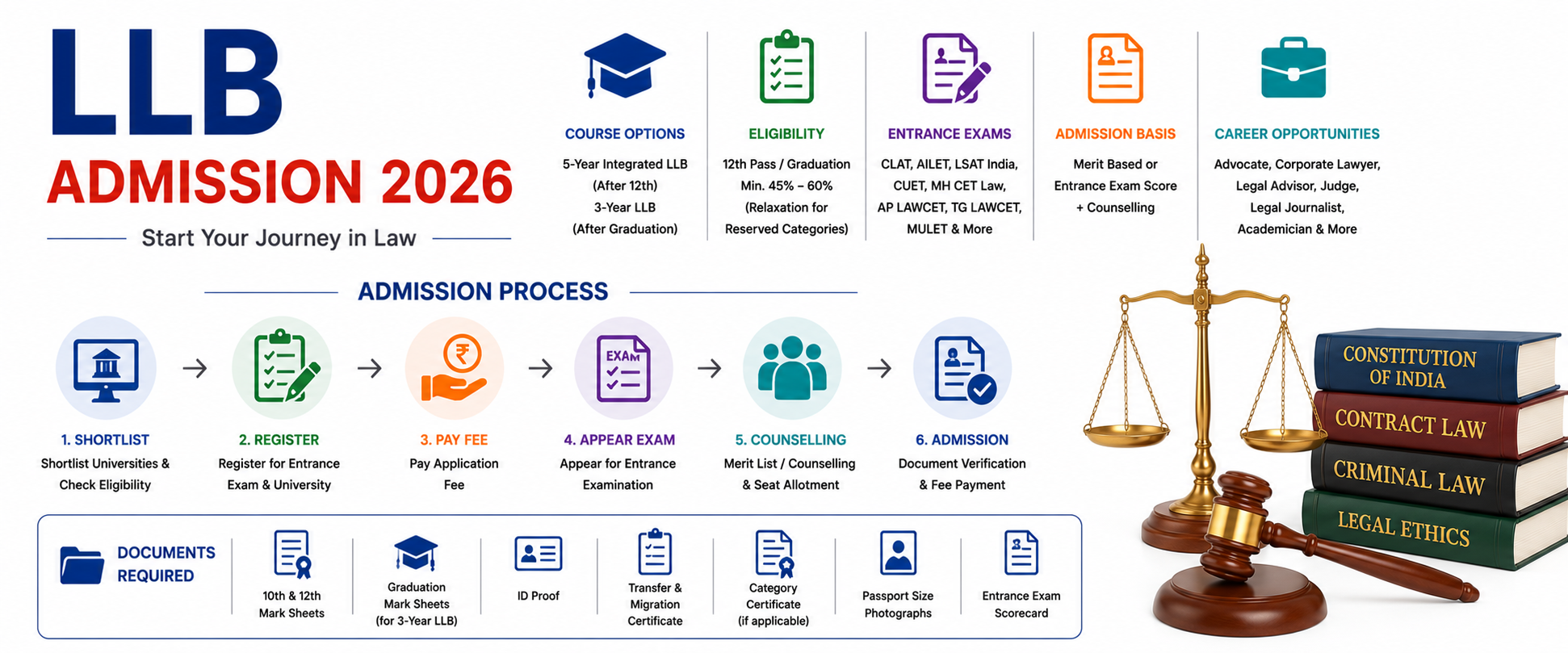
Students can pursue law through two different pathways. Candidates who have completed Class 12 can apply for a 5-year integrated LLB programme, while graduates from any discipline are eligible for the 3-year LLB programme. Admissions are generally based on entrance examinations conducted at the national, state, and university levels, followed by counselling and document verification.
This guide covers everything you need to know about LLB Admission 2026, including eligibility criteria, entrance exams, admission process, required documents, preparation tips, and career opportunities.
What is LLB?
LLB (Bachelor of Laws) is a professional undergraduate law degree regulated by the Bar Council of India (BCI). It provides students with comprehensive knowledge of legal principles, constitutional law, criminal law, civil law, corporate law, and judicial procedures.
Students can pursue LLB through two formats:
The 5-year integrated LLB programme, available after Class 12, includes courses such as BA LLB, BBA LLB, BCom LLB, BSc LLB, and BTech LLB.
The 3-year LLB programme is designed for candidates who have already completed a bachelor's degree in any discipline.
Both programmes prepare students for careers in legal practice, corporate organizations, government services, and higher legal education.
LLB Admission 2026 Eligibility Criteria
The eligibility criteria differ depending on whether candidates are applying for a 5-year integrated programme or a 3-year LLB programme.
Eligibility for 5-Year Integrated LLB
Candidates must have successfully completed Class 12 or an equivalent examination from a recognized board.
Most universities require a minimum aggregate of 45% to 60% marks, depending on the institution and category. Generally, General category candidates require at least 45%, OBC candidates around 42%, and SC/ST candidates around 40%, although individual universities may have different requirements.
There is currently no upper age limit for admission, as per the Bar Council of India guidelines.
Applicants must also qualify for the relevant entrance examination accepted by their chosen university.
Eligibility for 3-Year LLB
Candidates must possess a bachelor's degree from a recognized university in any discipline.
The minimum aggregate marks generally range between 45% and 60%, depending on the university and category.
Admission is usually based on performance in entrance examinations accepted by the respective institutions.
Popular Entrance Exams for LLB Admission 2026
Most reputed law universities and colleges admit students through entrance examinations. Applying for multiple entrance exams increases the chances of securing admission.
Some of the major entrance examinations include:
- CLAT (Common Law Admission Test) is conducted by the Consortium of National Law Universities and is accepted by most National Law Universities (NLUs). It evaluates English, Legal Reasoning, Logical Reasoning, General Knowledge, Current Affairs, and Quantitative Techniques.
- AILET (All India Law Entrance Test) is conducted by National Law University Delhi and is mandatory for admission to NLU Delhi. It assesses Legal Aptitude, English, General Knowledge, Reasoning, and Basic Mathematics.
- LSAT India is accepted by several private law universities and evaluates Reading Comprehension, Analytical Reasoning, and Logical Reasoning.
- CUET (Common University Entrance Test) is conducted by the National Testing Agency and is accepted by many central and private universities for integrated law programmes.
Several states also conduct entrance examinations such as MH CET Law, AP LAWCET, TG LAWCET, and other university-level entrance tests like MULET, depending on the institution.
LLB Admission Process 2026
- Although admission procedures vary among universities, the overall process remains similar.
- Candidates should first shortlist universities and verify their eligibility for either the 3-year or 5-year LLB programme.
- Next, they must register for the relevant entrance examinations such as CLAT, AILET, LSAT India, CUET, or state-level law entrance exams.
- After completing entrance exam registration, candidates should separately fill out the university application forms wherever required.
- Applicants need to pay the prescribed application fees, which generally range between ₹1,000 and ₹5,000, depending on the examination and category.
- Candidates then appear for the entrance examination and wait for the declaration of results.
- Based on entrance scores, universities release merit lists or shortlist candidates for counselling or personal interviews where applicable.
- Finally, selected candidates complete document verification, pay the admission fee, and confirm their seats.
Documents Required for LLB Admission 2026
Candidates should keep all important documents ready before the counselling process begins.
The commonly required documents include:
- Class 10 Mark Sheet and Certificate
- Class 12 Mark Sheet and Certificate
- Graduation Mark Sheets (for 3-year LLB applicants)
- Transfer Certificate
- Migration Certificate (if applicable)
- Category Certificate (if applicable)
- Entrance Examination Scorecard
- Passport-size Photographs
- Government-issued Identity Proof
Preparation Tips for LLB Entrance Exams
- Proper preparation significantly improves admission chances.
- Students should apply for multiple entrance examinations instead of relying on a single test.
- Reading newspapers and legal editorials daily helps improve current affairs knowledge and legal awareness.
- Practising previous years' question papers enables candidates to understand the exam pattern and improve time management.
- Candidates should regularly revise English comprehension, logical reasoning, legal reasoning, basic mathematics, and general knowledge.
It is also advisable to keep all required documents scanned and ready before application windows open to avoid last-minute issues.
Career Opportunities After LLB
An LLB degree opens diverse career opportunities in both the public and private sectors.
Graduates can pursue careers as:
- Litigation Advocate
- Corporate Lawyer
- Legal Advisor
- Legal Consultant
- Public Prosecutor
- Judicial Services Officer
- Legal Journalist
- Academician
- Compliance Officer
- Corporate Legal Executive
After gaining professional experience, law graduates may also pursue an LLM, PhD, judicial services examinations, or specialize in areas such as Corporate Law, Criminal Law, Intellectual Property Law, International Law, Cyber Law, Constitutional Law, and Environmental Law.
Why Choose LLB in 2026?
Pursuing an LLB in 2026 offers numerous advantages for students interested in law and justice.
The legal profession provides excellent career stability, attractive earning potential, opportunities to work with leading law firms and multinational corporations, and the chance to contribute to society through legal services. With the growing demand for legal professionals in corporate organizations, startups, government agencies, and international firms, an LLB degree continues to be one of the most promising professional qualifications.
Conclusion
LLB Admission 2026 provides aspiring legal professionals with multiple pathways to build a successful career in law through either a 5-year integrated programme after Class 12 or a 3-year programme after graduation. By understanding the eligibility criteria, preparing for national and state-level entrance examinations, completing the admission process carefully, and keeping all required documents ready, candidates can significantly improve their chances of securing admission to a reputed law college. With diverse career opportunities in litigation, corporate law, judiciary, public service, and higher education, an LLB degree remains an excellent choice for students seeking a respected and rewarding profession.