





Introduction
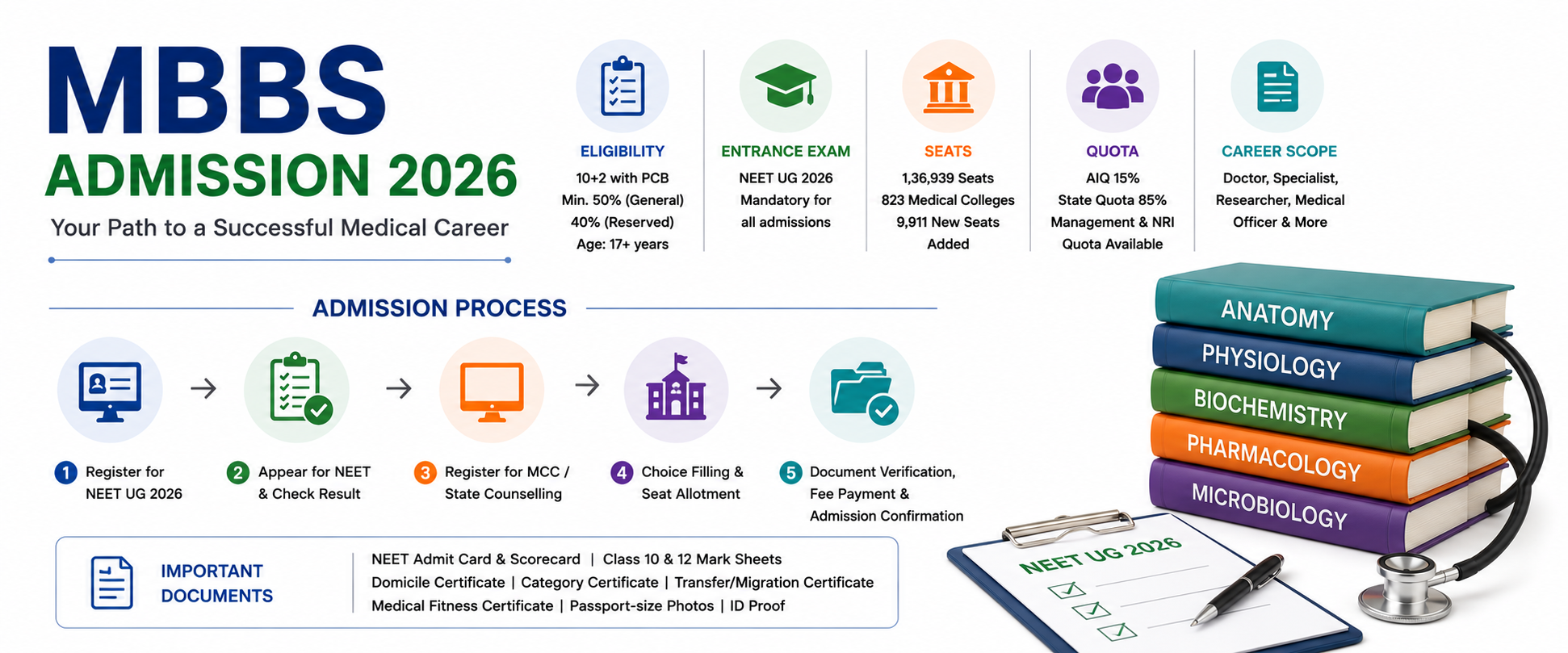
MBBS Admission 2026 is one of the most competitive admission processes in India. Every year, lakhs of medical aspirants compete for limited MBBS seats through the National Eligibility cum Entrance Test (NEET UG). Admission to government, private, deemed universities, AIIMS, JIPMER, and central institutions is conducted entirely on the basis of NEET scores and counselling.
The Bachelor of Medicine and Bachelor of Surgery (MBBS) is the primary medical degree that allows graduates to become registered medical practitioners after completing the mandatory internship and registration with the National Medical Commission (NMC). It also serves as the foundation for postgraduate medical education and specialization.
This guide explains the complete MBBS Admission 2026 process, including eligibility, counselling, quota types, seat distribution, required documents, and career prospects.
What is MBBS?
MBBS (Bachelor of Medicine and Bachelor of Surgery) is a professional undergraduate medical degree designed to prepare students for careers in healthcare and clinical medicine.
The course duration is 5.5 years, including:
- 4.5 years of academic study
- 1 year of compulsory rotating internship in a recognized hospital
After successfully completing the internship, graduates become eligible to register with the National Medical Commission and practice medicine in India.
MBBS Admission 2026 Eligibility Criteria
Candidates applying for MBBS Admission 2026 must satisfy the eligibility criteria prescribed by the National Medical Commission.
The general eligibility requirements include:
- Completion of Class 12 from a recognized board.
- Physics, Chemistry, Biology/Biotechnology, and English as compulsory subjects.
- Minimum 50% aggregate marks in Physics, Chemistry, and Biology for General category candidates.
- Minimum 40% aggregate marks for SC, ST, and OBC candidates.
- PwD candidates in the General category require the prescribed qualifying percentage as per applicable regulations.
- Candidates must be at least 17 years of age on or before 31 December 2026.
- There is currently no upper age limit as per prevailing regulations.
NEET UG 2026: The Mandatory Entrance Examination
NEET UG is the only entrance examination accepted for MBBS Admission 2026 across India.
The examination is conducted by the National Testing Agency (NTA) in offline mode and includes questions from Physics, Chemistry, Botany, and Zoology.
Candidates must qualify the required percentile to become eligible for counselling.
Generally, the qualifying percentile includes:
- General Category – 50th Percentile
- SC/ST/OBC – 40th Percentile
- General PwD – 45th Percentile
A valid NEET scorecard is compulsory for admission under every quota.
MBBS Seat Matrix in India
India has significantly expanded medical education opportunities.
For MBBS Admission 2026, the National Medical Commission has approved:
- 1,36,939 MBBS seats
- 823 medical colleges
- Approximately 9,911 newly added seats
These seats are distributed among government medical colleges, private colleges, deemed universities, and central institutions.
Types of MBBS Seat Quotas
Candidates can secure admission through different counselling categories.
All India Quota (AIQ)
Fifteen percent of government medical college seats are filled through the Medical Counselling Committee (MCC). Students from across India can participate based on their NEET rank.
State Quota
Eighty-five percent of government medical college seats are reserved for state counselling conducted by respective state authorities. Many states require domicile certificates for eligibility.
Management Quota
Private medical colleges reserve management quota seats. Admission still requires NEET qualification, although fee structures are comparatively higher.
NRI Quota
Many private and deemed universities offer NRI quota seats for eligible NRI, OCI, and PIO candidates. NEET qualification remains mandatory.
Deemed Universities
Admissions to deemed universities are conducted through MCC counselling based on NEET scores.
MBBS Admission 2026 Counselling Process
The counselling process determines final admission after NEET results.
The admission procedure generally includes:
NEET Registration and Examination
Candidates first register for NEET UG and appear for the examination conducted by NTA.
Result Declaration
After the examination, candidates download their scorecard containing marks, percentile, All India Rank, and qualifying status.
MCC Counselling
Candidates seeking admission under All India Quota, AIIMS, JIPMER, Central Universities, and Deemed Universities register through the Medical Counselling Committee portal.
Multiple counselling rounds usually include:
- Round 1
- Round 2
- Mop-Up Round
- Stray Vacancy Round
State Counselling
Candidates seeking admission under the State Quota register separately through their respective state counselling authorities. For Kerala, admissions are conducted through the CEE Kerala portal.
Choice Filling and Seat Allotment
Applicants select preferred colleges and courses. Seats are allotted according to NEET rank, reservation category, preferences, and seat availability.
Reporting to the College
Candidates who receive allotment must report to the allotted institution for verification and payment of admission fees to confirm their seats.
Documents Required for MBBS Admission 2026
Candidates should keep all required documents ready during counselling.
Important documents include:
- NEET UG 2026 Admit Card
- NEET UG Scorecard
- Class 10 Mark Sheet and Certificate
- Class 12 Mark Sheet and Certificate
- Transfer Certificate
- Migration Certificate (if applicable)
- Nativity or Domicile Certificate
- Category Certificate (if applicable)
- Medical Fitness Certificate
- Passport-size Photographs
- Government-issued Identity Proof
Career Opportunities After MBBS
An MBBS degree opens numerous career opportunities in both public and private healthcare sectors.
Graduates can work as:
- Medical Officer
- General Physician
- Hospital Administrator
- Clinical Research Associate
- Public Health Officer
- Emergency Medicine Practitioner
- Healthcare Consultant
Many graduates also pursue postgraduate medical education such as MD, MS, DM, or MCh to specialize in disciplines including Cardiology, Surgery, Dermatology, Pediatrics, Orthopedics, Psychiatry, Radiology, and many others.
Why Choose MBBS in 2026?
Pursuing MBBS continues to be one of the most rewarding career choices in India.
Some major advantages include:
- Excellent career stability and job security.
- Opportunity to serve society through healthcare.
- High earning potential after specialization.
- Global recognition of the MBBS degree after meeting licensing requirements abroad.
- Wide range of postgraduate specialization options.
- Growing opportunities in medical research, biotechnology, and pharmaceuticals.
- Increasing demand for qualified doctors in India and internationally.
Conclusion
MBBS Admission 2026 offers aspiring medical students an opportunity to build a respected and fulfilling career in healthcare. Admission is entirely based on NEET UG performance, followed by centralized counselling through MCC and respective state authorities. Candidates should carefully understand the eligibility criteria, prepare thoroughly for NEET, participate in counselling rounds, and keep all required documents ready. With over 1.36 lakh approved MBBS seats across India, proper planning and timely application can significantly improve your chances of securing admission to a recognized medical college and beginning a successful journey in the medical profession.