





Introduction
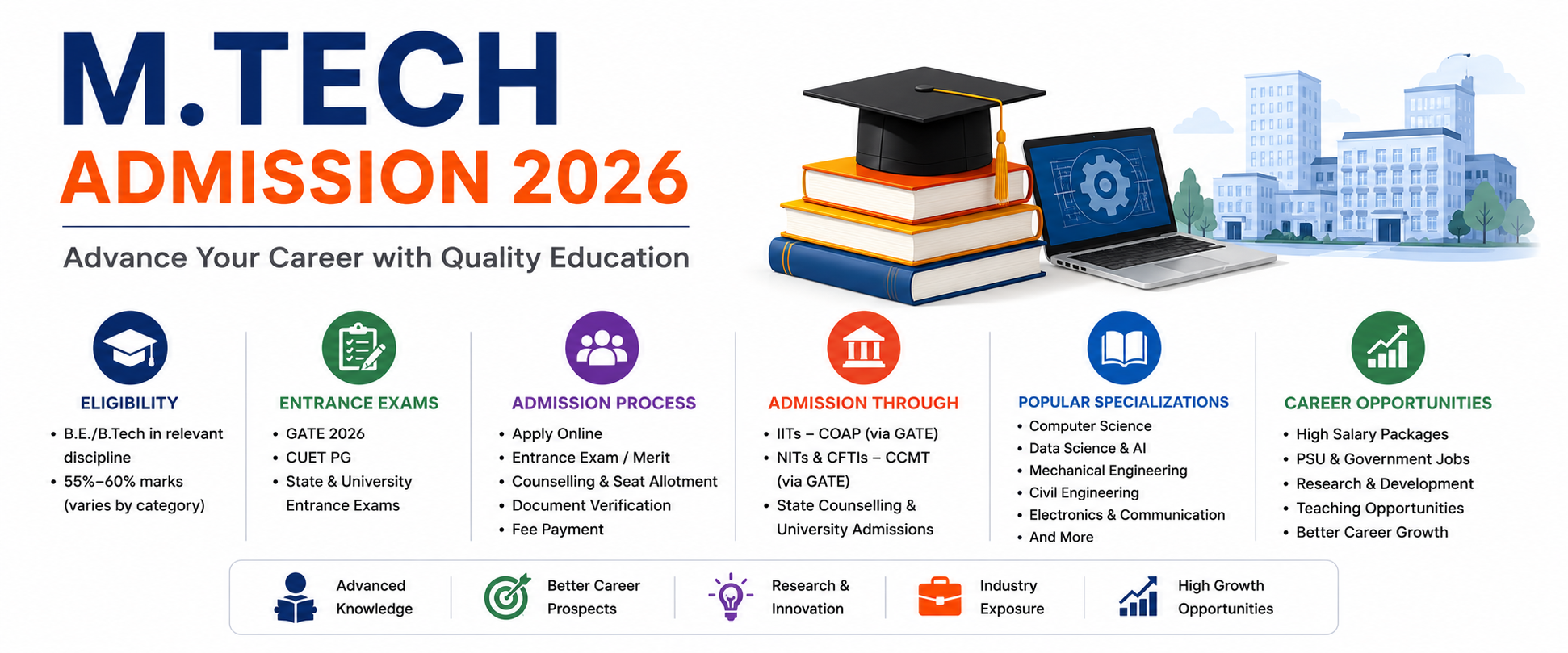
M.Tech Admission 2026 is the gateway for engineering graduates seeking advanced technical knowledge, research opportunities, and better career prospects. Master of Technology (M.Tech) is a postgraduate engineering program that enables students to specialize in their chosen field while improving technical expertise and industry skills.
Admissions to M.Tech programs in India are offered by prestigious institutions including IITs, NITs, IIITs, centrally funded technical institutions, state universities, and private universities. While GATE remains the most widely accepted entrance examination, many universities also offer admission through university-level entrance tests, CUET PG, or direct merit-based selection.
Students planning for M.Tech Admission 2026 should understand the eligibility requirements, entrance examinations, counseling procedures, and available specializations before beginning the admission process.
Why Choose M.Tech in 2026?
An M.Tech degree helps students gain specialized knowledge in engineering disciplines while opening opportunities in research, teaching, product development, consulting, and high-paying technical roles. Many industries prefer postgraduate engineers for advanced design, research, and leadership positions.
Benefits of pursuing M.Tech include:
- Advanced technical specialization
- Better placement opportunities
- Higher salary packages
- Research and innovation exposure
- Eligibility for Ph.D. programs
- Opportunities in government organizations, PSUs, and multinational companies
M.Tech Admission 2026 Eligibility Criteria
The eligibility requirements may vary slightly across universities and specializations. However, the general criteria include:
- Bachelor's degree (B.E. or B.Tech) in a relevant engineering discipline.
- Minimum 55%–60% aggregate marks in qualifying degree.
- Reserved category candidates may receive relaxation as per government norms.
- Candidates should satisfy the eligibility criteria specified by the respective institution.
Some universities also consider final-year engineering students, subject to completion of their qualifying degree before admission.
M.Tech Admission 2026 Process
The admission process generally follows these steps:
Check Eligibility
Ensure that you meet the academic eligibility requirements prescribed by your preferred university.
Submit the Application Form
Complete the online application by providing academic details, personal information, and uploading the required documents.
Appear for Entrance Examination
Most leading institutes require valid entrance examination scores such as GATE, while some universities conduct their own entrance examinations.
Merit List and Counseling
Qualified candidates are shortlisted based on entrance examination scores or merit. Selected candidates participate in counseling for seat allotment.
Document Verification
Candidates must verify their educational certificates and other required documents before admission confirmation.
Fee Payment
After successful document verification, candidates need to pay the admission fee to confirm their allotted seat.
National-Level M.Tech Admission 2026
IIT Admissions through COAP
Admissions to Indian Institutes of Technology (IITs) primarily depend on valid GATE scores. Candidates receive admission offers through the Common Offer Acceptance Portal (COAP), where they can accept, retain, or reject offers from participating IITs and IISc.
NIT Admissions through CCMT
Admissions to National Institutes of Technology (NITs), IIITs, and other Centrally Funded Technical Institutions are conducted through Centralized Counselling for M.Tech (CCMT). Seat allocation is based on GATE scores and candidate preferences.
Kerala M.Tech Admission 2026
Students seeking admission to engineering colleges in Kerala can participate in the admission process conducted by the Directorate of Technical Education (DTE), Kerala.
The Kerala M.Tech admission process generally includes:
- Online registration
- Publication of rank lists
- Trial allotment
- Final seat allotment
- Document verification
- Admission confirmation
Students should regularly monitor the official Kerala M.Tech admission portal for counseling schedules and seat allotment updates.
M.Tech Admission 2026 Without GATE
Although GATE is the preferred examination for most reputed institutions, several universities provide alternative admission options.
Admission without GATE is available through:
- CUET PG
- University-level entrance examinations
- Merit-based admissions
- Private university entrance tests
- Sponsored category admissions for working professionals
Many private universities conduct their own entrance examinations and may also consider undergraduate academic performance during selection.
Popular M.Tech Entrance Exams 2026
Students can apply through various national and state-level entrance examinations, including:
- GATE 2026
- CUET PG 2026
- TS PGECET 2026
- AP PGECET 2026
- OJEE 2026
- Karnataka PGCET
- MHT CET M.Tech Counselling
- SRMJEEE PG 2026
- VITMEE 2026
Each examination has its own eligibility requirements, syllabus, and counseling procedure.
M.Tech Entrance Exam Syllabus
The syllabus generally includes engineering subjects studied during the undergraduate program along with aptitude-based questions.
Common topics include:
- General Aptitude
- Engineering Mathematics
- Core Engineering Subjects
- Logical Reasoning
- Numerical Ability
- Subject-specific technical concepts
The syllabus varies depending on the entrance examination and engineering specialization.
Preparation Tips for M.Tech Admission 2026
Proper preparation significantly improves the chances of securing admission to reputed institutions.
Students should:
- Understand the latest examination syllabus.
- Prepare a structured study schedule.
- Practice previous years' question papers.
- Revise important engineering concepts.
- Strengthen aptitude and mathematics.
- Attempt mock tests regularly.
- Improve time management skills.
Popular M.Tech Specializations
Students can choose from a wide range of engineering specializations based on their interests and career goals.
Some of the most popular M.Tech specializations include:
- Computer Science and Engineering
- Big Data Analytics
- Artificial Intelligence
- Civil Engineering
- Structural Engineering
- Transportation Engineering
- Mechanical Engineering
- Electronics and Communication Engineering
- Electrical Engineering
- Remote Sensing & GIS
- Data Science
- Cyber Security
- Robotics
- VLSI Design
Each specialization offers distinct career opportunities across industries and research organizations.
High-Paying M.Tech Specializations
Several engineering domains continue to offer excellent salary packages due to growing industry demand.
Among the highest-paying specializations are:
- Big Data Analytics
- Artificial Intelligence
- Data Science
- Electronics & Communication Engineering
- Mechanical Engineering
- Structural Engineering
- Remote Sensing & GIS
- Cyber Security
Graduates from these disciplines often secure positions in multinational companies, research organizations, government sectors, and technology firms.
Documents Required for M.Tech Admission 2026
Candidates should keep the following documents ready during counseling and admission:
- Class 10 Certificate
- Class 12 Certificate
- B.E./B.Tech Degree Certificate
- Semester Mark Sheets
- Entrance Examination Scorecard
- Transfer Certificate
- Migration Certificate (if applicable)
- Category Certificate (if applicable)
- Passport-size Photographs
- Government-issued Identity Proof
Career Opportunities After M.Tech
An M.Tech degree significantly enhances career prospects across multiple industries.
Graduates can work as:
- Design Engineer
- Software Engineer
- Data Scientist
- AI Engineer
- Structural Engineer
- Research Engineer
- Project Manager
- Consultant
- Assistant Professor
- PSU Engineer
- R&D Scientist
Starting salary packages generally range between ₹6 LPA and ₹16 LPA, depending on the specialization, institute, skills, and employer, with higher growth potential through experience and advanced technical expertise.
Conclusion
M.Tech Admission 2026 provides engineering graduates with an excellent opportunity to enhance their technical knowledge, research capabilities, and professional growth. Whether applying through GATE, CCMT, COAP, state counseling, or university-level entrance examinations, understanding the admission process, eligibility criteria, counseling procedures, and available specializations is essential. Careful preparation, timely application, and choosing the right specialization can help students secure admission to leading engineering institutions and build a successful career in technology, research, and innovation.