





Introduction
Pursuing a Doctor of Philosophy (Ph.D.) is the highest academic qualification and an important milestone for students who wish to build careers in research, higher education, innovation, and specialized industries. Ph.D. Admission 2026 offers opportunities across engineering, science, management, humanities, commerce, medicine, law, and social sciences through universities, research institutions, and institutes of national importance.
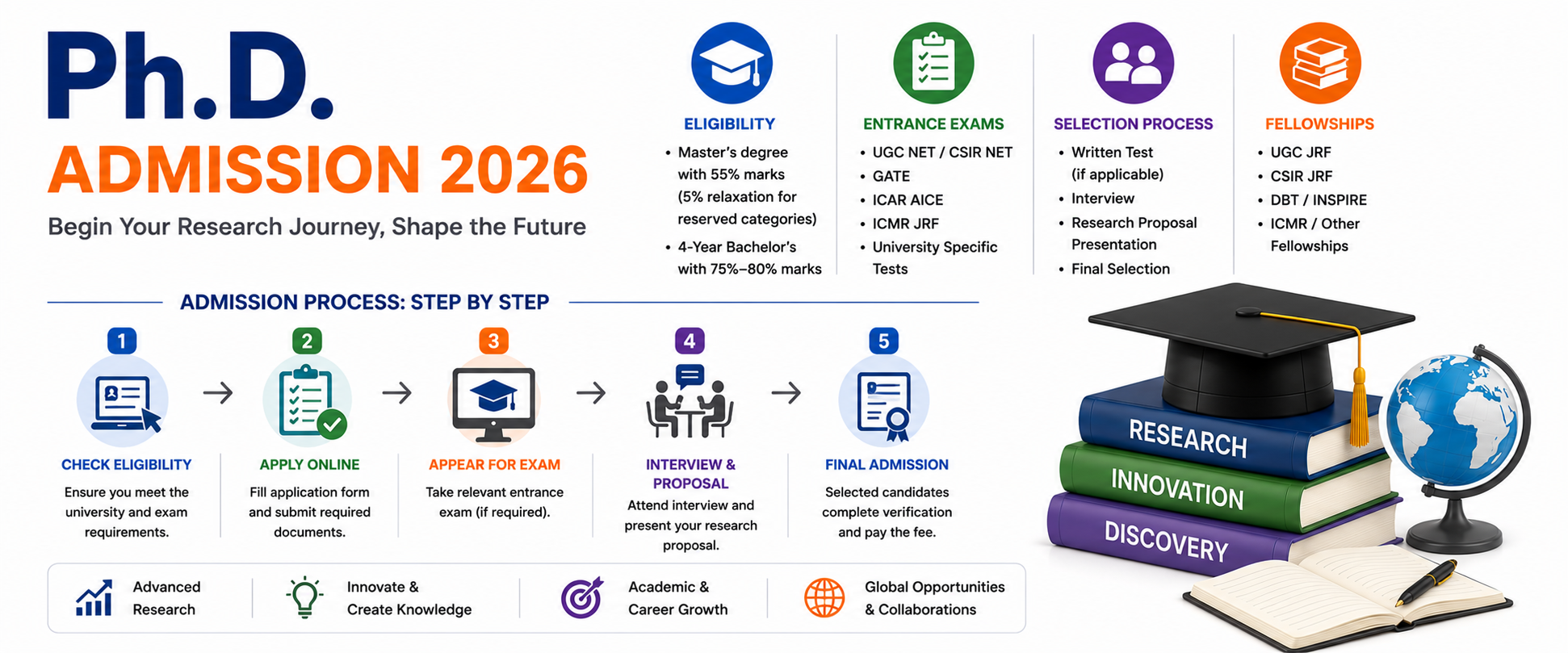
Admissions are conducted according to the latest University Grants Commission (UGC) regulations and institutional guidelines. Depending on the university, admission may be based on national-level entrance examinations such as UGC NET, CSIR NET, GATE, ICAR AICE, ICMR JRF, or university-specific entrance tests followed by interviews and research proposal presentations.
What is a Ph.D. Program?
A Ph.D. is an advanced research degree focused on generating original knowledge in a chosen field of study. Unlike undergraduate or postgraduate education, doctoral studies emphasize independent research, critical analysis, academic writing, experimentation, and publication.
During the program, scholars work under the supervision of experienced faculty members while conducting research that contributes new findings to their discipline. Many universities also encourage publication in peer-reviewed journals, conference presentations, and collaborative research projects.
Why Pursue Ph.D. Admission 2026?
A Ph.D. offers several academic and professional advantages, including:
- Opportunity to conduct advanced research
- Eligibility for Assistant Professor and academic positions
- Better career prospects in R&D organizations
- Higher earning potential in specialized industries
- Access to research fellowships and scholarships
- International collaboration opportunities
- Contribution to innovation and scientific advancement
- Development of analytical and problem-solving skills
Ph.D. Admission Eligibility 2026
Eligibility requirements vary depending on the university and discipline, but the general criteria remain similar across India.
Master's Degree Pathway
Candidates should possess a one-year or two-year Master's degree in a relevant discipline from a recognized university with a minimum of 55% aggregate marks or equivalent CGPA. Reserved category candidates generally receive a relaxation of 5% as per UGC norms.
Four-Year Bachelor's Degree Pathway
Several universities now permit direct Ph.D. admission after completing a four-year bachelor's degree, provided applicants have secured approximately 75%–80% marks or an equivalent CGPA, depending on institutional requirements.
Direct Admission for Engineering Graduates
Exceptional B.E. or B.Tech graduates with strong academic records and valid GATE scores or national fellowships may be eligible for direct doctoral admission in selected institutions.
Additional Requirements
Most universities also require:
- Relevant academic background
- Statement of Purpose (SOP)
- Research Proposal
- Academic transcripts
- Entrance examination qualification (where applicable)
National-Level Ph.D. Entrance Exams 2026
Several entrance examinations are accepted for Ph.D. admissions across India.
UGC NET
Conducted by the National Testing Agency (NTA), UGC NET is accepted by universities offering doctoral programs in Humanities, Commerce, Education, Management, Social Sciences, Languages, and many other disciplines.
CSIR NET
CSIR NET is designed for candidates pursuing research in:
- Life Sciences
- Chemical Sciences
- Mathematical Sciences
- Physical Sciences
- Earth Sciences
Successful candidates may qualify for Junior Research Fellowship (JRF).
GATE
Graduate Aptitude Test in Engineering (GATE) is widely accepted for engineering, technology, architecture, and science-related doctoral programs. Many IITs, NITs, and research institutions consider valid GATE scores during admissions.
ICAR AICE
Students interested in agricultural sciences, veterinary sciences, fisheries, and allied disciplines can apply through ICAR AICE.
ICMR JRF
Candidates planning research in biomedical and medical sciences can appear for the ICMR Junior Research Fellowship examination.
Exemption from University Entrance Tests
Many universities exempt candidates from written entrance examinations if they possess:
- UGC NET with JRF
- CSIR NET qualification
- Valid GATE score
- National Fellowships
- M.Phil degree (where applicable)
- Institution-specific exemptions
Such candidates usually appear directly for interviews and research proposal presentations.
Ph.D. Admission Process 2026
Although every university has its own admission procedure, the general process follows similar stages.
Check Eligibility
Review the university's eligibility requirements, required qualifications, minimum marks, and entrance examination criteria.
Select Research Area
Choose your preferred research discipline based on your academic background, career goals, and interests.
Choose Universities
Identify institutions with experienced faculty members, research laboratories, publications, and ongoing projects in your chosen field.
Prepare for Entrance Exams
Register and appear for relevant entrance examinations if required.
Submit the Online Application
Complete the application form by uploading all required documents before the deadline.
Attend Interview
Shortlisted candidates are invited for interviews where they discuss their research interests, academic background, and future research objectives.
Present Research Proposal
Most universities require applicants to present a research proposal demonstrating the originality, feasibility, and significance of the proposed research.
Final Admission
Selected candidates complete document verification, pay admission fees, and begin their doctoral research program.
Research Proposal Requirements
A well-prepared research proposal significantly improves admission chances. It generally includes:
- Research title
- Introduction
- Research objectives
- Literature review
- Research methodology
- Expected outcomes
- References
Most institutions recommend proposals between 500 and 1,000 words.
Documents Required
Applicants should keep the following documents ready during admission:
- Class 10 and 12 certificates
- Bachelor's degree certificates
- Master's degree certificates
- Semester mark sheets
- Transfer Certificate
- Migration Certificate (if applicable)
- Category Certificate (if applicable)
- Valid entrance exam scorecard
- Research Proposal
- Statement of Purpose
- Passport-size photographs
- Government-issued ID proof
Types of Ph.D. Programs
Students can choose from multiple doctoral formats depending on their professional and academic goals.
Full-Time Ph.D.
This is the most common option, requiring regular campus attendance and active research participation. Most fellowships are available for full-time scholars.
Part-Time Ph.D.
Designed for working professionals, part-time Ph.D. programs offer flexible schedules while maintaining the same academic standards.
Sponsored Ph.D.
Industry-sponsored candidates or faculty members may pursue doctoral studies while receiving financial support from employers or sponsored research projects.
Integrated Ph.D.
Exceptional undergraduate students may enroll in integrated Master's and Ph.D. programs offered by selected institutions.
Fellowships and Financial Support
Many doctoral students receive financial assistance through:
- UGC Junior Research Fellowship (JRF)
- CSIR JRF
- DBT Fellowships
- INSPIRE Fellowships
- ICMR Fellowships
- Institutional Assistantships
- Sponsored Research Projects
These fellowships often include monthly stipends, contingency grants, and research funding.
How to Choose the Right Ph.D. Program
Selecting the right doctoral program requires careful evaluation of several important factors.
Consider the university's research reputation, faculty expertise, publication record, laboratory facilities, funding opportunities, collaborations, placement support, alumni achievements, and research infrastructure. Students should also evaluate the institution's location, academic culture, and opportunities for interdisciplinary research before making a final decision.
Career Opportunities After Ph.D.
A Ph.D. opens career opportunities across multiple sectors.
Graduates may work as:
- Assistant Professor
- University Researcher
- Scientist
- Research Associate
- Data Scientist
- Policy Analyst
- Industry R&D Specialist
- Consultant
- Laboratory Director
- Innovation Manager
- Government Research Officer
- International Research Fellow
Research experience also creates opportunities in multinational corporations, think tanks, government organizations, startups, and international universities.
Conclusion
Ph.D. Admission 2026 provides an excellent opportunity for students who aspire to build careers in research, innovation, and higher education. With multiple admission pathways through Master's degrees, four-year bachelor's programs, national-level entrance examinations, and university-specific selection processes, candidates have several options to begin their doctoral journey. Preparing a strong research proposal, qualifying the appropriate entrance examinations, selecting universities that align with your research interests, and understanding the complete admission process will significantly improve your chances of securing admission to a reputed Ph.D. program in India.