





Introduction
Australia has become one of the most preferred destinations for international students who wish to pursue a career in nursing. With globally recognized universities, high-quality education, advanced healthcare facilities, and excellent employment opportunities, the country offers an ideal environment for aspiring nurses. Australian nursing programs combine classroom learning with extensive clinical placements, ensuring students graduate with both theoretical knowledge and practical experience.
A Nursing degree in Australia prepares students to provide quality patient care across hospitals, community healthcare centres, aged care facilities, rehabilitation centres, and many other healthcare settings. Graduates also benefit from internationally respected qualifications that open doors to employment opportunities both in Australia and around the world.
What is a Bachelor of Nursing?
A Bachelor of Nursing is a professional undergraduate degree designed to prepare students for a successful career as a registered nurse. The program provides comprehensive education in anatomy, physiology, pharmacology, medical-surgical nursing, community health, mental health, and patient care.
Students also gain hands-on clinical experience through placements in hospitals and healthcare institutions, allowing them to apply classroom knowledge in real healthcare environments. After completing the degree and meeting registration requirements, graduates can apply for nursing registration and begin working in public and private healthcare facilities.
Depending on the university, the duration of the Bachelor of Nursing generally ranges from three to four years.
Why Study Nursing in Australia?
Australia offers numerous advantages for students planning to build a successful nursing career.
World-Class Education
Australian universities are internationally recognized for delivering high-quality nursing education. Nursing programs are accredited by the Australian Nursing and Midwifery Accreditation Council (ANMAC), ensuring graduates meet national healthcare standards and are well prepared for professional practice.
Globally Recognized Qualification
A nursing degree from Australia is respected by employers worldwide. Graduates receive internationally recognized qualifications that increase career opportunities across different countries.
Strong Employment Opportunities
Australia continues to experience strong demand for qualified nurses due to an ageing population, expanding healthcare services, and increasing healthcare needs. This creates excellent employment opportunities for both domestic and international graduates.
Practical Clinical Training
Australian universities place strong emphasis on clinical education. Students complete supervised clinical placements in hospitals, community health centres, aged care facilities, and specialist healthcare institutions, gaining valuable real-world experience.
Excellent Salary Packages
Nursing is one of Australia's most rewarding professions. Competitive salaries, regular salary growth, and excellent employment benefits make nursing an attractive career choice.
Career Growth
Australia encourages continuous professional development. Nurses can specialize in areas such as mental health, pediatrics, emergency care, critical care, operating theatre nursing, rehabilitation, aged care, oncology, and community nursing.
Supportive Healthcare Environment
Australian healthcare organizations continuously invest in improving working conditions, employee benefits, professional development, and workplace support for nurses.
Top Universities for Nursing in Australia
Australia is home to several globally ranked universities offering high-quality nursing education.
Some of the leading universities include:
- The University of Sydney
- Monash University
- University of Technology Sydney (UTS)
- The University of Melbourne
- Griffith University
- Queensland University of Technology (QUT)
- The University of Queensland
- Deakin University
- Australian Catholic University
- La Trobe University
- The University of Newcastle
- Western Sydney University
Many of these universities are consistently ranked among the world's best institutions for Nursing.
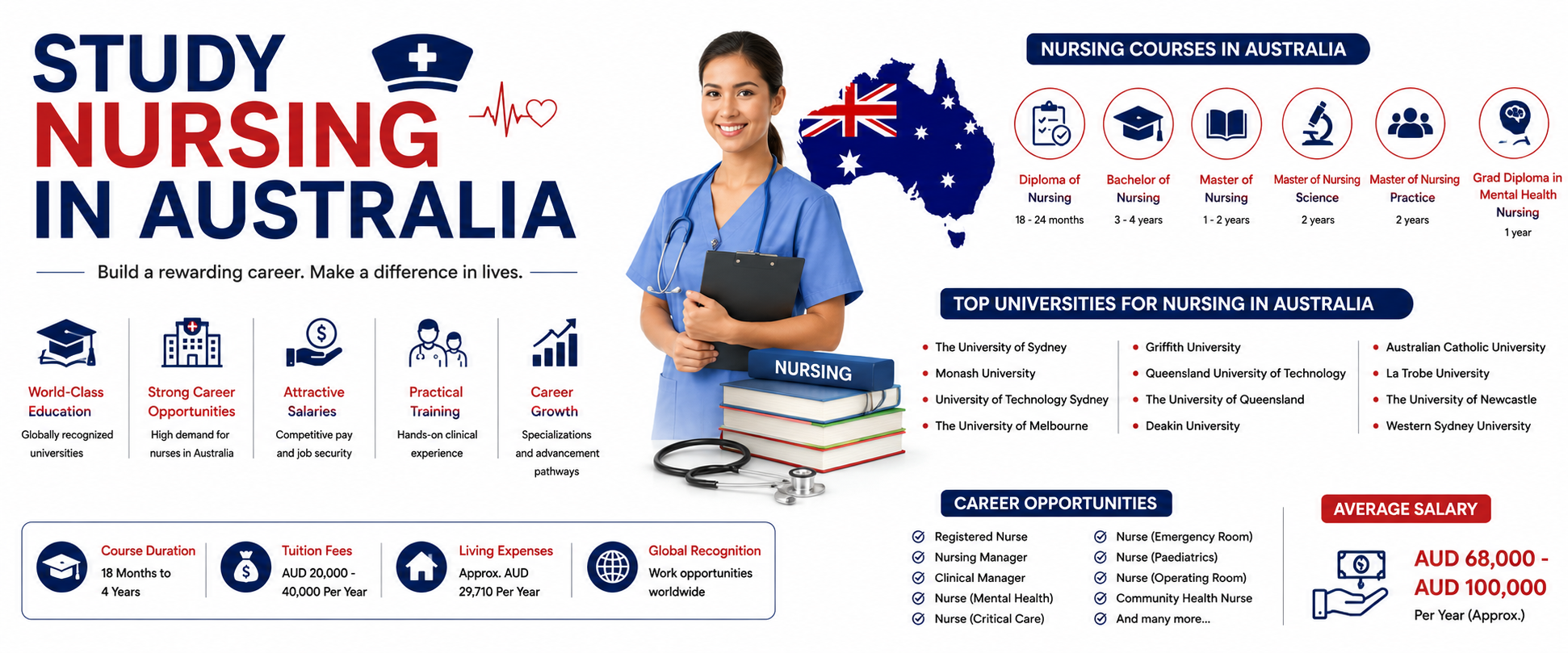
Nursing Courses Available in Australia
Australian universities offer nursing programs at different academic levels to suit various career goals.
Diploma of Nursing
The Diploma of Nursing generally takes 18–24 months to complete. It prepares students to work as Enrolled Nurses and focuses on patient care, anatomy, wound management, medication administration, and chronic disease management. Students also complete practical training through clinical placements and simulation laboratories.
Bachelor of Nursing
The Bachelor of Nursing usually requires three to four years of full-time study. The curriculum combines classroom instruction with extensive clinical placements, covering anatomy, physiology, pharmacology, mental health, community nursing, acute care, and professional nursing practice.
Master of Nursing
The Master of Nursing is generally completed within one to two years and is designed for graduates seeking advanced knowledge, leadership skills, and specialization in nursing practice.
Master of Nursing Science
This two-year postgraduate program focuses on research, advanced clinical practice, and evidence-based healthcare.
Master of Nursing Practice
The Master of Nursing Practice is another two-year postgraduate qualification designed to prepare graduates for advanced nursing roles through professional training and clinical experience.
Graduate Diploma in Mental Health Nursing
This one-year postgraduate program focuses specifically on mental health nursing. Students study legal and ethical practice, mental healthcare systems, diagnostic techniques, therapeutic interventions, and advanced clinical practice. Many programs are developed in consultation with the Australian College of Mental Health Nurses (ACMHN).
Cost of Studying Nursing in Australia
The cost of studying Nursing depends on the university and course level.
On average:
- Tuition fees range between AUD 20,000 and AUD 40,000 per year
- Living expenses are approximately AUD 29,710 per year
Students should also budget for accommodation, food, transportation, health insurance, study materials, and personal expenses.
Eligibility Requirements
International students applying for a Bachelor of Nursing generally need to meet the following requirements:
- Completion of Class 12 from a recognized board
- Science background with Physics, Chemistry, Biology, and in some cases Mathematics
- Minimum academic performance of approximately 50–60%
- English language proficiency through IELTS or equivalent examination
- Many universities require an overall IELTS score of 7.0, although requirements may vary by institution
Students should always check individual university admission requirements before applying.
Documents Required
Applicants generally need the following documents:
- Academic transcripts
- Class 12 certificates
- English language proficiency test scores
- Statement of Purpose (SOP)
- Letters of Recommendation (LOR)
- Valid Passport
- Updated Resume (if required)
- Scholarship documents (if applicable)
Additional documents may be requested depending on the university.
Scholarships for Nursing Students
Many Australian universities and organizations offer scholarships to international students pursuing nursing programs.
Some popular scholarships include:
- Western Union Foundation Global Scholarship Program
- Monash International Scholarship for Excellence
- Hani Zeini Scholarship
- VU Alumni Discount
- Griffith Remarkable Scholarship
Scholarship values vary and may cover partial tuition fees, full tuition fees, or provide financial assistance for living expenses.
Clinical Training and Work Placements
One of the biggest strengths of Australian nursing education is its practical approach.
Students gain extensive hands-on experience through:
- Hospital placements
- Community healthcare centres
- Aged care facilities
- Mental health institutions
- Simulation laboratories
- Web-based clinical simulations
Many Diploma programs include around 400 hours of clinical placement, while Bachelor's degrees provide extensive supervised practical training throughout the course.
Career Opportunities After Nursing in Australia
Graduates have excellent employment opportunities across Australia's healthcare sector.
Popular career options include:
- Registered Nurse
- Nursing Manager
- Clinical Manager
- Registered Nurse (Paediatrics)
- Registered Nurse (Mental Health)
- Registered Nurse (Critical Care)
- Registered Nurse (Emergency Department)
- Registered Nurse (Operating Theatre)
- Registered Nurse (Anaesthetic)
- Registered Nurse (Disability and Rehabilitation)
- Community Health Nurse
- Aged Care Nurse
Graduates may also work in public hospitals, private hospitals, rehabilitation centres, clinics, nursing homes, community healthcare organizations, research institutions, and government healthcare services.
Salary After Completing Nursing in Australia
Nursing professionals in Australia receive attractive salary packages.
Graduates can generally expect annual salaries ranging between AUD 68,000 and AUD 100,000, depending on their experience, specialization, employer, and location.
Senior nursing professionals and specialists often earn significantly higher salaries with additional professional qualifications and experience.
Why Choose Australia for Nursing?
Australia combines world-class education, internationally recognized qualifications, excellent healthcare infrastructure, and outstanding career opportunities. Students benefit from modern teaching methods, advanced simulation laboratories, practical clinical training, multicultural learning environments, and strong industry partnerships.
The country's growing healthcare sector continues to create demand for qualified nursing professionals, making nursing one of the most secure and rewarding career choices for international students.
Conclusion
Studying Nursing in Australia offers students the opportunity to gain a globally respected qualification while developing the practical skills needed for a successful healthcare career. With top-ranked universities, extensive clinical placements, modern healthcare facilities, generous scholarship opportunities, and excellent employment prospects, Australia remains one of the best destinations for nursing education. Whether you choose a Diploma, Bachelor, or postgraduate nursing program, you will graduate with the knowledge, confidence, and professional experience needed to make a meaningful impact in healthcare.