





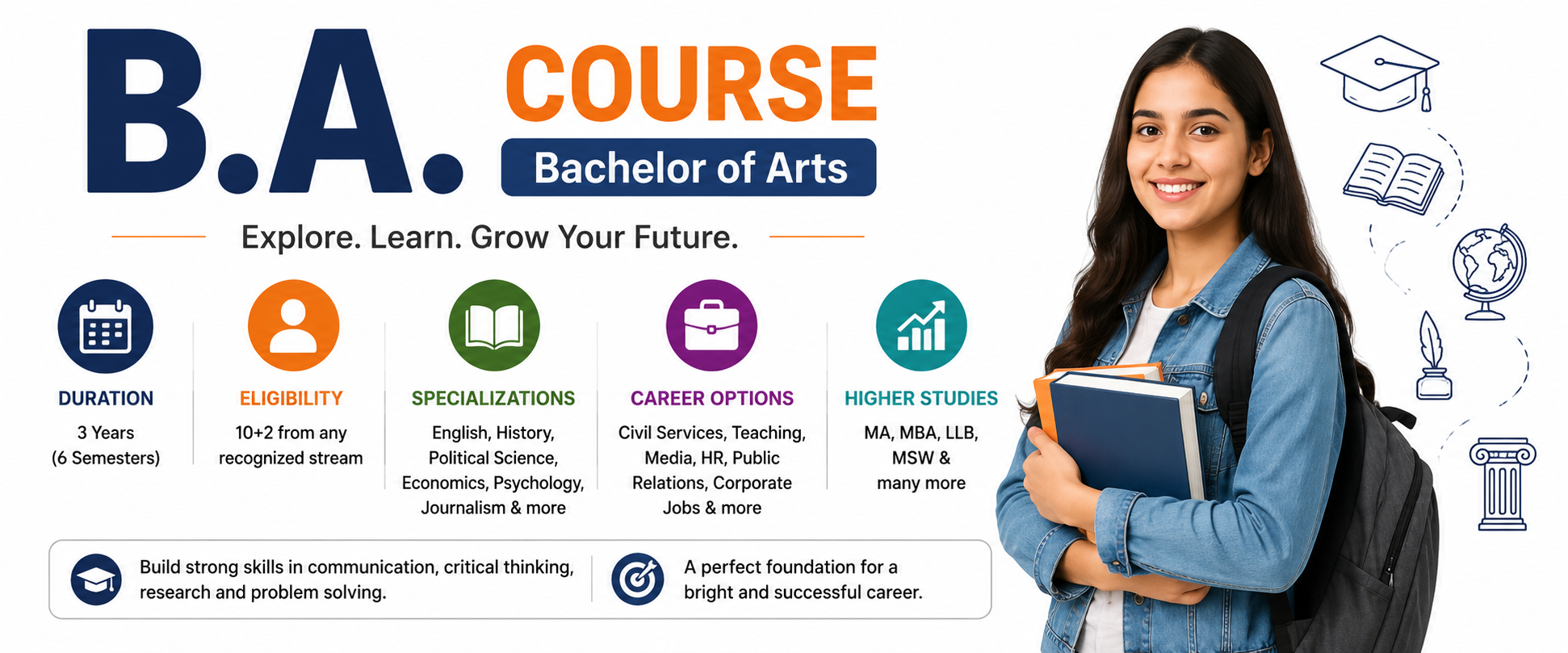
Introduction
The Bachelor of Arts (B.A.) is one of the most popular undergraduate degree programs chosen by students after completing Class 12. Designed around humanities, social sciences, and liberal arts, the B.A. course develops critical thinking, communication, analytical reasoning, research abilities, and problem-solving skills. These qualities make graduates suitable for careers in education, media, government services, corporate organizations, non-governmental organizations (NGOs), research institutions, and many other sectors.
Unlike professional degrees that focus on a single technical field, a B.A. offers flexibility through a wide range of specializations. Students can pursue their interests in literature, history, psychology, economics, political science, journalism, sociology, geography, and many other disciplines. The degree also serves as a strong foundation for higher education, including MA, MBA, LLB, and various competitive examinations.
What is a B.A. Course?
The full form of B.A. is Bachelor of Arts. It is an undergraduate degree program that focuses on humanities, liberal arts, and social sciences. The course is designed to provide students with subject knowledge while improving their communication, writing, research, and critical thinking abilities.
A B.A. program is suitable for students who wish to build careers in administration, education, journalism, media, public relations, psychology, research, content creation, social work, and government services.
B.A. Course Highlights
Some important highlights of the B.A. course include:
- Course Name: Bachelor of Arts (B.A.)
- Course Level: Undergraduate
- Course Duration: 3 years (6 semesters). Some universities offer a 4-year Honours or Honours with Research program.
- Eligibility: Class 12 from any recognized board.
- Admission Process: Merit-based or entrance examination.
- Learning Modes: Full-time, Part-time, Online, Distance Education, and Correspondence.
- Average Course Fees: ₹1,000 to ₹43.6 lakh (depending on the institution and specialization).
- Average Salary: Around ₹5.2 LPA (varies by role and experience).
Types of B.A. Courses
Universities offer different types of B.A. programs to suit students' academic interests.
B.A. General
The B.A. General (or Pass) program provides a broad education by allowing students to study multiple humanities and social science subjects throughout the degree.
B.A. Honours
B.A. Honours focuses on one major subject, allowing students to gain in-depth knowledge and specialization in a chosen discipline such as English, History, Political Science, or Psychology.
B.A. Honours with Research
The four-year Honours with Research program includes advanced coursework and a research dissertation, making it suitable for students planning higher studies or research careers.
Eligibility Criteria
Admission to a B.A. course is relatively simple compared to many professional programs.
Students generally need to meet the following requirements:
- Pass Class 12 (10+2) or an equivalent examination from a recognized board.
- Students from Arts, Science, or Commerce streams are eligible.
- Secure a minimum of 50% to 60% aggregate marks depending on the university.
- There is generally no upper age limit for admission.
Eligibility requirements may vary among universities.
Admission Process
Admission into B.A. programs is offered through either merit or entrance examinations.
The general admission process includes:
- Complete Class 12 from a recognized board.
- Apply online through the university admission portal.
- Appear for the required entrance examination if applicable.
- Participate in counselling or document verification.
- Confirm admission after fee payment.
Popular Entrance Exams
Many universities admit students based on merit, while others conduct entrance examinations.
Popular B.A. entrance exams include:
- CUET
- IPU CET
- LPU NEST
- University-specific entrance examinations
Admission policies vary depending on the institution.
Course Structure
The B.A. curriculum is generally divided into six semesters over three years.
Students study:
- Foundation courses
- Core subjects
- Discipline-specific papers
- Skill enhancement courses
- Elective subjects
- Ability enhancement courses
- Research or project work (in selected universities)
Some universities following the National Education Policy (NEP) also provide multidisciplinary learning opportunities.
Popular B.A. Subjects
Students can choose one major subject along with elective or minor subjects.
Common subjects include:
- English Literature
- Hindi
- Sanskrit
- Political Science
- History
- Economics
- Sociology
- Psychology
- Geography
- Philosophy
- Journalism and Mass Communication
- Public Administration
- Social Work
- Fine Arts
- Foreign Languages
The exact curriculum varies according to the university and specialization.
Popular B.A. Specializations
Some of the most preferred B.A. specializations include:
B.A. English
Students study literature, linguistics, language, creative writing, and literary criticism.
Career Options:
- Content Writer
- Editor
- Journalist
- Public Relations Executive
- Lecturer
- Corporate Communications Specialist
B.A. Political Science
Focuses on governance, constitutions, international relations, and political systems.
Career Options:
- Civil Services
- Policy Analyst
- Diplomat
- Political Consultant
- Journalist
- NGO Project Manager
B.A. Economics
Covers microeconomics, macroeconomics, statistics, and economic policy.
Career Options:
- Economist
- Financial Analyst
- Banking Professional
- Economic Researcher
- Consultant
- Policy Analyst
B.A. History
Includes ancient, medieval, modern, and world history.
Career Options:
- Historian
- Archaeologist
- Museum Curator
- Archivist
- Teacher
- Research Analyst
B.A. Psychology
Focuses on human behavior, counselling, research methods, and mental health.
Career Options:
- Counsellor
- Human Resource Professional
- Researcher
- Industrial Psychologist
- Clinical Psychology (after higher studies)
Best Subject Combinations
Students can choose subject combinations based on their career goals.
For Civil Services:
- Political Science
- History
- Sociology
- Public Administration
For Journalism and Media:
- English
- Journalism
- Psychology
For Finance and Analytics:
- Economics
- Mathematics
- Statistics
Choosing the right combination helps build a stronger academic and professional foundation.
Top Colleges Offering B.A.
Some well-known institutions offering B.A. programs include:
- Delhi University
- Banaras Hindu University
- St. Xavier's College, Mumbai
- Madras Christian College
- Loyola College
- Mithibai College
- Amity University
Many state universities and autonomous colleges also offer quality B.A. programs.
Career Opportunities After B.A.
A Bachelor of Arts degree opens opportunities in both government and private sectors.
Popular career options include:
- Human Resources Manager
- Public Relations Officer
- Content Writer
- Journalist
- Marketing Executive
- Financial Analyst
- Social Worker
- Psychologist
- Survey Researcher
- Teacher
- NGO Professional
- Research Assistant
- Lawyer (after LLB)
Students interested in government jobs often prepare for examinations such as UPSC, SSC, and various state public service commissions, where subjects like History, Political Science, Economics, and Sociology provide a strong academic foundation.
Top Recruiters
Leading recruiters for B.A. graduates include:
- Tata Consultancy Services (TCS)
- Accenture
- Times of India
- Hindustan Times
- HDFC Bank
- Axis Bank
- Bank of Baroda
- Thomson Reuters
- Max Hospital
- Fortis Hospital
- Balaji Telefilms
- National Museums
Higher Education Options
After completing a B.A., students can pursue:
- Master of Arts (MA)
- Master of Business Administration (MBA)
- Bachelor of Laws (LLB)
- Master of Social Work (MSW)
- M.Ed. (after fulfilling eligibility)
- Research programs
- Professional certification courses
Higher education enhances career opportunities and specialization in a chosen field.
Why Choose a B.A. Course?
A B.A. course offers flexibility, multidisciplinary learning, and diverse career opportunities. It helps students build transferable skills such as communication, research, analytical thinking, leadership, and creativity that are valued across industries. Whether your goal is to prepare for civil services, pursue higher education, work in media, enter the corporate sector, or contribute to social development, a Bachelor of Arts degree provides a strong academic foundation and numerous career pathways.
Conclusion
The B.A. course remains one of the most versatile undergraduate programs available after Class 12. With multiple specializations, flexible learning modes, affordable fees, and wide-ranging career opportunities, it caters to students with diverse interests and aspirations. From government services and journalism to education, human resources, public relations, research, and management, a Bachelor of Arts degree opens doors to rewarding careers. By selecting the right specialization based on your interests and long-term goals, you can build a successful academic and professional future.