





Introduction
Choosing between Bachelor of Business Administration (BBA) and Bachelor of Management Studies (BMS) is an important decision for students interested in business, management, finance, and entrepreneurship. Although both are three-year undergraduate management programs, they differ in their academic approach, specialization options, and career focus.
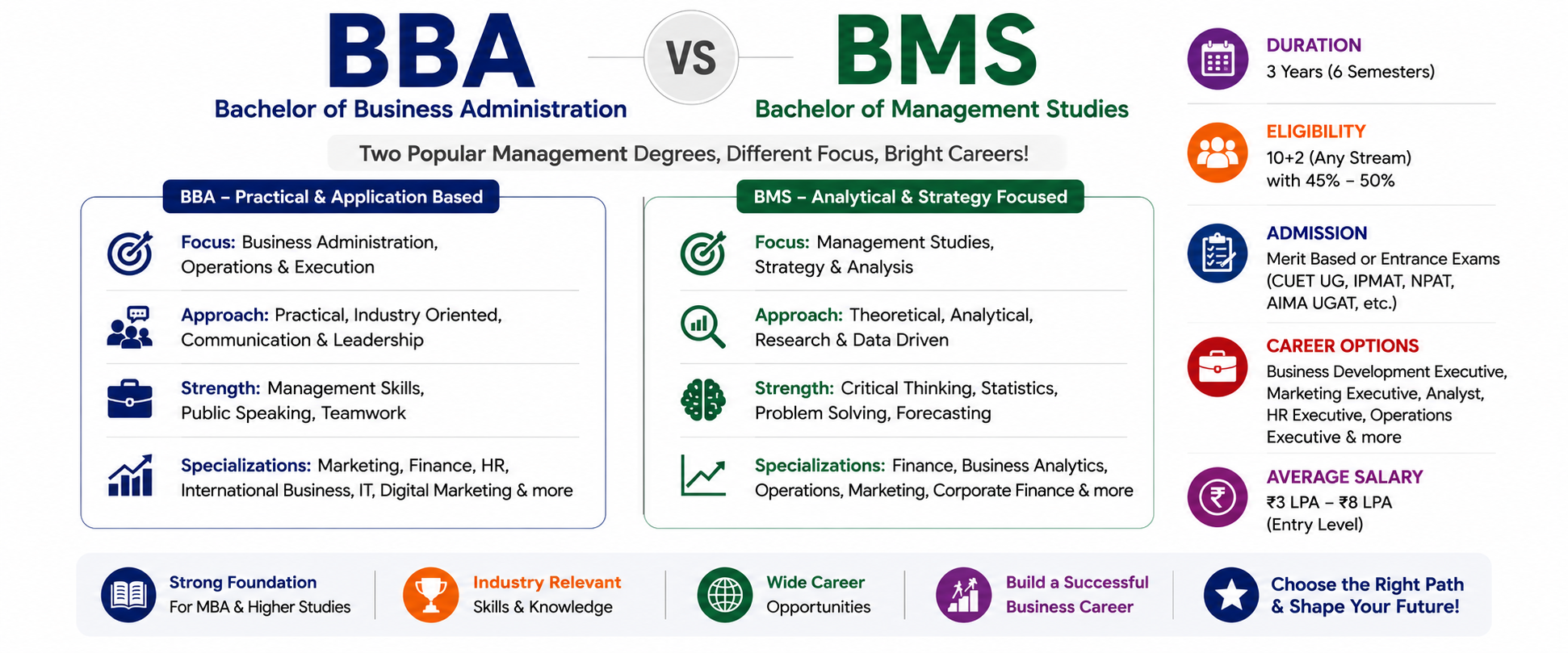
BBA emphasizes practical business administration and operational management, while BMS focuses on analytical thinking, strategic management, business research, and decision-making. Both degrees provide an excellent foundation for higher education such as an MBA and open doors to careers in corporate organizations, banking, consulting, marketing, finance, and human resources.
What is BBA?
The Bachelor of Business Administration (BBA) is a three-year undergraduate degree that develops practical knowledge of business administration, organizational management, leadership, marketing, finance, and entrepreneurship.
The course prepares students to manage business operations efficiently while improving communication, leadership, teamwork, and problem-solving skills. BBA is ideal for students who want careers in business administration, corporate management, sales, marketing, and entrepreneurship.
What is BMS?
The Bachelor of Management Studies (BMS) is also a three-year undergraduate program, but it focuses more on management principles, strategic planning, business analytics, economics, finance, and organizational development.
BMS helps students develop analytical thinking, quantitative skills, research abilities, and decision-making capabilities. It is suitable for students who are interested in management consulting, corporate strategy, financial management, and business analysis.
Difference Between BBA and BMS
Although both degrees belong to the management field, their academic focus is different.
BBA focuses on:
- Business administration
- Practical management
- Business operations
- Leadership development
- Communication skills
- Marketing and organizational management
BMS focuses on:
- Strategic management
- Business analytics
- Financial management
- Research and data interpretation
- Critical thinking
- Corporate decision-making
Students interested in practical business operations generally prefer BBA, whereas those interested in strategic management and analytical roles often choose BMS.
Course Duration
Both BBA and BMS are undergraduate programs with a duration of three years, divided into six semesters.
The curriculum combines classroom learning, presentations, projects, internships, industrial visits, and practical assignments to prepare students for corporate careers.
Eligibility Criteria
The general eligibility requirements for both courses include:
- Completion of Class 12 or equivalent from a recognized board.
- Minimum aggregate marks of 45% to 50%, depending on the institution.
- Students from Commerce, Science, and Arts streams are generally eligible.
- English is often a compulsory subject.
- Some universities may have additional eligibility requirements.
Admission criteria vary across institutions.
Admission Process
Admission to BBA and BMS programs generally follows these steps:
Check Eligibility
Candidates should review the eligibility criteria prescribed by the preferred university.
Application
Complete the online or offline application form and upload the required documents.
Entrance Examination
Some universities conduct entrance examinations, while others offer admission based on Class 12 merit.
Popular entrance examinations include:
- CUET UG
- IPMAT
- NPAT
- AIMA UGAT
- SET
- DUJAT
- IPU CET
- TSMAT
- Christ University Entrance Test
- CUCET
- LPU NEST
- GITAM GAT
- JMI Entrance Examination
Merit List and Counselling
Selected candidates participate in counselling, document verification, and fee payment before confirming admission.
BBA Syllabus
The BBA curriculum focuses on business administration and practical management.
Important subjects include:
- Business Management
- Operations Management
- Business Accounting
- Management Accounting
- Business Law
- Managerial Economics
- International Marketing
- Public Relations Management
- Import and Export Management
- Family Business Management
The curriculum also includes presentations, internships, industrial training, and case studies.
BMS Syllabus
The BMS curriculum emphasizes management theories and analytical skills.
Major subjects include:
- Business Statistics
- Strategic Management
- Financial Management
- Cost Accounting
- Business Ethics
- Corporate Social Responsibility
- International Finance
- Industrial Law
- Computer Applications
- Banking and Insurance
Students also study business research methods and quantitative analysis.
Popular Specializations
Both programs offer multiple specialization options.
BBA Specializations
Popular BBA specializations include:
- Marketing
- Finance
- Human Resource Management
- International Business
- Digital Marketing
- Hotel Management
- Travel Management
- Foreign Trade
- Business Analytics
- Information Technology
- Entrepreneurship
BMS Specializations
Common BMS specializations include:
- Finance
- Accounting
- Marketing
- Business Analytics
- Sales Management
- Corporate Finance
- Industrial Law
- Resource Allocation
- Operations Management
Students should choose a specialization based on their career interests and future goals.
Career Opportunities
Graduates from both programs have excellent employment opportunities across industries.
Career Options after BBA
Popular job roles include:
- Business Development Executive
- Marketing Executive
- Corporate Administrator
- Operations Executive
- Sales Executive
- Customer Relationship Manager
- Finance Executive
- Business Analyst
- Operations Manager
Career Options after BMS
Common job roles include:
- Business Development Executive
- Research Analyst
- Financial Analyst
- Marketing Executive
- HR Executive
- Accounts Manager
- Finance Manager
- Customer Success Executive
- Business Consultant
Both degrees provide opportunities in banking, finance, consulting, retail, IT, manufacturing, healthcare, hospitality, and e-commerce.
Salary After BBA and BMS
Fresh graduates generally receive salary packages ranging between ₹3 LPA and ₹8 LPA, depending on the college, specialization, skills, internship experience, and employer.
Experienced professionals working in managerial positions can earn significantly higher salaries with industry experience and additional qualifications.
Higher Education Options
After completing either degree, students can pursue higher studies to improve career prospects.
Popular options include:
- MBA
- Master of Management Studies (MMS)
- Chartered Financial Analyst (CFA)
- Chartered Accountant (CA)
- Company Secretary (CS)
- Certified Management Accountant (CMA)
- Certified Business Analyst (CBA)
- LLB
- Project Management Professional (PMP)
- PG Diploma in Banking
- PG Diploma in Human Resource Management
- PG Diploma in Corporate Finance
Professional certifications further enhance employability and leadership opportunities.
Which Course Should You Choose?
The choice between BBA and BMS depends on your interests and career objectives.
Choose BBA if you prefer:
- Business administration
- Leadership
- Marketing
- Entrepreneurship
- Sales and operations
- Corporate management
Choose BMS if you prefer:
- Strategic planning
- Business analytics
- Financial management
- Research
- Data-driven decision-making
- Corporate consulting
Both degrees provide excellent career opportunities and serve as strong foundations for postgraduate management education.
Conclusion
The BBA and BMS comparison shows that both programs offer valuable education in business and management, but each has a unique focus. BBA is ideal for students seeking practical business administration and operational roles, while BMS is better suited for those interested in strategic management and analytical careers. With diverse specializations, strong placement opportunities, and excellent prospects for higher education, both degrees can lead to rewarding careers in the corporate world.