





Introduction
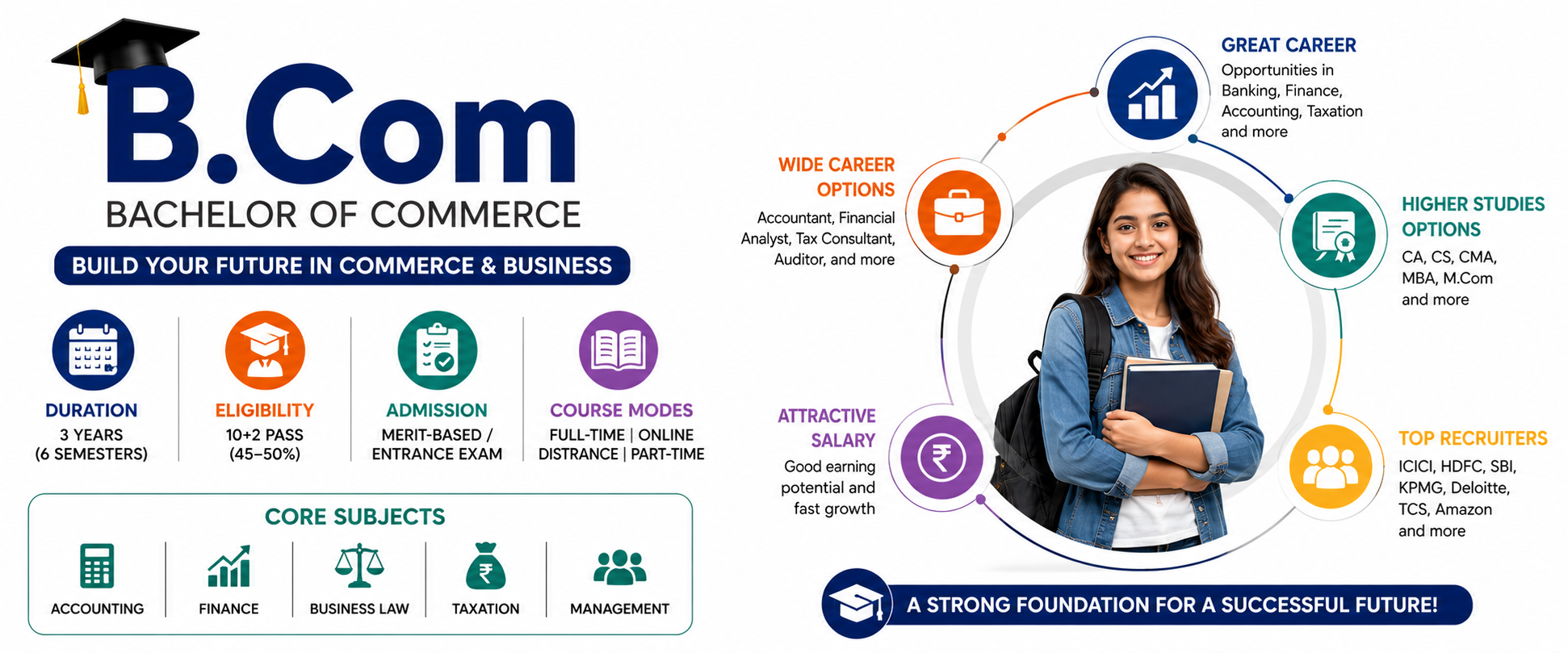
The Bachelor of Commerce (B.Com) is one of the most popular undergraduate degree programs for students interested in commerce, finance, accounting, taxation, economics, and business management. The course is designed to provide students with theoretical knowledge and practical skills required for careers in the corporate, banking, financial, taxation, and business sectors.
The B.Com degree serves as an excellent foundation for professional courses such as Chartered Accountancy (CA), Company Secretary (CS), Cost and Management Accountancy (CMA), MBA, M.Com, and other specialized finance and management programs. Graduates also find opportunities in government organizations, multinational companies, consulting firms, and financial institutions.
What is a B.Com Course?
The Bachelor of Commerce (B.Com) is a three-year undergraduate degree divided into six semesters. It focuses on developing a strong understanding of commerce-related subjects including accounting, business law, economics, taxation, auditing, finance, management, and business communication.
The curriculum prepares students to understand how businesses operate, manage financial records, analyze economic conditions, and make informed business decisions. Along with academic learning, many universities also encourage internships, industrial exposure, seminars, and project work to enhance practical knowledge.
B.Com Course Highlights
Some of the major highlights of the B.Com program include:
- Duration of 3 years divided into 6 semesters.
- Suitable for students interested in commerce, finance, accounting, banking, and business.
- Admission through merit or entrance examinations depending on the institution.
- Strong foundation for professional courses such as CA, CS, CMA, MBA, and M.Com.
- Available in full-time, online, distance, and part-time study modes.
- Career opportunities in banking, finance, accounting, taxation, consulting, and corporate sectors.
Eligibility Criteria
Students seeking admission to the B.Com program should satisfy the following eligibility requirements:
- Completion of Class 12 or equivalent from a recognized board.
- Commerce stream is generally preferred.
- Subjects such as Accountancy, Business Studies, Economics, and Mathematics are advantageous.
- Students from Science and Arts streams may also be eligible in many institutions.
- Most colleges require a minimum of 45% to 50% aggregate marks, while reputed institutions may have higher cut-off marks.
- There is generally no upper age limit for admission.
Admission Process
The admission process varies among universities and colleges but generally follows these steps:
Check Eligibility
Candidates should ensure they meet the eligibility requirements prescribed by the desired institution.
Online Registration
Applicants must register through the official admission portal and complete the application form.
Upload Documents
Students need to submit academic certificates, identity proof, passport-size photographs, and other required documents.
Entrance Examination
Some universities conduct entrance examinations, while many colleges offer admission based on Class 12 merit.
Merit List and Counselling
Eligible candidates are shortlisted based on entrance exam scores or academic performance. Selected students participate in counselling and document verification.
Admission Confirmation
Candidates confirm admission by paying the prescribed fees within the specified deadline.
B.Com Entrance Exams
Several national and university-level entrance examinations are accepted for B.Com admissions.
Popular entrance exams include:
- CUET UG
- AIMA UGAT
- IPU CET
- NPAT
- SET (Symbiosis Entrance Test)
- Christ University Entrance Test
- CUCET
- GITAM GAT
- Jamia Millia Islamia Entrance Exam
- LPU NEST
Many private colleges also provide direct admission based on merit.
Types of B.Com Courses
Students can choose from different modes of pursuing a B.Com degree depending on their career goals and learning preferences.
B.Com General
This is the most common program, covering a wide range of commerce subjects and offering flexibility in career choices.
B.Com Honours
B.Com Honours provides advanced academic learning with greater specialization in areas such as Accounting, Finance, Banking, Taxation, and Economics.
Integrated B.Com Programs
Integrated courses combine B.Com with professional qualifications such as:
- B.Com LLB
- B.Com MBA
- B.Com CMA
These programs help students earn dual qualifications in a shorter duration.
Full-Time B.Com
Regular classroom-based learning with practical sessions, projects, and campus activities.
Online B.Com
Students attend virtual classes and complete coursework online, making it ideal for working professionals and remote learners.
Distance B.Com
Distance education allows students to study independently while maintaining flexibility.
Part-Time B.Com
Designed for students balancing work or other commitments, with flexible schedules and extended course duration.
B.Com Curriculum
The curriculum is designed to build comprehensive knowledge of commerce and business.
First Year
Students study foundational subjects such as:
- Business Organisation and Management
- Financial Accounting
- Business Economics
- Environmental Studies
- Business Mathematics
- Business Statistics
Second Year
The focus shifts to legal and financial concepts including:
- Corporate Accounting
- Business Law
- Company Law
- Income Tax Law
- Financial Analysis
- Human Resource Management
- E-Commerce
- Industrial Laws
Third Year
Advanced subjects prepare students for professional careers.
These include:
- Cost Accounting
- Auditing and Corporate Governance
- Financial Management
- Corporate Tax Planning
- Management Accounting
- Organisational Behaviour
- Principles of Marketing
Course Fees
The B.Com course fees vary depending on the institution.
- Government colleges generally charge between ₹3,000 and ₹2 lakh for the complete program.
- Private colleges may charge between ₹20,000 and ₹15 lakh, depending on reputation, facilities, and specialization.
Career Opportunities
A B.Com degree opens doors to numerous career opportunities across industries.
Popular job roles include:
- Accountant
- Financial Analyst
- Tax Consultant
- Accounts Executive
- Accounts Manager
- Auditor
- Banking Executive
- Business Executive
- Investment Analyst
- Finance Executive
Graduates can work in banking, insurance, taxation, consulting, e-commerce, manufacturing, retail, information technology, and government organizations.
Higher Education Options
Many students pursue higher education after completing B.Com to improve their career prospects.
Popular options include:
- M.Com
- MBA
- Chartered Accountancy (CA)
- Company Secretary (CS)
- Cost and Management Accountant (CMA)
- CFA
- CPA
- PGDM
- Government Competitive Examinations
These qualifications enhance technical expertise and increase earning potential.
Salary After B.Com
Salary depends on experience, skills, employer, and job profile.
Fresh graduates generally receive salaries ranging from ₹2.5 LPA to ₹5 LPA. Professionals with certifications such as CA, CMA, CFA, or MBA often earn significantly higher salaries as they progress in their careers.
Top Recruiters
Leading organizations across industries recruit B.Com graduates.
Some of the top recruiters include:
- HDFC Bank
- ICICI Bank
- State Bank of India (SBI)
- Axis Bank
- Punjab National Bank (PNB)
- Reserve Bank of India (RBI)
- LIC
- Deloitte
- EY
- KPMG
- PwC
- Accenture
- Capgemini
- Tata Consultancy Services (TCS)
- Infosys
- Wipro
- IBM
- Amazon
- Flipkart
- Zomato
- Tata Group
- Goldman Sachs
Why Choose a B.Com Course?
The B.Com degree offers several advantages for students seeking careers in commerce and business.
Key benefits include:
- Strong foundation in commerce and finance.
- Wide range of career opportunities.
- Excellent preparation for professional certifications.
- Flexible study modes.
- High demand across industries.
- Opportunities in both private and government sectors.
- Pathway to entrepreneurship and business management.
- Global career prospects in finance and accounting.
Conclusion
The Bachelor of Commerce (B.Com) is an excellent undergraduate program for students interested in commerce, accounting, finance, banking, taxation, and business management. With a well-rounded curriculum, flexible learning options, and diverse career opportunities, the degree provides a strong platform for professional success. Whether students plan to enter the workforce immediately or pursue advanced studies such as CA, CS, CMA, MBA, or M.Com, a B.Com degree remains one of the most valuable and versatile qualifications in the commerce stream.