





Introduction
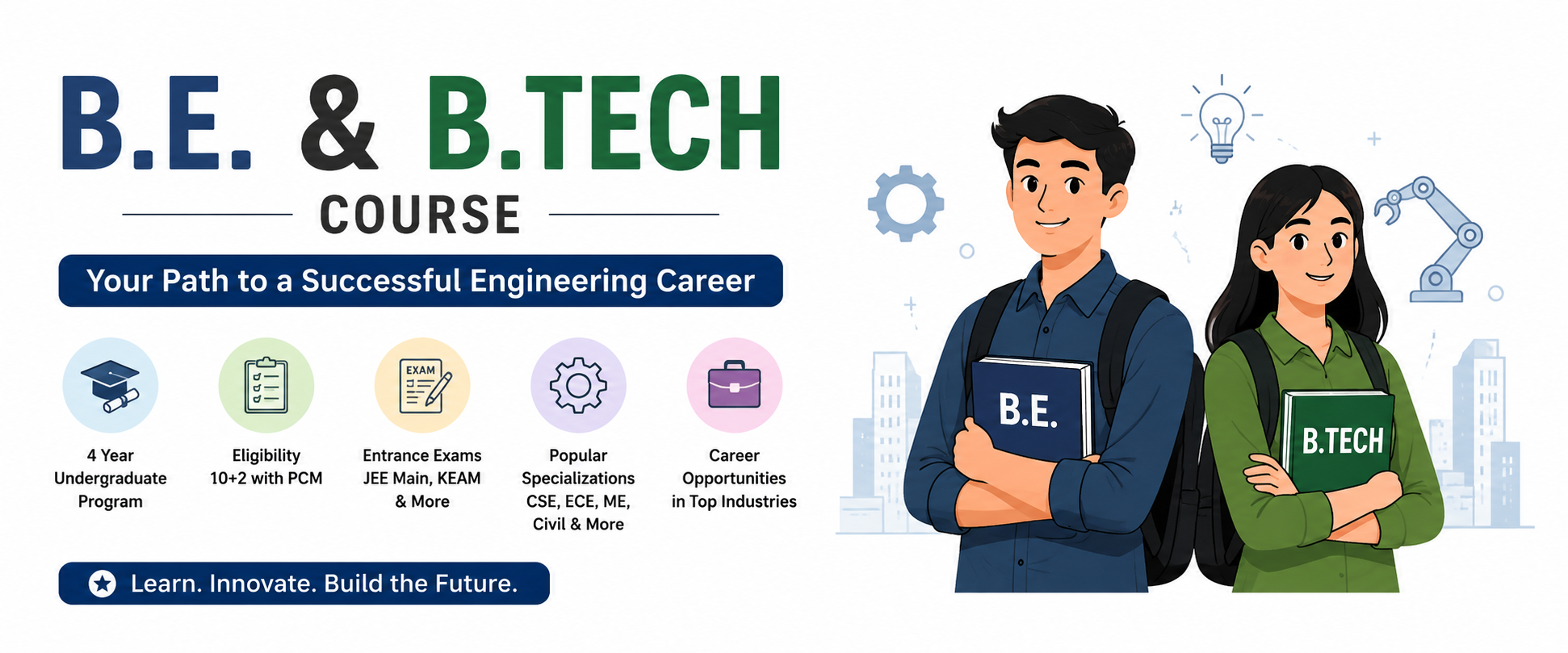
Engineering remains one of the most preferred career choices among students after completing Class 12. However, while exploring engineering admissions, students often come across two undergraduate degree titles—Bachelor of Engineering (B.E.) and Bachelor of Technology (B.Tech). Since both degrees are four-year undergraduate programs, many students wonder whether they are different and which one is better.
The truth is that both B.E. and B.Tech are recognized engineering degrees approved by the All India Council for Technical Education (AICTE) and accepted by universities, government organizations, and private employers across India. The primary distinction lies in the teaching approach rather than the value of the degree. B.E. traditionally focuses more on engineering theory and scientific fundamentals, whereas B.Tech emphasizes practical learning, technical skills, industry exposure, and project-based education.
This guide explains the complete difference between B.E. and B.Tech, including eligibility, entrance exams, curriculum, specializations, career opportunities, and admission requirements.
What is B.E. and B.Tech?
B.E. (Bachelor of Engineering) is one of the oldest engineering degree programs in India. It mainly focuses on engineering principles, mathematics, scientific concepts, analytical thinking, and theoretical knowledge. Students who are interested in research, higher education, or core engineering often prefer B.E.
B.Tech (Bachelor of Technology) is a more application-oriented engineering degree that emphasizes practical learning, laboratory work, industrial projects, internships, innovation, and technical skill development. Many IITs, NITs, and private universities offer B.Tech programs with industry-integrated curricula.
Both programs have a duration of four years, divided into eight semesters, and are considered academically equivalent.
B.E. vs B.Tech: Key Differences
Although both degrees lead to engineering careers, they differ mainly in their teaching methodology.
B.E. (Bachelor of Engineering)
- Focuses on engineering theory and core scientific concepts.
- Curriculum is more knowledge-based and analytical.
- Ideal for students interested in research, postgraduate studies, and government engineering services.
- Greater emphasis on engineering fundamentals and problem-solving.
B.Tech (Bachelor of Technology)
- Focuses on practical applications and technical implementation.
- Includes industry-oriented projects, laboratory work, internships, and skill development.
- Designed for students seeking immediate employment in technical industries.
- Encourages innovation, hands-on learning, and professional certifications.
Despite these academic differences, employers generally treat both degrees equally.
Course Highlights
Some important highlights of both programs include:
- Course Duration: 4 Years
- Course Level: Undergraduate
- Eligibility: 10+2 with Physics, Chemistry, and Mathematics (PCM)
- Minimum Marks: Usually 50% aggregate (may vary by institution)
- Approval: AICTE-recognized programs
- Higher Education: Eligible for M.Tech, M.E., MBA, MS, and other postgraduate programs
- Career Opportunities: Government, PSU, IT, Manufacturing, Infrastructure, Automobile, Electronics, Civil Engineering, Research, and more.
Eligibility Criteria
Admission requirements for B.E. and B.Tech are almost identical across most universities.
Students must satisfy the following conditions:
- Pass Class 12 (10+2) from a recognized board.
- Study Physics, Chemistry, and Mathematics as compulsory subjects.
- Secure at least 50% aggregate marks, although some universities may require higher scores.
- Qualify in the relevant entrance examination accepted by the university.
Certain institutions may also have category-wise relaxation in minimum qualifying marks.
Popular Entrance Exams
Admission into engineering colleges is primarily based on national, state, or university-level entrance examinations.
Some of the most popular engineering entrance exams include:
- JEE Main
- JEE Advanced
- KEAM
- MHT CET
- KCET
- TS EAMCET
- COMEDK UGET
- WBJEE
- CUET
- BITSAT
Many universities also conduct their own entrance examinations for admission.
Direct Admission Without Entrance Examination
Some private engineering colleges offer direct admission based on Class 12 academic performance.
Admissions are generally provided through:
- Management Quota
- Merit-Based Admission
Eligibility and seat availability vary depending on the institution and state regulations.
Subjects Covered
Although individual university curricula differ, students generally study the following subjects during the course:
- Engineering Mathematics
- Engineering Physics
- Engineering Chemistry
- Engineering Mechanics
- Fluid Mechanics
- Thermodynamics
- Computer Programming
- Electronics
- Digital Electronics
- Engineering Economics
- English Communication
- Basic Materials and Construction
- Mechanical Engineering Fundamentals
- Environmental Engineering
- Robotics
- System Design
Advanced subjects are introduced according to the chosen specialization.
Popular Engineering Specializations
Students can choose from numerous engineering branches based on their interests and career goals.
Popular specializations include:
- Computer Science Engineering
- Artificial Intelligence
- Electronics and Communication Engineering
- Electrical Engineering
- Mechanical Engineering
- Civil Engineering
- Chemical Engineering
- Biotechnology Engineering
- Robotics Engineering
- Environmental Engineering
- Petroleum Engineering
- Textile Engineering
- Biomedical Engineering
- Aeronautical Engineering
- Marine Engineering
- Production Engineering
- Mining Engineering
The specialization selected usually has a greater impact on career opportunities than whether the degree is titled B.E. or B.Tech.
Top Engineering Colleges in India
Several prestigious institutions offer B.E. and B.Tech programs.
Some of the leading engineering colleges include:
- Indian Institute of Technology (IIT) Madras
- Indian Institute of Technology (IIT) Delhi
- BITS Pilani
- Manipal Academy of Higher Education
- Lingaya's University
- Sikkim Manipal Institute of Technology
- St. Andrews Institute of Technology and Management
Many state universities and private universities also provide excellent engineering education.
Career Opportunities
Graduates from both B.E. and B.Tech programs enjoy similar career prospects.
Popular job roles include:
- Software Developer
- Computer Science Engineer
- Civil Engineer
- Mechanical Engineer
- Electrical Engineer
- Electronics Engineer
- Electronics and Communication Engineer
- Chemical Engineer
- Production Engineer
- Robotics Engineer
- Mining Engineer
- Automobile Engineer
- Lecturer or Professor (after higher studies)
- Research Engineer
Engineers are employed across sectors such as IT, manufacturing, infrastructure, construction, telecommunications, automotive, aerospace, energy, research organizations, and government departments.
Higher Education Options
After completing either B.E. or B.Tech, students can pursue:
- M.Tech
- M.E.
- MS Abroad
- MBA
- GATE Preparation
- PSU Recruitment
- Civil Services
- Technical Certifications
- Cyber Security
- Ethical Hacking
- Artificial Intelligence
- Robotics
- Nanotechnology
- Software Testing
Both degrees provide equal eligibility for postgraduate studies in India and abroad.
Which Degree Should You Choose?
The choice between B.E. and B.Tech should depend more on the university, curriculum, faculty, placement record, and specialization than on the degree title itself.
Choose B.E. if you prefer:
- Strong theoretical understanding
- Engineering fundamentals
- Research-oriented learning
- Higher education in specialized engineering fields
Choose B.Tech if you prefer:
- Practical learning
- Industry projects
- Internships
- Skill development
- Early industry exposure
In today's competitive job market, recruiters focus far more on your technical skills, internships, projects, certifications, and communication abilities than on whether your degree says B.E. or B.Tech.
Conclusion
The B.E. and B.Tech Course is primarily based on the style of education rather than recognition or career value. Both are AICTE-approved four-year undergraduate engineering degrees that offer excellent career opportunities in the public and private sectors. While B.E. traditionally emphasizes engineering theory and analytical concepts, B.Tech focuses more on practical applications, project-based learning, and industry readiness.
Ultimately, factors such as your chosen specialization, the reputation of the college, faculty quality, internship opportunities, and placement support will have a much greater influence on your career than the name of the degree itself. Students should carefully evaluate these aspects before making their final decision and choose the program that best aligns with their academic interests and long-term professional goals.