





Introduction
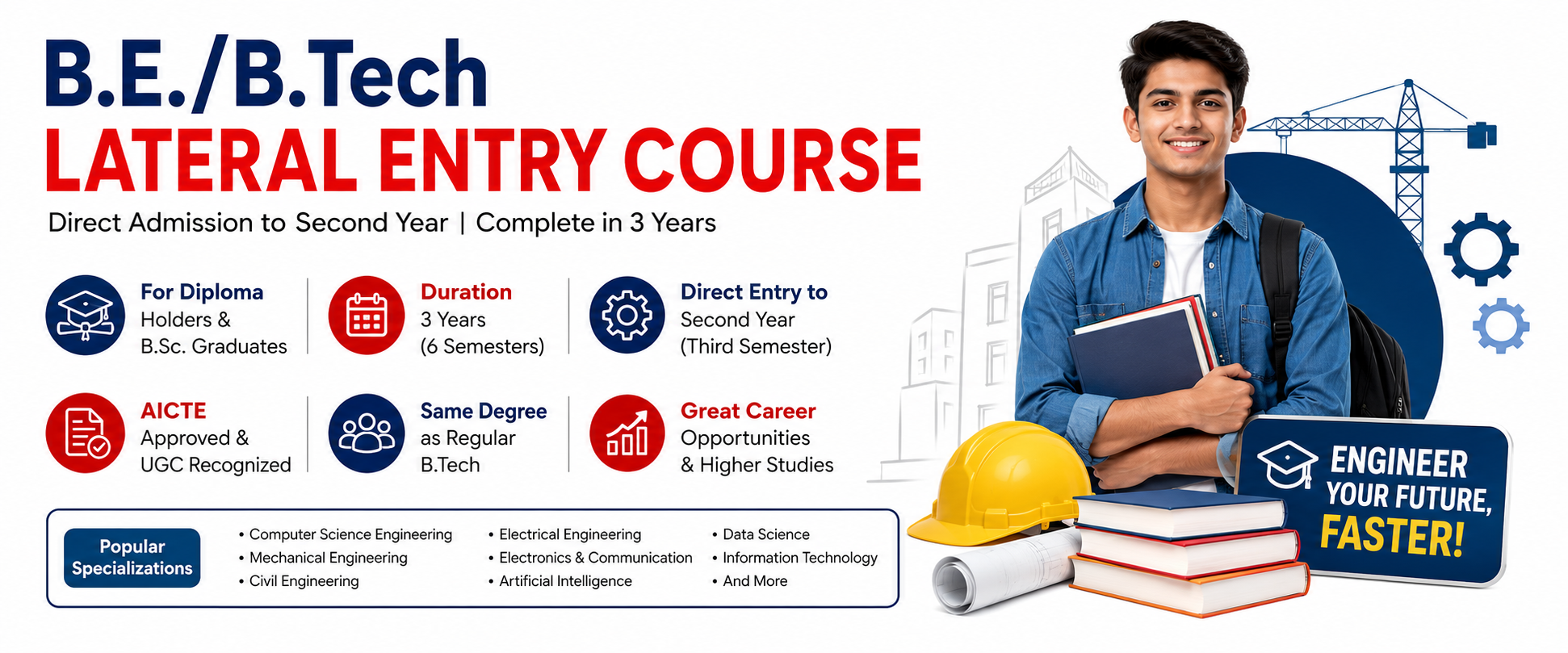
The B.E./B.Tech Lateral Entry Course is an excellent opportunity for Diploma holders and eligible B.Sc. graduates who wish to earn an engineering degree without starting from the first year. Through lateral entry admission, students are directly admitted into the second year (third semester) of a four-year B.E./B.Tech program, enabling them to complete the degree in three years instead of four.
This admission pathway is designed for students who already possess technical knowledge through a Diploma or B.Sc. program. Since they have already studied engineering fundamentals, they can skip the first-year foundation subjects and directly continue with core engineering courses. The degree obtained through lateral entry is fully recognized by AICTE and is considered equivalent to a regular B.Tech degree for employment, competitive examinations, and higher education.
What is B.E./B.Tech Lateral Entry?
B.E./B.Tech Lateral Entry is a special admission process that allows eligible students to join the second year of an engineering degree. Instead of beginning from the first semester, students enter directly into the third semester alongside regular B.Tech students.
This pathway is mainly intended for:
- Diploma holders in Engineering or Technology
- B.Sc. graduates with Mathematics
- Students possessing technical educational backgrounds
The program follows the same syllabus, examinations, and degree requirements as the regular B.Tech course.
Course Duration and Structure
The B.E./B.Tech Lateral Entry program is completed in three years, consisting of six semesters.
Students entering through lateral entry skip the first year because they have already studied equivalent technical subjects during their diploma or B.Sc. program. From the second year onwards, they attend classes with regular engineering students and study advanced engineering concepts, laboratory sessions, projects, industrial training, and internships.
Eligibility Criteria
Eligibility requirements vary slightly among universities and state admission authorities, but the general criteria include:
For Diploma Holders
- Must have completed a three-year Diploma in Engineering or Technology from a recognized institution.
- Some states also accept a two-year Diploma completed after Class 12.
- Minimum aggregate marks generally range between 45% and 50%, while some universities may require up to 60%.
For B.Sc. Graduates
- Must possess a recognized B.Sc. degree.
- Mathematics should generally be a compulsory subject either in Class 12 or during graduation.
- Most institutions require around 50% aggregate marks.
Many colleges also prefer candidates to choose a B.Tech specialization related to their Diploma branch, although certain universities permit interdisciplinary admissions.
Admission Process
Admission procedures differ depending on the university or state.
The common admission steps include:
- Verify eligibility criteria.
- Complete the online application form.
- Upload academic documents and identity proof.
- Appear for the entrance examination where applicable.
- Participate in counselling and seat allotment.
- Pay the admission fee to confirm the allotted seat.
Several private universities also provide direct admission based on Diploma or B.Sc. marks without conducting an entrance examination.
Entrance Exams for Lateral Entry
Many states conduct dedicated lateral entry entrance examinations for admission into engineering colleges. Some of the popular examinations include:
- AP ECET
- TS ECET
- WBJEE JELET
- OJEE
- Haryana LEET
- DTU LEET
- IPU CET
- HP LEET
- DTE Kerala LEET
Apart from these, numerous private universities offer merit-based admissions or conduct their own institutional entrance tests.
Documents Required
Students should keep the following documents ready during admission:
- Class 10 mark sheet and certificate
- Class 12 mark sheet and certificate
- Diploma certificate and mark sheets
- B.Sc. mark sheets (if applicable)
- Transfer Certificate
- Migration Certificate (if required)
- Character Certificate
- Aadhaar Card or other identity proof
- Passport-size photographs
- Caste Certificate (if applicable)
- Income Certificate
- Domicile Certificate
- Gap Certificate (if applicable)
- Seat allotment letter
Kerala Lateral Entry Admission
In Kerala, admissions for the B.Tech Lateral Entry Course are regulated by the LBS Centre for Science and Technology on behalf of the Directorate of Technical Education (DTE).
The engineering curriculum and examinations are conducted under APJ Abdul Kalam Technological University (KTU). Applications are submitted online through the official LBS portal, followed by rank list publication, option registration, trial allotment, and final seat allotment. Separate rank lists are prepared for Diploma/D.Voc and B.Sc./B.Voc candidates.
Popular B.E./B.Tech Lateral Entry Specializations
Students can choose from various engineering branches based on their educational background and career interests.
Popular specializations include:
- Computer Science Engineering
- Mechanical Engineering
- Civil Engineering
- Electrical Engineering
- Electronics and Communication Engineering
- Artificial Intelligence
- Machine Learning
- Data Science
- Cloud Computing
- Information Technology
These specializations provide strong career opportunities across manufacturing, construction, software development, automation, artificial intelligence, and digital technologies.
Top B.E./B.Tech Lateral Entry Colleges in India
Several reputed institutions offer lateral entry admissions, including:
- Anna University
- Jadavpur University
- Manipal Institute of Technology
- Delhi Technological University (DTU)
- Thapar Institute of Engineering and Technology
- KIIT University
- PSG College of Technology
- College of Engineering Pune (COEP)
- Pondicherry Engineering College
- Amity University
- Manav Rachna International Institute of Research and Studies
- Manav Rachna University
Students should evaluate colleges based on accreditation, faculty, infrastructure, industry exposure, internships, placement records, and specialization availability.
Career Opportunities
Graduates of the B.E./B.Tech Lateral Entry Course enjoy the same career opportunities as regular engineering graduates.
Popular career roles include:
- Software Engineer
- Computer Science Engineer
- Civil Engineer
- Mechanical Engineer
- Electrical Engineer
- Electronics Engineer
- AI Engineer
- Data Analyst
- Cloud Engineer
- Project Engineer
Fresh graduates generally receive average salary packages ranging between ₹4.5 LPA and ₹6 LPA, depending on specialization, company, location, and technical skills.
Higher Study Options
After completing the degree, students can pursue:
- M.Tech
- MBA
- PGDM
- M.Sc.
- Artificial Intelligence Certifications
- Cloud Computing Certifications
- Data Analytics Programs
- Ethical Hacking Courses
- Cyber Security Certifications
These qualifications improve technical expertise and enhance career growth in both India and abroad.
Why Choose B.E./B.Tech Lateral Entry?
The B.E./B.Tech Lateral Entry Course offers several advantages:
- Complete an engineering degree in only three years
- Save one academic year
- Lower overall tuition costs
- Continue technical education without repetition
- Same degree validity as regular B.Tech
- Better placement opportunities
- Eligibility for government jobs and higher studies
- Industry-oriented practical learning
For Diploma holders and eligible B.Sc. graduates, lateral entry provides a faster and cost-effective route to becoming a qualified engineer while opening doors to excellent employment opportunities across core engineering and emerging technology sectors.
Conclusion
The B.E./B.Tech Lateral Entry Course is an ideal pathway for Diploma holders and eligible B.Sc. graduates who want to earn an engineering degree in less time. By providing direct admission to the second year, the program helps students save one academic year while building on their existing technical knowledge. With AICTE-recognized qualifications, diverse engineering specializations, strong placement opportunities, and eligibility for higher studies and government jobs, lateral entry offers the same career value as a regular B.Tech degree. Choosing the right college and specialization can help students develop industry-ready skills and achieve long-term success in engineering and technology careers.