





Introduction
An LLM (Master of Laws) is a postgraduate degree in law designed for graduates who wish to deepen their legal knowledge, develop specialized expertise, and advance their professional careers. For legal professionals who are already employed, LLM for Working Professionals offers a flexible learning pathway that enables them to pursue higher legal education without interrupting their careers.
Unlike traditional full-time programs, this specialized postgraduate course is structured to accommodate working advocates, corporate lawyers, legal consultants, compliance officers, judicial aspirants, legal advisors, and professionals employed in law firms, multinational corporations, government organizations, and regulatory bodies.
The program combines advanced legal theory with practical applications, allowing professionals to strengthen their legal expertise while immediately applying newly acquired knowledge to real-world legal matters.
What is LLM for Working Professionals?
LLM for Working Professionals is a postgraduate legal education program specifically designed for individuals who have already completed a law degree and are actively engaged in the legal profession.
The course offers flexible study options such as:
- Executive learning
- Part-time classes
- Evening or weekend sessions
- Online learning
- Hybrid learning
- Distance education (where offered by eligible institutions)
This flexibility allows legal professionals to continue their employment while acquiring advanced knowledge in specialized areas of law.
The curriculum emphasizes legal research, analytical thinking, case law analysis, policy interpretation, corporate governance, legal drafting, compliance management, and emerging legal developments.
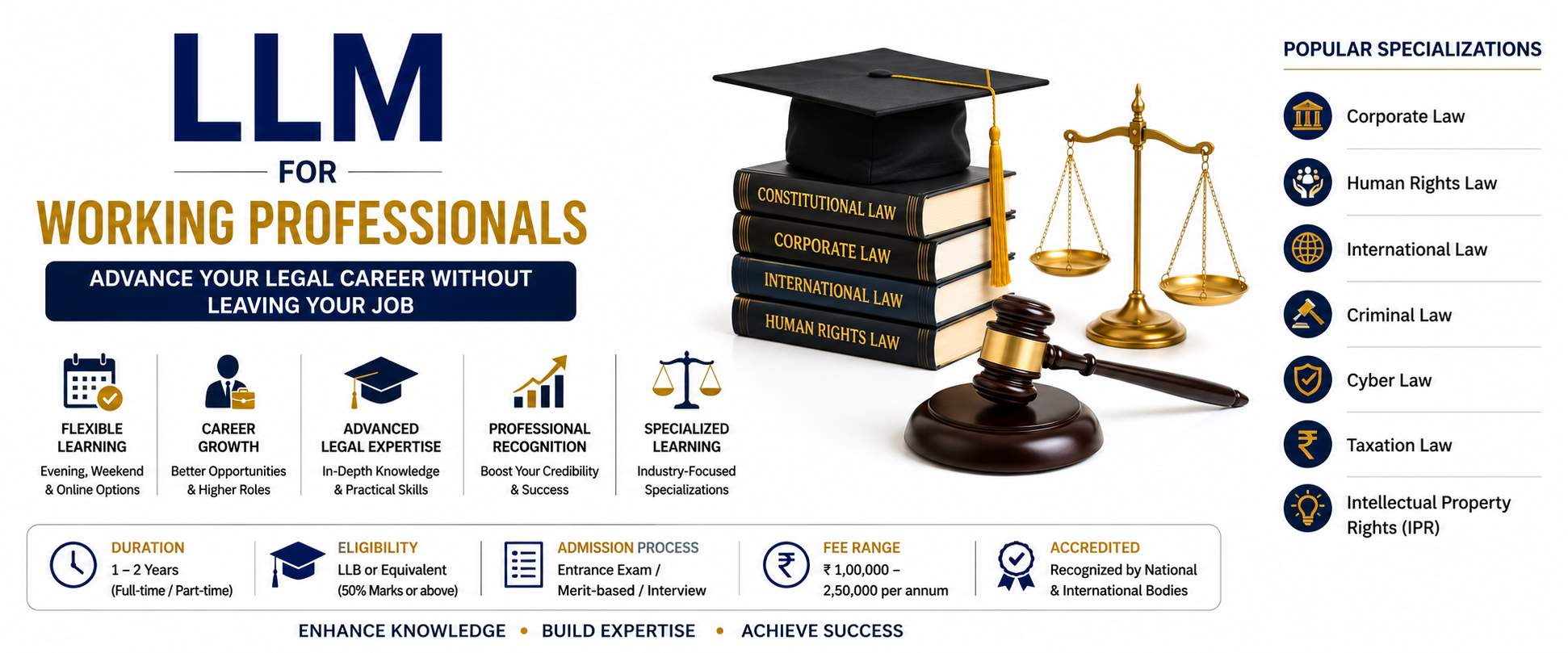
Course Overview – Master of Laws (LLM)
- Course Name: Master of Laws (LLM)
- Course Level: Postgraduate
- Course Duration: Typically 1–2 years, depending on the mode of study
- Eligibility: LLB or an equivalent law degree with the required qualifying marks
- Fee Structure: Approximately ₹1,00,000–₹2,50,000 per year (varies by institution)
- Admission Process: Entrance examination, merit-based admission, and/or personal interviews (depending on the institution)
- Practical Learning: Includes moot courts, legal research, internships, case studies, and dissertation work
- Career Opportunities: Lawyer, Advocate, Corporate Lawyer, Legal Consultant, Legal Associate, Lecturer, Compliance Officer, and Judicial Services Aspirant
Eligibility Criteria
Admission requirements may differ across universities, but the general eligibility criteria include:
- A recognized LLB degree.
- Candidates with BA LLB, BBA LLB, B.Com LLB, or other recognized integrated law degrees are also eligible.
- Equivalent recognized law qualifications may also be accepted.
- Most universities require a minimum of 50% to 60% aggregate marks in the qualifying law degree.
- Some executive or working professional programs may prefer or require relevant legal work experience.
Applicants are generally required to submit:
- Degree certificates
- Academic transcripts
- Identity proof
- Passport-size photographs
- Work experience certificates (if applicable)
- Other admission-related documents specified by the university
Candidates should always verify the admission requirements of their preferred institution.
Admission Process
The admission process varies depending on the university.
Common admission methods include:
- National or university-level entrance examinations
- Merit-based admission
- Personal interviews
- Evaluation of academic performance
- Review of professional experience (for executive programs)
Some universities consider both academic records and professional achievements while selecting candidates for working professional LLM programs.
Course Duration and Learning Flexibility
The duration of the LLM program depends on the learning mode.
Generally:
- Full-time programs: Approximately 1 year
- Part-time or Working Professional programs: Usually 2 years
- Executive or hybrid programs: Duration varies according to institutional policies
Classes are generally scheduled during evenings, weekends, or through online learning platforms, making it easier for professionals to continue working while studying.
Many institutions also provide:
- Live online lectures
- Recorded sessions
- Digital study materials
- Virtual legal discussions
- Research supervision
- Flexible assignment submission schedules
Curriculum and Subjects
The LLM curriculum is designed to provide advanced legal knowledge along with strong research and analytical skills.
Common subjects include:
- Advanced Legal Research Methodology
- Constitutional Law
- Corporate Governance
- Risk Management
- Legal Drafting
- Comparative Law
- International Legal Systems
- Jurisprudence
- Legal Ethics
- Dissertation or Research Project
The curriculum combines theoretical legal education with practical legal applications to prepare professionals for advanced legal careers.
Popular LLM Specializations
Students can choose from several specialized areas depending on their professional interests.
Corporate Law
Focuses on mergers and acquisitions, company law, securities regulation, business transactions, corporate governance, and commercial litigation.
Human Rights Law
Covers national and international legal protections related to human rights, civil liberties, equality, and social justice.
International Law
Deals with treaties, international organizations, diplomatic relations, cross-border disputes, and global legal frameworks.
Criminal Law
Provides advanced knowledge of criminal justice, criminal procedure, forensic law, criminal litigation, and victim rights.
Commercial Law
Emphasizes business contracts, trade regulations, banking law, and commercial dispute resolution.
Cyber Law
Focuses on digital privacy, cybercrime, data protection, information technology law, and internet regulations.
Taxation Law
Explores direct and indirect taxation, tax planning, GST regulations, and corporate taxation.
Intellectual Property Rights (IPR)
Covers patents, copyrights, trademarks, industrial designs, licensing, technology transfer, and innovation protection.
Benefits of Pursuing LLM While Working
An LLM for Working Professionals offers several significant career advantages.
Continue Your Career
Professionals can pursue higher education without leaving their current employment.
Advanced Legal Expertise
The program develops specialized legal knowledge in rapidly evolving areas of law.
Professional Credibility
An advanced law degree strengthens professional reputation among employers, clients, and legal institutions.
Career Advancement
Graduates become eligible for senior legal advisory positions, corporate leadership roles, compliance management, policy development, and specialized legal consulting.
Research Skills
Students develop strong legal research, critical thinking, drafting, interpretation, and analytical skills.
Global Opportunities
Specializations such as International Law, Corporate Law, and Intellectual Property Law create opportunities in multinational corporations, international organizations, and cross-border legal practice.
Career Opportunities
After completing an LLM, professionals can explore a wide range of career opportunities in both private and public sectors.
Popular career options include:
- Advocate
- Lawyer
- Corporate Lawyer
- Legal Consultant
- Legal Associate
- Compliance Officer
- Corporate Legal Advisor
- Risk Management Consultant
- Public Prosecutor
- Legal Researcher
- Lecturer or Assistant Professor
- Judicial Services Aspirant
- Intellectual Property Consultant
- Tax Consultant
- Arbitration Specialist
Graduates may also work in law firms, multinational companies, government departments, financial institutions, regulatory authorities, NGOs, international organizations, and educational institutions.
Why Choose LLM for Working Professionals?
The legal profession is becoming increasingly specialized with growing demand for experts in corporate governance, technology law, intellectual property, taxation, compliance, international business, and dispute resolution.
An LLM for Working Professionals enables legal practitioners to stay updated with evolving legal frameworks while enhancing their qualifications without sacrificing their careers. The flexible learning format makes it an ideal choice for professionals seeking continuous learning and long-term career growth.
Conclusion
LLM for Working Professionals is an excellent postgraduate program for advocates, lawyers, legal consultants, compliance officers, and corporate legal professionals seeking advanced legal education while continuing full-time employment. With flexible learning options, specialized legal disciplines, research-focused curriculum, and practical legal applications, the program equips professionals with the expertise required for leadership roles, judicial careers, academia, corporate legal practice, and international legal opportunities.