





Introduction
The Master of Arts (MA Course) is one of the most popular postgraduate programs for students interested in humanities, social sciences, languages, and fine arts. Designed to deepen subject knowledge and strengthen research, analytical, and communication skills, the MA course helps graduates build rewarding careers in education, media, government, research, public policy, corporate organizations, and non-governmental sectors.
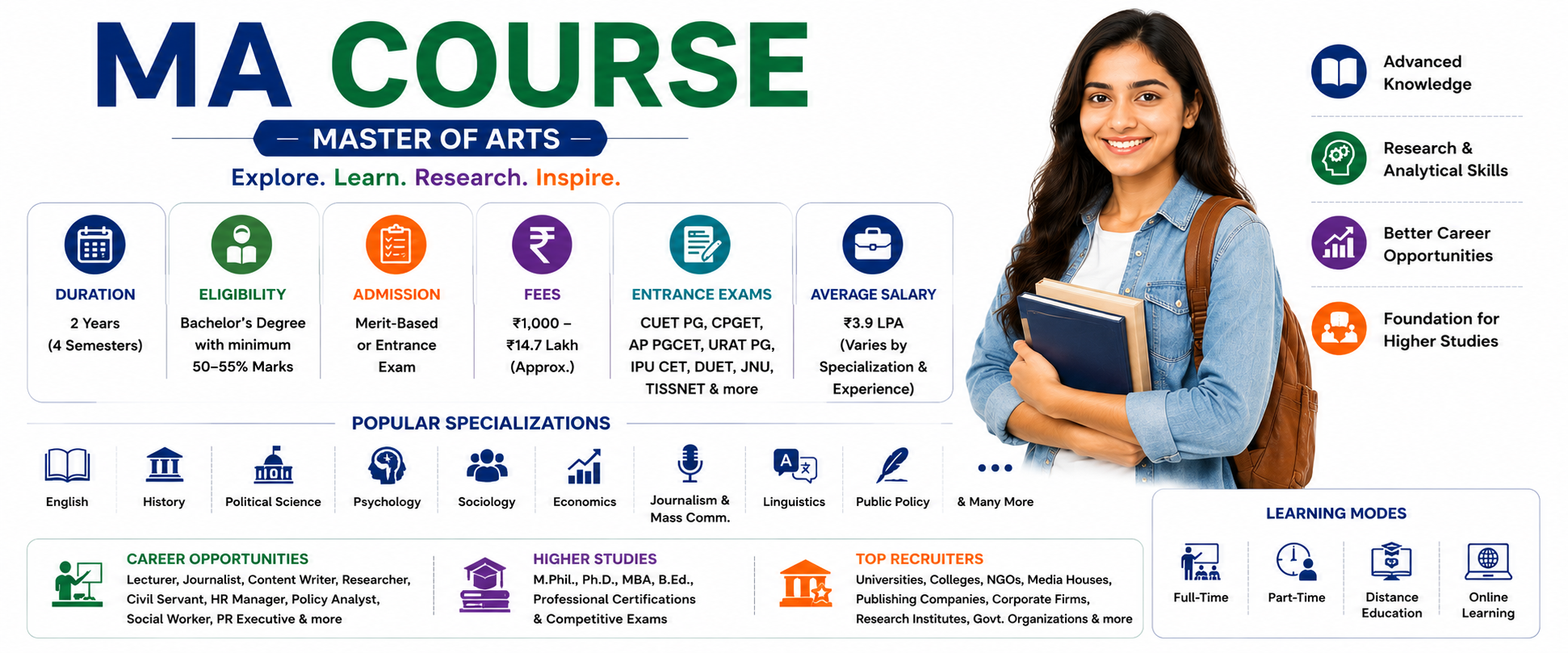
The MA course typically lasts 2 years, divided into 4 semesters, and combines classroom learning, seminars, research methodology, practical assignments, and a dissertation or thesis. Students can pursue the program in full-time, part-time, distance, or online mode, depending on the university.
An MA degree not only provides academic specialization but also serves as a stepping stone for higher education, including M.Phil., Ph.D., MBA, B.Ed., and professional certifications.
MA Course Highlights
- Course Name: Master of Arts (MA)
- Course Level: Postgraduate (PG)
- Duration: 2 Years (4 Semesters)
- Study Modes: Full-Time, Part-Time, Distance Education, and Online
- Eligibility: Bachelor's degree (BA, BSc, BCom, or equivalent) with a minimum of 50–55% aggregate marks from a recognized university.
- Admission Process: Merit-based or Entrance Exam-based, depending on the university.
- Popular Entrance Exams: CUET PG, CPGET, AP PGCET, URAT PG, IPU CET, JMI Entrance, DUET, JNU Entrance, and TISSNET.
- Average Course Fees: Approximately ₹1,000 to ₹14.7 Lakh, varying by institution and specialization.
- Popular Specializations: English, History, Political Science, Psychology, Sociology, Economics, Journalism & Mass Communication, Philosophy, and Linguistics.
- Career Opportunities: Lecturer, Journalist, Content Writer, Research Assistant, Public Relations Executive, HR Manager, Policy Analyst, Civil Servant, Translator, Historian, and Social Worker.
- Higher Education Options: M.Phil., Ph.D., MBA, B.Ed., and various professional certification programs.
- Average Salary: Around ₹3.9 LPA, with higher salary potential based on specialization, skills, experience, and employer.
Why Choose an MA Course?
An MA degree offers much more than academic knowledge. It helps students specialize in their chosen subject while preparing them for professional growth.
Major benefits include:
- Advanced subject specialization
- Strong research and analytical skills
- Better career opportunities
- Improved communication abilities
- Preparation for teaching and academic careers
- Eligibility for government examinations
- Foundation for doctoral research
Students pursuing an MA develop critical thinking and gain expertise that is valuable across multiple industries.
MA Course Duration and Learning Format
The MA course generally takes 2 years to complete and consists of 4 semesters.
Students can choose among different learning formats:
- Regular Full-Time MA
- Part-Time MA
- Distance Education MA
- Online MA
The curriculum includes:
- Core theoretical subjects
- Elective papers
- Research methodology
- Seminars
- Dissertation or thesis
- Practical assignments depending on specialization
MA Course Eligibility
Although eligibility varies among universities, the general requirements include:
- Bachelor's degree from a recognized university
- BA is commonly preferred, although many universities also accept BSc and BCom graduates
- Minimum 50%–55% aggregate marks
- Final-year undergraduate students may also apply
- No upper age limit in most institutions
Some specialized MA programs may require applicants to have studied the same subject during graduation.
MA Admission Process
Admission to MA programs is conducted through Merit-Based and Entrance-Based selection.
Merit-Based Admission
Many colleges offer direct admission based on graduation marks.
The process generally includes:
- Online registration
- Application submission
- Merit list publication
- Document verification
- Fee payment
- Admission confirmation
Entrance-Based Admission
Several universities conduct entrance examinations to assess subject knowledge.
Popular entrance exams include:
- CUET PG
- CPGET
- AP PGCET
- DUET
- JNU Entrance Examination
- TISSNET
- IPU CET
- JMI Entrance
- URAT PG
Qualified candidates participate in counselling and seat allotment before final admission.
Documents Required
Applicants generally need:
- Graduation mark sheets
- Degree certificate
- Identity proof
- Passport-size photographs
- Entrance exam scorecard (if applicable)
- Category certificate (if applicable)
Popular MA Specializations
Students can choose from a wide range of specializations according to their interests and career goals.
Popular MA specializations include:
- MA English
- MA History
- MA Political Science
- MA Economics
- MA Psychology
- MA Sociology
- MA Journalism and Mass Communication
- MA Philosophy
- MA Linguistics
- MA Public Policy
- MA Hindi
- MA Foreign Languages
Each specialization has its own curriculum and career opportunities.
MA Course Syllabus
Although the syllabus varies by specialization, the curriculum generally includes:
First Year
- Core Subject Papers
- Research Methodology
- Theoretical Concepts
- Elective Subjects
- Assignments
- Seminars
Second Year
- Advanced Subject Papers
- Research Projects
- Dissertation or Thesis
- Practical Applications
- Specialization Electives
For example, MA English students study British Literature, Literary Theory, Indian Literature, American Literature, Cultural Studies, Comparative Literature, and complete a dissertation during the final semester.
MA Course Fees
Course fees vary depending on the institution.
Approximate fee ranges are:
- Government Colleges: ₹5,000 – ₹50,000 per year
- Private Universities: ₹50,000 – ₹2,00,000 per year
- Distance Education: ₹10,000 – ₹80,000
- Overall Range: ₹1,000 – ₹14.7 Lakh
Students should verify the exact fee structure from the respective university.
Top MA Colleges in India
Some leading institutions offering MA programs include:
- Delhi University (DU)
- Jawaharlal Nehru University (JNU)
- Banaras Hindu University (BHU)
- Jamia Millia Islamia (JMI)
- Loyola College
- St. Xavier's College
- Madras Christian College
- Amity University
- Tata Institute of Social Sciences (TISS)
- IGNOU
These universities offer quality education across various MA specializations.
Career Opportunities After MA
An MA degree opens career opportunities in education, research, government, media, publishing, corporate organizations, NGOs, and international institutions.
Popular job roles include:
- Lecturer
- Assistant Professor (after qualifying UGC NET)
- Research Assistant
- Journalist
- Content Writer
- Editor
- Public Relations Executive
- Human Resource Manager
- Policy Analyst
- Social Worker
- Translator
- Interpreter
- Historian
- Civil Servant
- Market Research Analyst
- Corporate Communications Specialist
Career options vary according to the specialization chosen.
Higher Education After MA
Students interested in academic and research careers can pursue:
- M.Phil.
- Ph.D.
- MBA
- B.Ed.
- Professional Certifications
Many universities consider an MA an ideal qualification for doctoral research and higher academic positions.
Salary After MA
The average salary after completing an MA depends on specialization, employer, experience, and skills.
Approximate salary ranges include:
- Freshers: ₹3–5 LPA
- Average Salary: ₹3.9 LPA
- Experienced Professionals: ₹6–12 LPA or more
Fields such as public policy, corporate communications, psychology, economics, and research often offer higher salary packages.
Top Recruiters
MA graduates are recruited by organizations including:
- Government Schools and Colleges
- Universities
- NGOs
- Research Institutes
- Media Houses
- Publishing Companies
- Corporate Organizations
- News Agencies
- Museums
- Art Galleries
- UnAcademy
- Coaching Institutes
- National and International Organizations
Conclusion
The MA Course is an excellent postgraduate program for students seeking advanced knowledge in humanities, social sciences, languages, and related disciplines. With flexible learning options, numerous specializations, affordable fees, and strong career prospects, an MA provides opportunities in education, government services, media, research, corporate organizations, and public administration. Whether your goal is professional advancement, academic excellence, or preparation for doctoral studies, pursuing an MA can significantly enhance your career and personal development.