





Introduction
The Doctor of Medicine (MD) is one of the most respected postgraduate medical degrees offered to MBBS graduates who wish to specialize in non-surgical branches of medicine. The program provides advanced clinical knowledge, diagnostic expertise, patient management skills, and research experience. An MD degree prepares doctors to diagnose and manage complex medical conditions while contributing to medical research, teaching, and healthcare innovation.
The course emphasizes evidence-based medicine, hospital-based clinical practice, and scientific research. Graduates can work as specialist physicians, consultants, academicians, or researchers in hospitals, medical colleges, government organizations, and private healthcare institutions.
What is Doctor of Medicine (MD)?
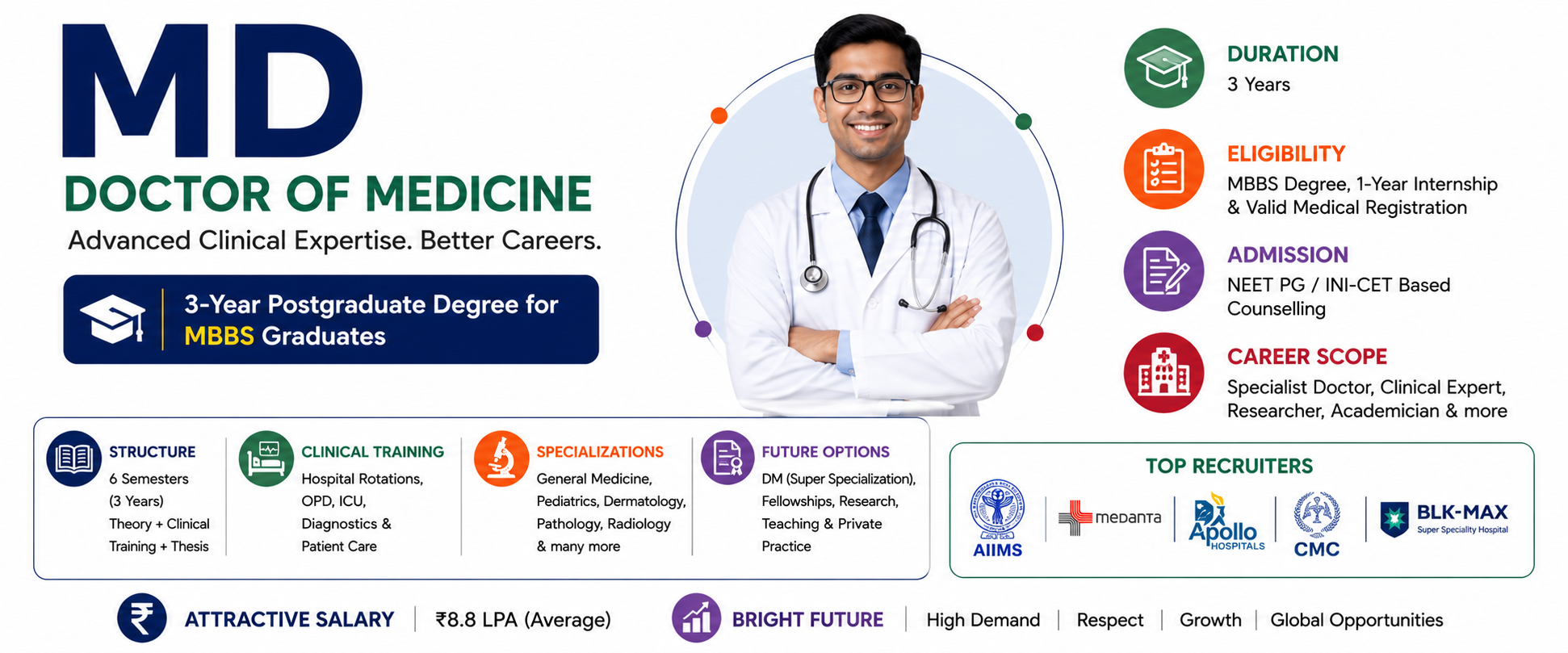
Doctor of Medicine (MD) is a three-year postgraduate degree pursued after completing an MBBS degree. It focuses on advanced medical education in various non-surgical specialties such as General Medicine, Pediatrics, Dermatology, Pathology, Radiology, Psychiatry, and many others.
Unlike MBBS, which provides general medical education, an MD allows doctors to gain specialized knowledge and clinical expertise in a specific branch of medicine. The program includes classroom learning, bedside clinical training, hospital rotations, seminars, journal presentations, research work, and thesis submission.
MD Course Highlights
Some of the major highlights of the MD program include:
- Three-year postgraduate medical degree.
- Six-semester curriculum.
- Admission primarily through entrance examinations.
- Mandatory clinical training and hospital rotations.
- Research thesis as an essential part of the course.
- Opportunity to specialize in various medical disciplines.
- Strong career prospects in hospitals, research, academics, and healthcare organizations.
Why Choose an MD Degree?
An MD degree enables doctors to become specialists in their chosen medical field. As healthcare becomes increasingly specialized, hospitals and patients prefer physicians with advanced expertise.
Benefits of pursuing an MD include:
- Higher professional recognition.
- Advanced diagnostic and clinical skills.
- Better employment opportunities.
- Eligibility for teaching positions.
- Increased earning potential.
- Opportunity for super-specialization through DM courses.
- Scope for medical research and innovation.
Eligibility Criteria
Candidates must satisfy the following eligibility requirements before applying for an MD program:
- MBBS degree from a recognized medical college approved by the National Medical Commission (NMC).
- Completion of a compulsory one-year rotatory internship.
- Valid registration with the National Medical Commission or State Medical Council.
- Minimum qualifying marks as prescribed by the admission authority.
- Qualification in the required entrance examination.
Eligibility requirements may vary slightly depending on the institution and category of admission.
Admission Process
Admission to MD programs is entirely merit-based and generally follows these steps:
Check Eligibility
Candidates should verify the eligibility criteria prescribed by the respective university or counselling authority.
Complete MBBS and Internship
Applicants must successfully complete both the MBBS degree and the mandatory internship before admission.
Entrance Examination
Students must appear for the required postgraduate medical entrance examination.
Application Process
Eligible candidates submit online applications and upload all required documents.
Result and Rank
Admission is based on entrance examination scores and overall merit ranking.
Counselling
Qualified candidates participate in centralized counselling, choose their preferred specialization and medical college, and complete seat allotment.
Document Verification
Original certificates are verified before admission is confirmed.
Fee Payment
Candidates pay the prescribed tuition fee and complete admission formalities.
MD Entrance Exams
Admission to MD courses is mainly based on national-level entrance examinations.
The most widely accepted examinations include:
- NEET PG
- INI-CET
- AIAPGET (for AYUSH postgraduate programs where applicable)
Among these, NEET PG is the primary entrance examination for most government and private medical colleges, while INI-CET is conducted for prestigious Institutes of National Importance such as AIIMS, JIPMER, PGIMER, and NIMHANS.
Course Duration and Structure
The MD program is completed over three years, divided into six semesters.
First Year
Students strengthen their understanding of applied basic sciences, research methodology, ethics, and specialty-specific theoretical knowledge.
Second Year
The focus shifts to intensive clinical training, patient care, ward postings, outpatient departments, diagnostic procedures, seminars, and case discussions.
Final Year
Students handle advanced clinical responsibilities, complete thesis work, participate in academic presentations, and prepare for final examinations.
The course concludes with university examinations, practical assessments, and thesis evaluation.
MD Specializations
Students can choose from a wide range of medical specialties based on their interests and career goals.
Popular MD specializations include:
- General Medicine
- Pediatrics
- Dermatology
- Psychiatry
- Pathology
- Radiology
- Community Medicine
- Microbiology
- Physiology
- Anatomy
- Biochemistry
- Pharmacology
- Anaesthesiology
- Pulmonary Medicine
- Emergency Medicine
- Radiotherapy
- Forensic Medicine
- Geriatrics
- Immunology
- Nuclear Medicine
- Ophthalmology
- Obstetrics and Gynecology
- Hematology
- Oncology
- Rehabilitation Medicine
Each specialization offers unique career opportunities and advanced clinical expertise.
MD Syllabus
Although the syllabus differs by specialization, the curriculum generally includes:
- Applied Medical Sciences
- Clinical Diagnosis
- Disease Management
- Research Methodology
- Medical Ethics
- Hospital-Based Clinical Practice
- Diagnostic Imaging
- Case Presentations
- Journal Clubs
- Seminars
- Thesis Preparation
- Viva Voce
Students also receive extensive hands-on training in hospital wards, outpatient departments, emergency units, and intensive care units.
Course Fees
The tuition fee for an MD program varies significantly depending on the institution and admission quota.
- Government medical colleges generally charge comparatively affordable fees.
- Private medical colleges have higher tuition fees.
- Management and NRI quota seats may involve substantially higher costs.
Students should review the fee structure of individual institutions before applying.
Career Opportunities
An MD degree opens numerous career opportunities across the healthcare sector.
Popular career options include:
- General Physician
- Consultant Specialist
- Assistant Professor
- Senior Resident
- Medical Researcher
- Clinical Specialist
- Hospital Consultant
- Public Health Specialist
- Medical Administrator
- Healthcare Consultant
Graduates can also establish private practice or join multi-specialty hospitals.
Higher Education Options
After completing an MD, doctors may pursue further specialization through:
- Doctorate of Medicine (DM)
- Fellowship Programs
- Clinical Research
- Medical Education
- Healthcare Management
- Public Health Programs
Super-specialization allows physicians to develop expertise in fields such as Cardiology, Neurology, Gastroenterology, Nephrology, Endocrinology, and Pulmonology.
Salary After MD
An MD graduate generally earns a significantly higher salary than an MBBS graduate due to specialized expertise.
Fresh specialists working in hospitals may earn attractive salaries, while experienced consultants and super-specialists receive considerably higher compensation. Income depends on specialization, hospital, location, experience, and private practice.
Top Recruiters
Leading healthcare organizations actively recruit MD graduates.
Some of the top recruiters include:
- AIIMS
- PGIMER Chandigarh
- Christian Medical College (CMC) Vellore
- Medanta The Medicity
- Apollo Hospitals
- Fortis Healthcare
- Max Healthcare
- Kokilaben Dhirubhai Ambani Hospital
- BLK-Max Super Speciality Hospital
- Government Medical Colleges
- Private Multi-specialty Hospitals
- Medical Universities and Research Institutes
Why Pursue an MD?
Choosing an MD offers several long-term professional benefits.
Key advantages include:
- Become a medical specialist.
- Gain advanced clinical expertise.
- Improve career opportunities.
- Higher earning potential.
- Opportunity for research and innovation.
- Eligibility for academic careers.
- Scope for super-specialization.
- Global recognition of specialized medical skills.
Conclusion
The Doctor of Medicine (MD) is one of the most prestigious postgraduate medical qualifications for MBBS graduates seeking specialization in clinical medicine. With rigorous academic training, extensive clinical exposure, research experience, and multiple specialization options, the MD program prepares doctors for successful careers in patient care, medical education, research, and healthcare leadership. Whether aspiring to become a consultant physician, academician, researcher, or super-specialist, pursuing an MD is a significant step toward a rewarding and impactful medical career.