





Introduction
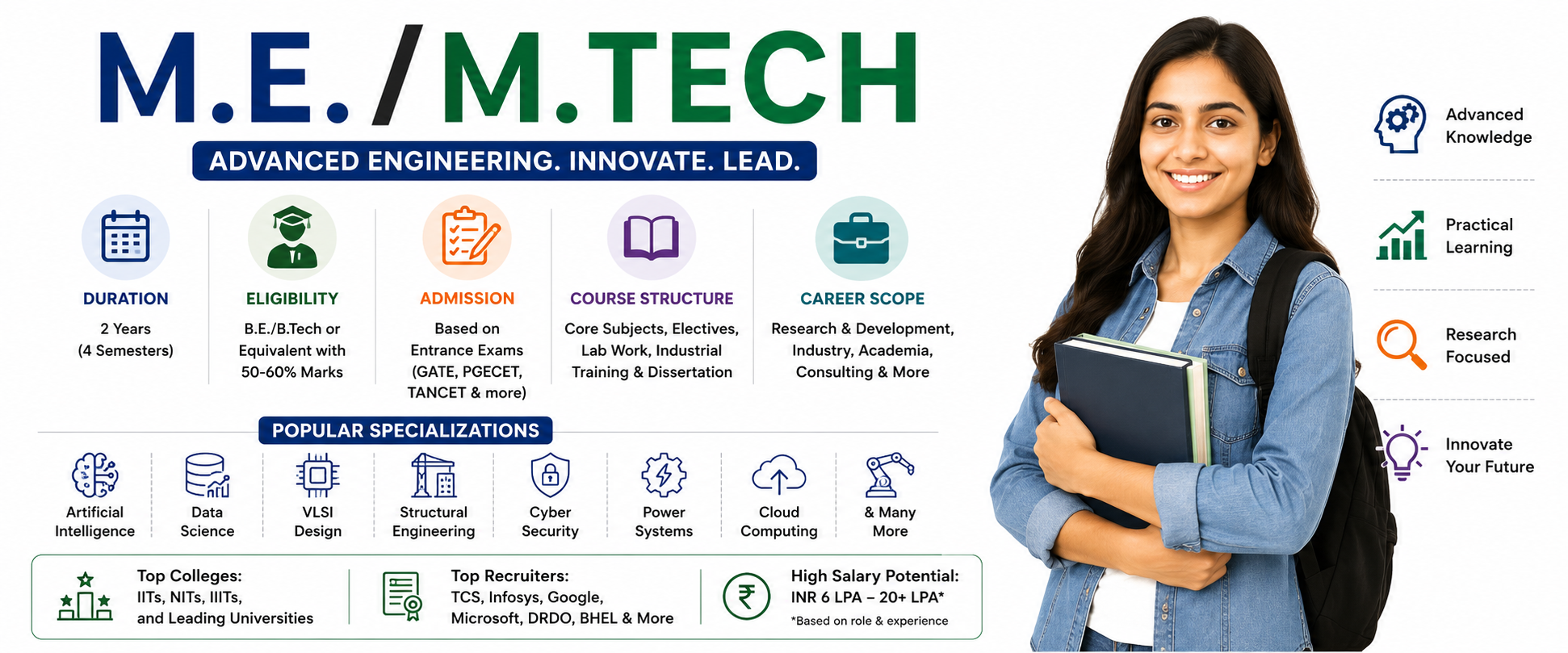
The M.E./M.Tech Course is one of the most popular postgraduate engineering programs for students who wish to gain advanced technical knowledge, specialize in a particular engineering discipline, and build successful careers in research, development, academia, and industry. These two-year postgraduate programs are designed to deepen engineering concepts while providing practical exposure through laboratory work, industrial training, seminars, and research projects.
Although Master of Engineering (M.E.) and Master of Technology (M.Tech) are often considered similar, both programs have slightly different academic approaches. M.E. generally emphasizes theoretical knowledge and engineering concepts, whereas M.Tech focuses more on technology implementation, practical applications, innovation, and industry-oriented learning. However, both qualifications are recognized by employers and higher education institutions across India.
What is an M.E./M.Tech Course?
An M.E./M.Tech Course is a postgraduate engineering degree that typically spans 2 years, divided into 4 semesters. The curriculum is designed to help students develop specialized technical expertise, analytical abilities, research skills, and practical problem-solving capabilities.
Students who complete these programs become well-equipped for advanced engineering positions, research organizations, higher education, and doctoral studies.
Duration and Course Structure
The standard duration of an M.E./M.Tech program is 2 years.
The curriculum generally includes:
- Advanced core engineering subjects
- Elective specialization subjects
- Laboratory sessions
- Industrial training
- Technical seminars
- Research methodology
- Dissertation or thesis project during the final year
The first year mainly focuses on advanced coursework and laboratory learning, while the second year is dedicated to research projects, dissertation work, seminars, and industrial exposure.
Eligibility Criteria
Admission requirements vary across institutions, but the general eligibility includes:
- B.E., B.Tech, or an equivalent engineering degree from a recognized university.
- Some universities also accept candidates with MCA or M.Sc. in relevant disciplines.
- Final-year undergraduate students may apply, provided they submit final mark sheets before admission.
- Minimum aggregate marks usually range between 50% and 60%, depending on the institution.
- Reserved category candidates generally receive a 5% relaxation according to government regulations.
- Diploma holders with relevant work experience may also be eligible for certain institutions.
Most reputed institutions also require candidates to qualify for an entrance examination.
Admission Process
Admission into an M.E./M.Tech Course can be either entrance-based or merit-based.
National-Level Entrance Exams
The most widely accepted examination is:
- GATE (Graduate Aptitude Test in Engineering)
GATE scores are accepted by:
- IITs
- NITs
- IIITs
- Government engineering colleges
- Numerous private engineering institutions
State-Level Entrance Exams
Several state universities conduct their own entrance examinations, including:
- AP PGECET
- TANCET
- State CET examinations
- PGCET
University-Level Entrance Exams
Some universities conduct independent entrance tests such as:
- VITMEE
- BITS Pilani HD
- Other institutional entrance examinations
The admission process generally involves:
- Online registration
- Entrance examination
- Merit list publication
- Counselling
- Document verification
- Fee payment
- Final admission
Popular M.E./M.Tech Specializations
Engineering students can choose from numerous specializations according to their career interests.
Some of the most popular specializations include:
- Artificial Intelligence
- Machine Learning
- Data Science
- Cybersecurity
- Cloud Computing
- Computer Science Engineering
- VLSI Design
- Embedded Systems
- Structural Engineering
- Construction Technology
- Thermal Engineering
- Power Systems
- Electrical Engineering
- Electronics Engineering
- Communication Engineering
- Instrumentation and Control Systems
- Information Technology
- Biotechnology
- Product Design and Development
- Petroleum Engineering
- Manufacturing Engineering
- Food Technology
- Aerospace Engineering
- Environmental Engineering
- Big Data and IoT
- Digital Communication and Networking
- Thermal Power Engineering
Choosing the right specialization plays a major role in determining future career opportunities.
M.E. and M.Tech: Academic Approach
While both programs are highly respected, their learning styles differ slightly.
Master of Engineering (M.E.)
- Greater emphasis on theoretical concepts
- Knowledge-oriented curriculum
- Strong analytical and conceptual learning
- Suitable for students interested in engineering design, research, and advanced theoretical understanding
Master of Technology (M.Tech)
- Focuses on practical applications
- Industry-oriented curriculum
- Emphasizes technology implementation
- Extensive laboratory work and real-world projects
- Ideal for careers in industrial research and product development
Despite these academic differences, both degrees enjoy equal recognition in the engineering industry.
Regulatory Bodies
M.E. and M.Tech programs in India are governed by:
- University Grants Commission (UGC)
- All India Council for Technical Education (AICTE)
- National Board of Accreditation (NBA)
These bodies ensure that engineering education maintains national quality standards.
Career Opportunities After M.E./M.Tech
Graduates have excellent opportunities across public and private sectors.
Popular career options include:
- Research Scientist
- Software Architect
- Structural Engineer
- Construction Manager
- Design Engineer
- Automation Manager
- Machine Design Engineer
- Production Manager
- Product Development Engineer
- Data Scientist
- AI Engineer
- Cybersecurity Specialist
- Cloud Engineer
- Electronics Engineer
- Lecturer
- Assistant Professor
- Research Associate
- Technical Consultant
Students interested in academics often continue with Ph.D. programs, while others pursue careers in research laboratories, multinational corporations, government organizations, and technology companies.
Top Recruiters
Many leading organizations recruit M.E./M.Tech graduates, including:
- TCS
- Infosys
- Accenture
- Microsoft
- GAIL
- ONGC
- BHEL
- Bajaj
- ISRO
- DRDO
- L&T
- Siemens
- Bosch
- Wipro
- Tata Technologies
These organizations offer opportunities in research, design, consulting, software development, manufacturing, and engineering management.
Salary Expectations
Salary depends on specialization, skills, institution, and experience.
Typical salary ranges include:
- Fresh graduates: ₹6–12 LPA
- Experienced professionals: ₹8–20 LPA or more
Graduates from premier institutions with expertise in emerging technologies often receive higher compensation packages.
Why Choose an M.E./M.Tech Course?
An M.E./M.Tech Course provides several advantages:
- Advanced engineering specialization
- Strong research and technical expertise
- Better career opportunities
- Higher salary potential
- Industry-focused practical learning
- Eligibility for doctoral studies
- Opportunities in teaching and academia
- Improved leadership and project management skills
- Access to cutting-edge technologies
- Global career opportunities
Conclusion
The M.E./M.Tech Course is an excellent postgraduate option for engineering graduates who wish to enhance their technical expertise and specialize in emerging technologies. Whether pursuing Master of Engineering (M.E.) or Master of Technology (M.Tech.), students gain valuable knowledge through advanced coursework, practical training, industrial exposure, and research projects. With diverse specializations, recognized qualifications, strong career prospects, competitive salaries, and opportunities in research, higher education, and industry, an M.E./M.Tech degree serves as a solid foundation for long-term professional growth in the engineering and technology sectors.