





Introduction
M.Phil (Master of Philosophy) and Ph.D (Doctor of Philosophy) in Arts are prestigious research-oriented academic programs that prepare scholars for careers in teaching, research, policymaking, publishing, and intellectual leadership. These programs emphasize critical thinking, advanced research methodologies, academic writing, and original contributions to knowledge across humanities and social science disciplines.
For students passionate about exploring literature, history, philosophy, sociology, economics, psychology, political science, and other humanities subjects, these advanced degrees provide an excellent platform to build expertise and contribute meaningful research to society. With increasing emphasis on interdisciplinary studies, innovation, and evidence-based policymaking, research qualifications in Arts have become more valuable than ever.
What is M.Phil in Arts?
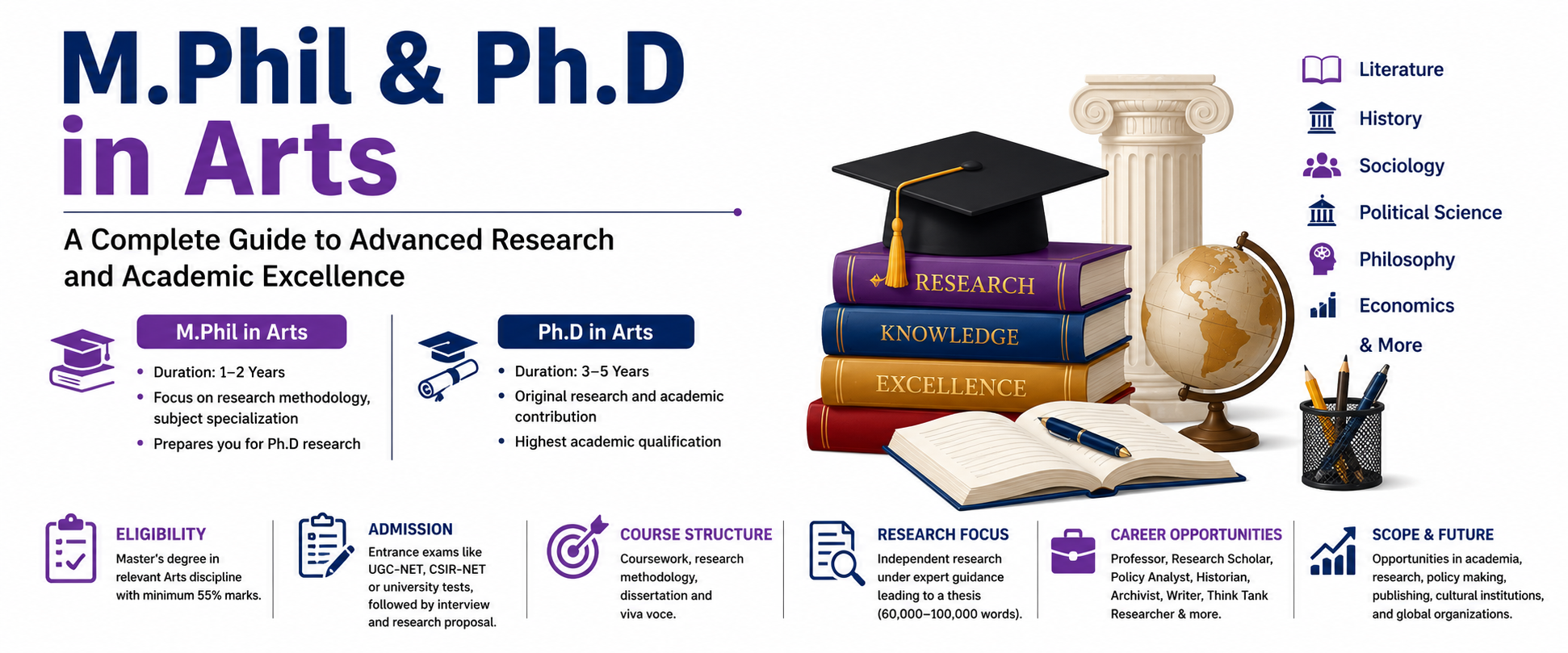
The Master of Philosophy (M.Phil) in Arts is an advanced postgraduate research degree that traditionally served as a bridge between a Master's degree and a Ph.D. The program focused on strengthening research skills, subject specialization, academic writing, and theoretical knowledge through coursework and dissertation work.
Typically, the program lasted 1–2 years, including one year of research methodology and advanced coursework followed by dissertation writing under the guidance of a faculty supervisor.
However, under the National Education Policy (NEP) and the University Grants Commission (UGC) guidelines in India, standalone M.Phil programs have been discontinued, with greater emphasis now placed on direct admission into Ph.D. programs after a qualifying Master's degree.
Key Highlights
- Duration of 1–2 years (historically)
- Focus on research methodology and academic writing
- Advanced subject specialization
- Dissertation-based research
- Previously served as preparation for doctoral research
What is Ph.D in Arts?
A Doctor of Philosophy (Ph.D.) in Arts is the highest academic qualification awarded in humanities and social sciences. The program is designed for scholars who wish to conduct original research that contributes new knowledge to their chosen field.
Unlike taught postgraduate degrees, a Ph.D. focuses primarily on independent research under the supervision of experienced faculty members. Scholars investigate research problems, review existing literature, collect and analyze data, and prepare a comprehensive doctoral thesis demonstrating originality, innovation, and academic excellence.
The duration generally ranges from 3 to 5 years, although some universities may allow up to six years depending on research progress and institutional regulations.
Key Highlights
- Highest academic qualification in Arts
- Duration of 3–5 years (may vary by institution)
- Focus on original and independent research
- Comprehensive thesis and viva voce examination
- Suitable for careers in academia, research, and policy development
Eligibility Criteria
Admission to M.Phil and Ph.D. in Arts generally requires candidates to possess strong academic backgrounds along with research aptitude.
The common eligibility requirements include:
- A Master's degree in a relevant Arts, Humanities, or Social Science discipline from a recognized university.
- Minimum 55% aggregate marks or equivalent grade (relaxation may apply for reserved categories as per university norms).
- Qualification in national entrance examinations such as UGC-NET, CSIR-NET (where applicable), or university-specific entrance tests.
- Personal interview and presentation of a research proposal.
Candidates who qualify national-level eligibility examinations like UGC-NET are often exempted from university entrance examinations, depending on institutional policies.
Admission Process
Admission to Ph.D. programs generally involves multiple stages to assess a candidate's academic preparedness and research potential.
The admission process usually includes:
- Submission of an online application.
- Verification of academic qualifications.
- Entrance examination (if applicable).
- Evaluation of research proposal.
- Personal interview or viva.
- Final selection based on academic merit and research aptitude.
Admission criteria may differ across universities and research institutions.
Popular Specializations
Students can pursue advanced research across numerous disciplines within Arts and Humanities.
Some of the most popular specializations include:
- English Literature
- Foreign Languages
- History
- Sociology
- Political Science
- Economics
- Psychology
- Philosophy
- Public Administration
- Cultural Studies
- Linguistics
- Fine Arts
- Visual Studies
- Cinema Studies
These disciplines enable scholars to examine social, historical, political, cultural, linguistic, and philosophical issues from both theoretical and practical perspectives.
Course Structure
Although course structures vary among universities, research programs generally follow a similar framework.
Coursework
The initial stage includes coursework covering:
- Research Methodology
- Literature Review
- Research Ethics
- Subject-specific Advanced Theories
- Academic Writing Techniques
The coursework equips scholars with the knowledge and skills required for high-quality academic research.
Research and Dissertation
Following coursework, candidates undertake independent research under the supervision of an experienced research guide. They identify a research problem, conduct extensive literature reviews, collect and analyze data, and prepare a dissertation or doctoral thesis.
A Ph.D. thesis typically ranges between 60,000 and 100,000 words, depending on university guidelines and research discipline.
Viva Voce
The final stage involves a Viva Voce (oral defense) before an expert panel, where scholars defend their research findings, methodology, and conclusions before the degree is awarded.
Career Opportunities After M.Phil & Ph.D in Arts
Graduates possessing advanced research qualifications have access to diverse career opportunities across academic, public, private, and international sectors.
Popular career options include:
- University Professor
- Assistant Professor
- Lecturer
- Research Scholar
- Policy Analyst
- Government Advisor
- Historian
- Archivist
- Museum Curator
- Academic Writer
- Editor
- Social Scientist
- Think Tank Researcher
- Educational Consultant
- Publishing Professional
Employment opportunities are available in universities, colleges, government departments, research organizations, museums, libraries, NGOs, international organizations, publishing houses, and policy research institutes.
Scope and Future Prospects
The future for Arts researchers continues to expand with increasing demand for interdisciplinary research and evidence-based policymaking. Areas such as digital humanities, cultural studies, public policy, social development, and educational research are creating new opportunities for highly qualified scholars.
Graduates also contribute significantly to curriculum development, academic administration, corporate research, content strategy, social impact projects, and international collaborations.
As governments, educational institutions, and organizations increasingly rely on research to shape decisions, Arts scholars play an important role in preserving cultural heritage, understanding society, influencing public policy, and advancing knowledge.
Why Choose M.Phil & Ph.D in Arts?
Choosing an advanced research degree in Arts offers both intellectual and professional rewards.
Some of the key advantages include:
- Opportunity to conduct original and meaningful research
- Strong academic and research credentials
- Career opportunities in higher education and research
- Global recognition of research qualifications
- Contribution to policymaking and social development
- Expertise in critical thinking, analysis, and communication
- Freedom to specialize in areas of personal academic interest
- Opportunities for interdisciplinary and international research collaborations
Conclusion
M.Phil and Ph.D. in Arts represent the highest levels of academic learning and research in the humanities and social sciences. While standalone M.Phil programs have largely been discontinued in India under UGC regulations, the Ph.D. remains the premier pathway for students aspiring to become researchers, academicians, policymakers, and subject experts.
These programs cultivate advanced research skills, intellectual curiosity, and scholarly excellence while preparing graduates to address complex social, cultural, historical, and political challenges. Whether your goal is teaching at a university, conducting impactful research, influencing public policy, or contributing to global knowledge, pursuing a Ph.D. in Arts offers a rewarding and respected academic journey with long-term career prospects.