





Introduction
Engineering is one of the fastest-evolving fields, driving technological progress, industrial development, and scientific innovation. For engineers who wish to move beyond conventional professional roles and contribute to cutting-edge research, M.Phil (Master of Philosophy) and Ph.D. (Doctor of Philosophy) in Engineering offer an ideal academic pathway. These advanced research programs prepare scholars to solve real-world engineering challenges through innovation, experimentation, and interdisciplinary research.
Whether your goal is to become a university professor, research scientist, R&D specialist, or technology innovator, pursuing an M.Phil or Ph.D. in Engineering provides the knowledge, skills, and research experience required to excel in academia, government organizations, and leading industries worldwide.
What is M.Phil in Engineering?
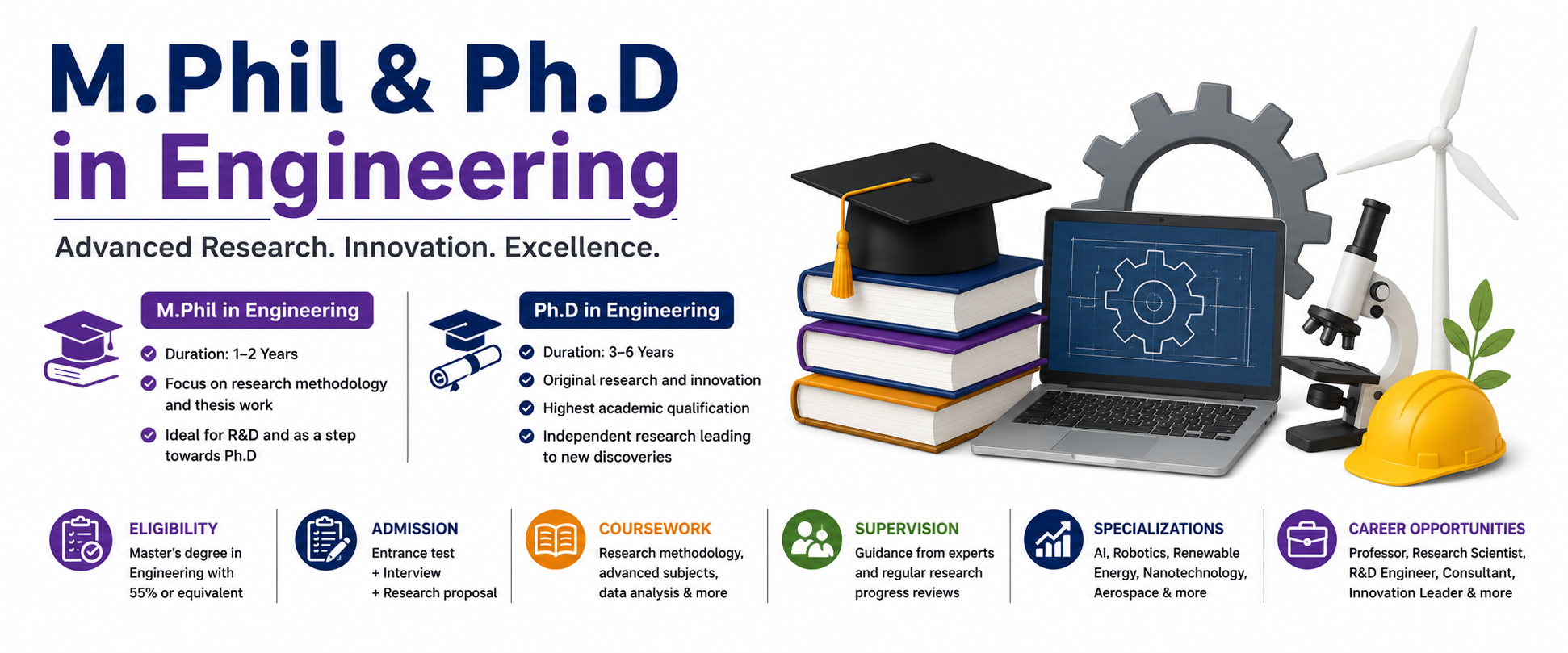
The Master of Philosophy (M.Phil) in Engineering is a postgraduate research degree that traditionally served as an intermediate qualification between a master's degree and a Ph.D. It focuses on developing research methodology, analytical thinking, technical expertise, and problem-solving skills through supervised research and dissertation work.
The program is particularly suitable for students who wish to strengthen their research foundation before pursuing doctoral studies or entering research-oriented industrial roles.
Key Features of M.Phil in Engineering
- Duration of 1–2 years
- Focus on research methodology and technical analysis
- Dissertation-based research under faculty supervision
- Advanced study in specialized engineering fields
- Suitable for industrial research and development (R&D)
- Acts as a strong foundation for Ph.D. studies
What is Ph.D. in Engineering?
A Doctor of Philosophy (Ph.D.) in Engineering is the highest academic qualification in engineering and technology. The program focuses on conducting original research that contributes new knowledge, innovative technologies, or engineering solutions to a specific field.
Ph.D. candidates work independently under experienced supervisors while addressing complex engineering challenges through scientific methods, experimentation, simulations, and analytical models. The research often leads to publications, patents, and technological advancements with real-world applications.
Key Features of Ph.D. in Engineering
- Duration of 3–6 years, depending on research progress and institution
- Independent and original research
- Advanced coursework and comprehensive examinations
- Doctoral dissertation and thesis defense
- Opportunities for publications, patents, and global research collaborations
- Preparation for leadership roles in academia, research, and industry
Eligibility Criteria
Admission to M.Phil and Ph.D. programs in Engineering requires a strong academic background along with research aptitude.
Typical eligibility requirements include:
- Master's degree (M.E., M.Tech., or equivalent) in Engineering, Technology, or a relevant science discipline from a recognized university.
- Minimum 55% aggregate marks (some universities may require 60% or an equivalent CGPA).
- Qualification in entrance examinations such as GATE, UGC-NET (where applicable), or institute-specific entrance tests.
- Successful performance in a personal interview and research proposal presentation.
Some universities also offer direct admission to Ph.D. programs for candidates with exceptional academic records or outstanding research achievements.
Admission Process
The admission process generally involves several stages designed to evaluate academic excellence and research potential.
The common admission procedure includes:
- Submission of an online application
- Entrance examination or screening test
- Submission and evaluation of a research proposal
- Personal interview before the selection committee
- Final admission based on academic performance, entrance scores, and interview results
Admission requirements may vary depending on the university, specialization, and research area.
Program Structure
Engineering research programs combine theoretical learning with extensive practical research to develop highly skilled researchers.
Duration
- M.Phil: Generally completed in 1–2 years
- Ph.D.: Typically completed in 3–4 years, though many institutions allow up to 6 years depending on research progress
Many universities also offer flexible part-time Ph.D. programs for working professionals.
Coursework
The initial phase usually includes advanced coursework covering:
- Research Methodology
- Data Analysis and Statistical Techniques
- Advanced Engineering Concepts
- Domain-Specific Electives
- Research Ethics and Technical Writing
This coursework provides scholars with the necessary theoretical and research foundation before commencing independent research.
Research Supervision
Each scholar is assigned a faculty supervisor or research advisory panel. Regular meetings with supervisors help students monitor research progress, discuss technical challenges, and refine research objectives throughout the program.
Thesis and Viva Voce
The final stage involves preparing a comprehensive research thesis based on original findings. Candidates must defend their research through a Viva Voce (oral examination) conducted before internal and external experts, demonstrating the significance, methodology, and outcomes of their work.
Popular Engineering Specializations
Engineering research offers numerous specialized fields aligned with emerging technologies and industry demands.
Popular research areas include:
- Computer Science & Engineering
- Mechanical Engineering
- Electrical & Electronics Engineering
- Civil Engineering
- Electronics & Communication Engineering
- Artificial Intelligence & Machine Learning
- Data Science & Big Data Analytics
- Robotics & Artificial Intelligence
- Sustainable Energy & Biofuels
- Renewable Energy Engineering
- Advanced Materials & Nanotechnology
- Aerospace & Mechanical Systems
- Chemical Engineering
These specializations enable researchers to contribute to technological advancements across industries such as manufacturing, healthcare, transportation, automation, infrastructure, and environmental sustainability.
Career Opportunities After M.Phil & Ph.D. in Engineering
Graduates with advanced research qualifications enjoy excellent career opportunities across academia, government, research institutions, and multinational industries.
Popular career options include:
- Professor
- Assistant Professor
- Research Scientist
- Research Engineer
- Research and Development (R&D) Specialist
- Product Development Engineer
- Data Scientist
- Artificial Intelligence Researcher
- Technical Consultant
- Government Research Officer
- Innovation and Technology Advisor
- Policy Advisor
- Engineering Consultant
Employment opportunities exist in universities, research laboratories, government organizations, public sector enterprises, multinational corporations, technology startups, and international research institutions.
Why Choose M.Phil & Ph.D. in Engineering?
Pursuing an advanced research degree in Engineering offers numerous academic and professional benefits.
Some of the major advantages include:
- Advanced technical expertise and research skills
- Opportunities to develop innovative engineering solutions
- Global research collaborations and international exposure
- Publications in reputed journals and conferences
- Opportunities to obtain patents and intellectual property
- Strong demand in academia and industrial R&D
- Leadership roles in technology-driven organizations
- Long-term career growth and professional recognition
Scope and Future Prospects
The future of engineering research is expanding rapidly due to advancements in artificial intelligence, robotics, automation, renewable energy, smart manufacturing, advanced materials, and digital transformation.
Organizations worldwide are investing heavily in research and innovation, creating increasing demand for highly qualified engineering researchers capable of solving complex technological problems.
Engineering scholars also contribute significantly to funded research projects, industrial innovation, public infrastructure, sustainable development, healthcare technologies, aerospace, defense, and smart city initiatives. The combination of academic excellence and industry collaboration makes doctoral engineering graduates highly valuable in both national and international job markets.
Conclusion
M.Phil and Ph.D. in Engineering are prestigious research programs that equip scholars with advanced technical knowledge, research expertise, and innovation skills required to address modern engineering challenges. While the M.Phil provides a strong research foundation, the Ph.D. represents the highest level of academic achievement through original contributions to engineering and technology.
With opportunities spanning higher education, research laboratories, multinational corporations, government organizations, and high-tech industries, these programs offer excellent career prospects for individuals passionate about scientific discovery and technological advancement. Pursuing an advanced research degree in Engineering is an investment in a future of innovation, leadership, and global impact.