





Introduction
The Master of Science (M.Sc.) is one of the most popular postgraduate degree programs for students who wish to gain advanced knowledge and specialized skills in science, technology, and research-oriented disciplines. Designed for graduates with a science or related academic background, the M.Sc. course combines theoretical learning, laboratory training, research methodology, and dissertation work to prepare students for professional careers as well as higher education.
An M.Sc. degree is suitable for students aspiring to work in research organizations, pharmaceutical companies, biotechnology firms, information technology, healthcare, environmental science, academics, and government sectors. It also serves as an excellent foundation for pursuing doctoral studies and advanced research.
What is an M.Sc. Course?
The full form of M.Sc. is Master of Science. It is a postgraduate degree awarded after completing a bachelor's degree, usually a B.Sc. or another relevant undergraduate qualification.
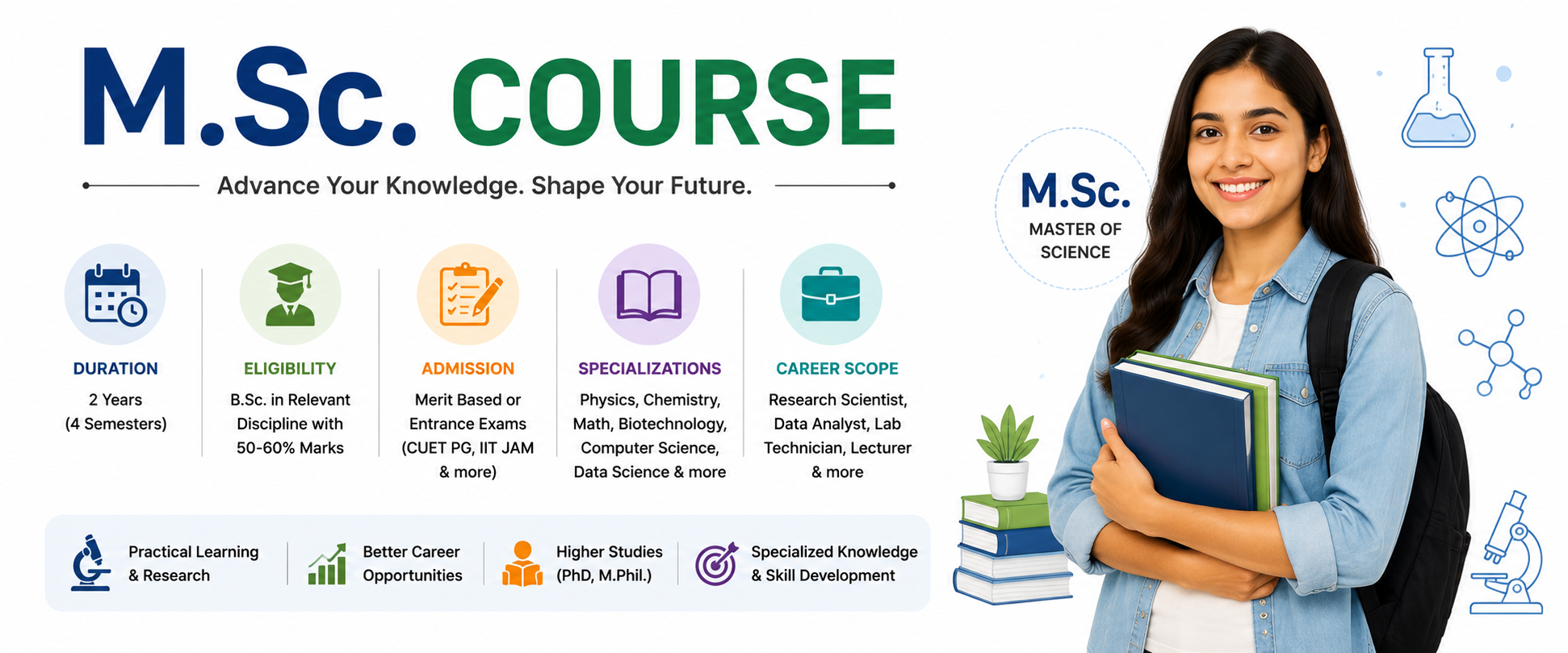
The program generally spans two years and is divided into four semesters. During the course, students develop advanced subject knowledge, analytical thinking, laboratory skills, research capabilities, and problem-solving abilities. Most universities also require students to complete a research project or dissertation in the final semester.
M.Sc. Course Highlights
Some important highlights of the M.Sc. course include:
- Course Level: Postgraduate
- Course Duration: 2 Years (4 Semesters)
- Mode of Study: Regular, Distance, Online, and Correspondence (depending on the institution)
- Eligibility: Bachelor's degree (B.Sc., B.Tech., or equivalent) in a relevant discipline
- Admission Process: Merit-based or Entrance Examination
- Average Course Fees: ₹10,000 to ₹60 lakh (varies by institution and specialization)
- Average Salary: ₹4 LPA to ₹30 LPA (depending on specialization, experience, and employer)
Why Choose an M.Sc. Course?
An M.Sc. program offers several advantages for students who want to build expertise in scientific and technical fields.
Some key benefits include:
- Advanced subject specialization
- Strong research and analytical skills
- Practical laboratory experience
- Better career opportunities
- Higher salary potential
- Eligibility for PhD and research programs
- Opportunities in academia, government organizations, healthcare, and industry
The course is ideal for students interested in innovation, scientific discovery, technology, and higher education.
Eligibility Criteria
Students applying for an M.Sc. course should generally fulfill the following eligibility requirements:
- Hold a Bachelor's degree such as B.Sc., B.Tech., or an equivalent qualification from a recognized university.
- Have studied a relevant subject during undergraduate education.
- Secure a minimum of 50% to 60% aggregate marks, depending on the institution.
- Reserved category candidates may receive a 5% relaxation in qualifying marks according to institutional norms.
- There is generally no upper age limit for admission.
Some specializations may require candidates to have studied specific subjects at the undergraduate level. For example:
- M.Sc. Computer Science generally requires a background in Computer Science or Mathematics.
- M.Sc. Biotechnology usually requires Biology or Life Sciences.
- M.Sc. Physics requires Physics as a core subject in graduation.
Admission Process
The admission process varies across universities.
Merit-Based Admission
Many universities admit students based on undergraduate academic performance. Merit lists are prepared using graduation marks.
Entrance-Based Admission
Several universities conduct entrance examinations to evaluate candidates' subject knowledge and analytical ability.
The general admission process includes:
- Online registration on the university portal.
- Submission of the application form.
- Entrance examination (where applicable).
- Publication of merit lists.
- Counselling and document verification.
- Fee payment and admission confirmation.
Students should regularly check university admission schedules to avoid missing important deadlines.
Popular Entrance Exams
Admission to M.Sc. programs is offered through national, state, and university-level entrance examinations.
Popular entrance exams include:
- CUET PG
- IIT JAM
- ICAR AIEEA
- CPGET
- MCAER CET
- AP PGCET
- MAH CET
- NEST
- University-specific entrance examinations
Many government and private universities accept these examination scores for admission.
Course Structure
The M.Sc. curriculum is designed to provide both theoretical understanding and practical expertise.
The course generally includes:
- Core subjects
- Elective subjects
- Laboratory sessions
- Practical experiments
- Research methodology
- Case studies
- Seminar presentations
- Dissertation or thesis project
The research dissertation completed in the final semester helps students develop scientific research and data analysis skills.
Popular M.Sc. Specializations
Students can choose from a wide variety of science and technology disciplines based on their interests and career goals.
Popular specializations include:
Pure Sciences
- Physics
- Chemistry
- Mathematics
- Botany
- Zoology
Applied Sciences
- Biotechnology
- Computer Science
- Microbiology
- Environmental Science
- Statistics
- Medical Sciences
Emerging and Multidisciplinary Fields
- Data Science
- Artificial Intelligence
- Cognitive Science
- Forensic Science
Selecting the right specialization plays a significant role in determining future career opportunities.
M.Sc. Syllabus Overview
Although the syllabus differs according to specialization, most programs include:
- Advanced theoretical concepts
- Laboratory practicals
- Research assignments
- Data analysis
- Scientific methodology
- Project work
- Dissertation
For example:
M.Sc. Computer Science commonly includes:
- Advanced Programming
- Machine Learning
- Artificial Intelligence
- Data Analytics
- Database Systems
M.Sc. Physics commonly includes:
- Quantum Mechanics
- Nuclear Physics
- Solid State Physics
- Advanced Electromagnetism
The curriculum is designed to strengthen scientific reasoning and technical expertise.
Top Colleges Offering M.Sc.
Several prestigious institutions in India offer high-quality M.Sc. programs.
Some of the leading colleges include:
- Banaras Hindu University (BHU)
- Delhi University (DU)
- Hindu College
- Jawaharlal Nehru University (JNU)
- Jamia Millia Islamia
Many IITs, NITs, state universities, and autonomous colleges also offer excellent postgraduate science education.
Career Opportunities After M.Sc.
Graduates can explore diverse career opportunities across government, private, healthcare, research, and technology sectors.
Popular job roles include:
- Research Scientist
- Data Analyst
- Software Engineer
- Programmer
- Clinical Research Associate
- Agriculture Officer
- Food Analyst
- Laboratory Manager
- Environmental Consultant
- App Developer
- Lecturer or Assistant Professor (after fulfilling eligibility requirements)
Career opportunities vary according to the chosen specialization.
Top Recruiters
Many leading organizations recruit M.Sc. graduates.
Some major recruiters include:
- Cipla
- Glenmark Pharmaceuticals
- Infosys
- Tata Consultancy Services (TCS)
- BHEL
- ITC
- GAIL India
Research institutes, pharmaceutical companies, biotechnology firms, IT companies, hospitals, and government laboratories also hire M.Sc. graduates.
Higher Education Options
Students who wish to continue their academic journey can pursue:
- PhD
- M.Phil. (where applicable)
- Research Fellowships
- Postdoctoral Research
- Professional Certifications
- Specialized Technical Courses
An M.Sc. degree provides an excellent foundation for careers in university teaching and advanced scientific research.
Conclusion
The M.Sc. course is an excellent postgraduate program for students who want to specialize in science, technology, research, and innovation. With advanced coursework, laboratory training, research methodology, and dissertation work, the program equips graduates with the knowledge and practical skills required for both academic and professional success. Whether your goal is to work in research laboratories, pharmaceutical companies, information technology, environmental sciences, healthcare, or higher education, an M.Sc. degree offers diverse career opportunities and long-term growth. Choosing the right specialization based on your interests and career aspirations can help you build a rewarding future in science and technology.