





Introduction
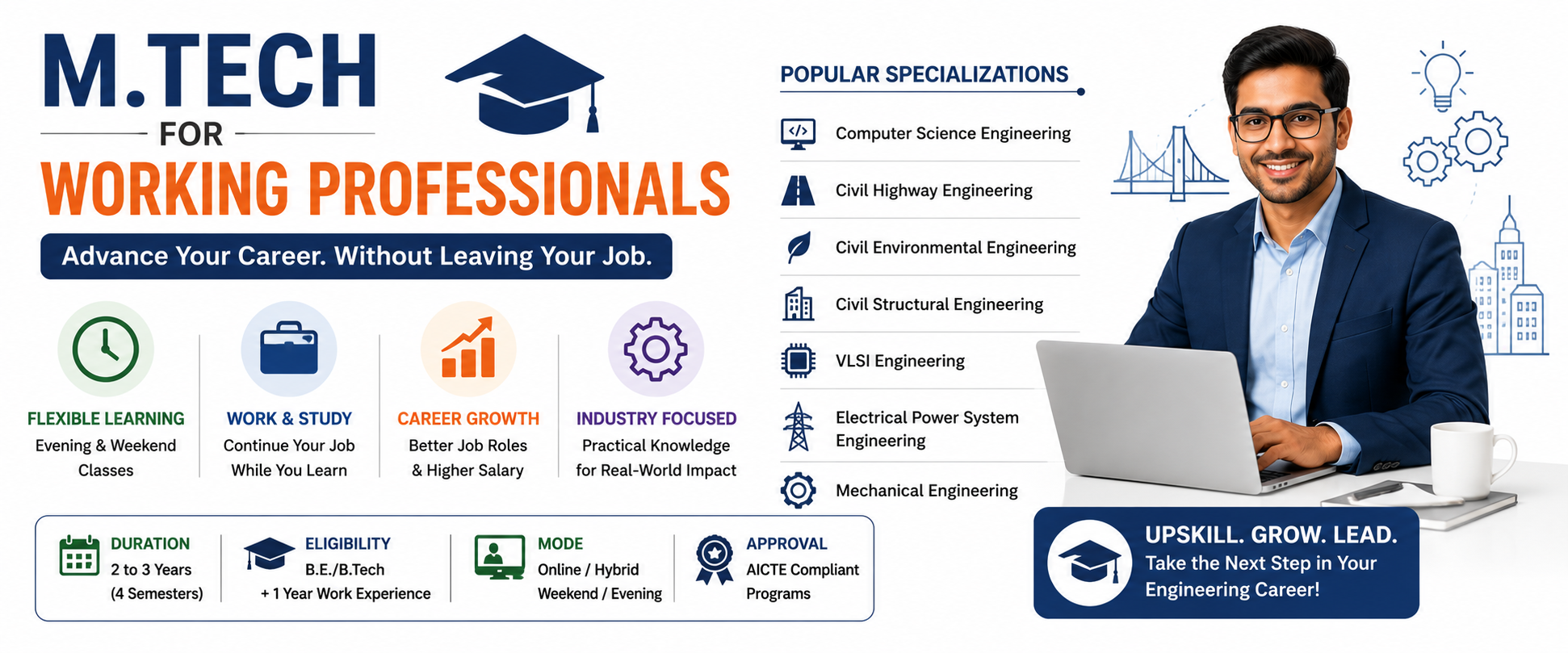
M.Tech for Working Professionals is a specialized postgraduate engineering program developed for employed engineers who wish to upgrade their technical knowledge and professional qualifications without interrupting their careers. Unlike conventional full-time M.Tech programs, this course follows a flexible learning model with evening classes, weekend sessions, and hybrid or online learning options, enabling professionals to balance higher education with their work responsibilities.
The program is ideal for engineers working in industries such as information technology, manufacturing, civil engineering, electrical engineering, electronics, construction, automation, and research. It combines advanced engineering concepts with practical industrial applications, allowing learners to immediately implement newly acquired knowledge in their workplace.
Designed to strengthen technical expertise and leadership capabilities, M.Tech for Working Professionals prepares candidates for senior engineering, research, development, consulting, and management positions across various industries.
What is M.Tech for Working Professionals?
M.Tech for Working Professionals is a flexible postgraduate engineering degree intended exclusively for professionals who already possess an undergraduate engineering qualification and relevant industry experience.
The program focuses on advanced technologies, research methodologies, engineering innovation, and practical problem-solving. Since participants are already working in technical environments, the curriculum emphasizes real-world applications rather than purely theoretical learning.
Classes are conducted during evenings after office hours, on weekends, or through hybrid learning methods that combine online lectures with occasional campus visits for laboratory work, practical sessions, or examinations.
This learning model enables professionals to continue earning while enhancing their qualifications and career prospects.
Program Duration
The standard duration of an M.Tech program is generally two years.
For working professionals, the curriculum is typically organized into four semesters, with some universities including an additional practical-focused semester in accordance with their academic structure and applicable AICTE guidelines for work-integrated programs.
The exact duration may vary slightly depending on the university, mode of study, and curriculum requirements, but most institutions complete the program within 2 to 3 years.
Program Structure and Learning Flexibility
One of the biggest advantages of this program is its flexible academic structure.
Learning methods generally include:
- Evening classes after office hours
- Weekend classroom sessions
- Hybrid learning combining online and offline instruction
- Live interactive lectures
- Recorded video lectures
- Digital learning resources
- Laboratory sessions
- Practical workshops
- Project work
- Semester examinations
This flexible approach enables professionals to pursue higher education without taking a career break.
Popular M.Tech Specializations
Universities offer various specializations based on current industry requirements.
Popular specializations include:
- M.Tech in Computer Science Engineering
- M.Tech in Civil Highway Engineering
- M.Tech in Civil Environmental Engineering
- M.Tech in Civil Structural Engineering
- M.Tech in VLSI Engineering
- M.Tech in Electrical Power System Engineering
- M.Tech in Mechanical Engineering
Many institutions also offer emerging technology specializations such as:
- Artificial Intelligence
- Data Science
- Cloud Computing
- Machine Learning
- Embedded Systems
- Cyber Security
- Internet of Things (IoT)
Students should choose a specialization that aligns with their current profession and long-term career objectives.
Eligibility Criteria
Admission requirements may differ among universities, but the general eligibility criteria include:
- A B.E. or B.Tech degree in the relevant engineering discipline from a recognized institution.
- Minimum qualifying marks generally range between 50% and 60%, depending on university regulations.
- Applicants should possess at least one year of full-time work experience in a relevant engineering field.
- Work experience should be obtained in a registered company, government organization, autonomous institution, educational institution, manufacturing unit, industry, or engineering firm.
Many executive or work-integrated M.Tech programs do not require a GATE score, although admission policies vary across institutions.
Candidates should always verify the admission requirements of their chosen university.
Benefits of Pursuing M.Tech While Working
Pursuing an M.Tech while employed offers several academic and professional advantages.
No Career Break
Professionals can continue working full-time while earning a postgraduate engineering degree.
Immediate Practical Application
Advanced engineering concepts learned during classes can be directly applied to current industrial projects, improving both technical performance and workplace productivity.
Career Advancement
The qualification enhances eligibility for senior engineering positions, technical leadership roles, project management opportunities, and specialized research careers.
Higher Salary Potential
Many organizations reward postgraduate-qualified professionals with promotions, expanded responsibilities, and improved compensation packages.
Professional Networking
Students interact with experienced engineers from diverse industries, creating valuable professional connections that contribute to long-term career growth.
Industry-Relevant Learning
The curriculum focuses on contemporary engineering technologies and practical industrial challenges rather than purely academic theory.
Skills Developed During the Program
Besides advanced technical knowledge, students develop a wide range of professional competencies, including:
- Engineering research methodologies
- Project management
- Technical leadership
- Problem-solving
- Data analysis
- Design optimization
- Industrial automation
- Software development
- Cloud computing
- Artificial Intelligence applications
- VLSI design
- Power system engineering
- Structural analysis
- Technical communication
- Innovation management
- Team collaboration
These skills prepare graduates for both technical and managerial careers.
Career Opportunities
An M.Tech degree significantly expands career opportunities across public and private sectors.
Graduates can pursue positions such as:
- Technical Consultant
- Project Manager
- Software Engineer
- Technical Architect
- Research and Development Engineer
- Automation Engineer
- Mechanical Engineer
- Electronics Engineer
- Electrical Engineer
- Network Engineer
- Data Analyst
- Renewable Energy Specialist
- Quality Control Engineer
- Senior Design Engineer
- Systems Engineer
- Product Development Engineer
Professionals with advanced engineering qualifications and industry experience are highly valued in sectors including manufacturing, IT, telecommunications, construction, energy, infrastructure, electronics, automotive, and research organizations.
Why Choose M.Tech for Working Professionals?
The program is particularly suitable for engineers who wish to remain competitive in rapidly evolving technological industries.
With advancements in Artificial Intelligence, Data Science, Automation, Robotics, VLSI, Cloud Computing, and Smart Manufacturing, organizations increasingly seek professionals who possess both practical experience and advanced academic qualifications.
The flexible format allows learners to strengthen their expertise without compromising their existing employment.
Conclusion
M.Tech for Working Professionals is an excellent option for engineers seeking career advancement while continuing full-time employment. Through flexible class schedules, industry-oriented curriculum, practical learning, and advanced engineering specializations, the program enables professionals to enhance their technical knowledge, leadership abilities, and research skills. Whether your goal is promotion, specialization, higher salary, or entry into advanced technical roles, this postgraduate engineering program provides a practical and career-focused pathway to long-term professional success.