





Introduction
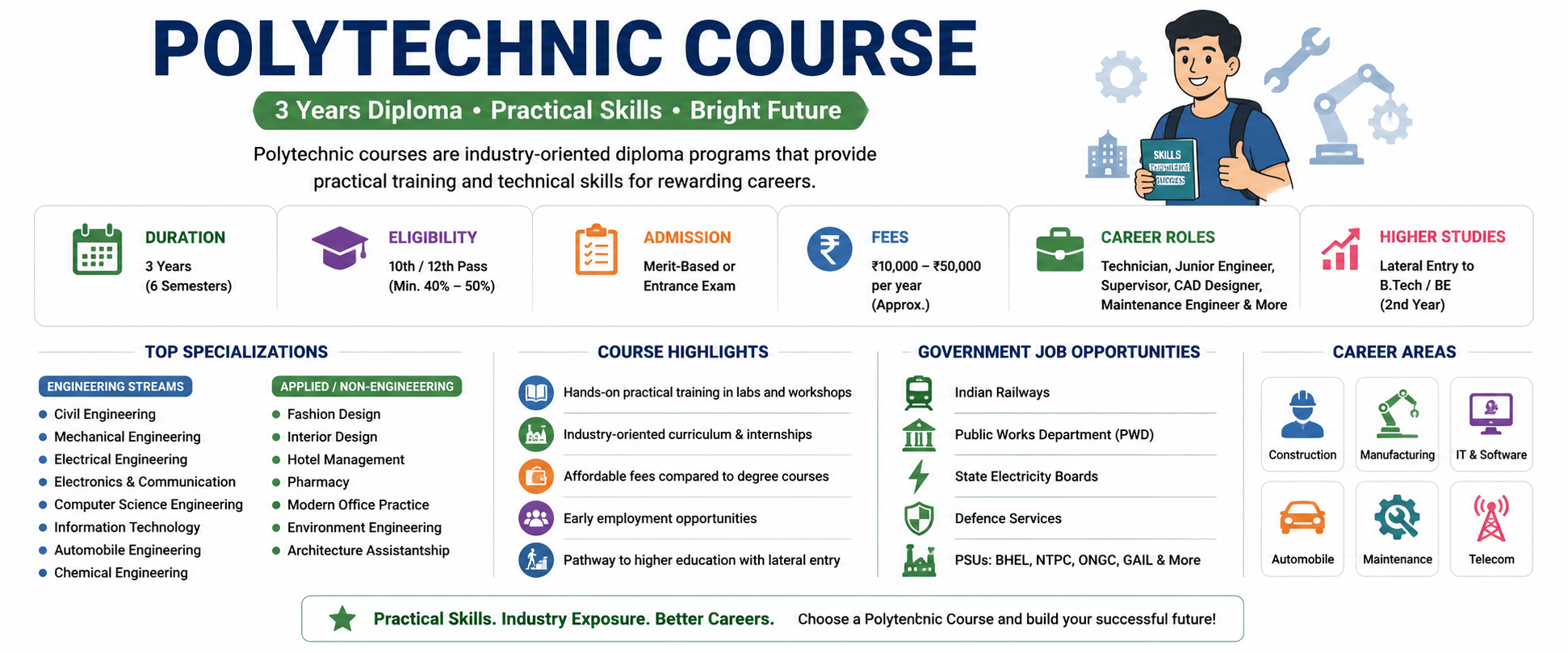
A Polytechnic Course is a practical, skill-oriented diploma program designed for students who want to build a career in engineering, technology, and applied sciences. Unlike conventional degree programs that emphasize theoretical learning, polytechnic courses focus on industry-oriented training, laboratory practice, workshops, industrial visits, and real-world applications. These programs help students become job-ready in a shorter duration while providing strong technical knowledge.
Polytechnic diploma programs are approved by the All India Council for Technical Education (AICTE) and are offered by both government and private polytechnic institutes across India. Students can pursue these courses after completing Class 10 or Class 12. One of the biggest advantages is that diploma holders can either start working immediately or continue higher education through lateral entry into the second year of a B.Tech or BE program.
Polytechnic Course Highlights
The key highlights of a Polytechnic Course include:
- Course Level: Diploma
- Duration: 3 Years (6 Semesters)
- Study Mode: Full-Time
- Eligibility: Class 10 or Class 12 from a recognized board
- Minimum Marks: Generally 40%–50% (varies by institute and state)
- Admission Process: Merit-Based or Entrance Examination
- Approved By: AICTE
- Annual Fees: Approximately ₹10,000–₹50,000 (varies by institution)
- Career Opportunities: Technician, Junior Engineer, Supervisor, CAD Designer, IT Support Executive, Production Engineer
- Higher Education: Lateral Entry to B.Tech/BE (Second Year)
Why Choose a Polytechnic Course?
Polytechnic education is ideal for students seeking practical knowledge and early career opportunities. These programs focus on developing technical skills that match industry requirements.
Major advantages include:
- Practical and industry-oriented curriculum
- Hands-on laboratory training
- Affordable course fees
- Faster employment opportunities
- Internship and industrial exposure
- Strong technical foundation
- Opportunity for lateral entry into engineering degree programs
- Excellent placement opportunities in government and private sectors
Polytechnic Course Duration
The Polytechnic Course generally takes 3 years to complete and is divided into 6 semesters.
Each semester typically includes:
- Theory classes
- Practical laboratory sessions
- Workshops
- Project work
- Industrial visits
- Internships (in selected colleges)
Students who join after completing Class 12 (PCM) may be eligible for lateral entry, allowing them to enter directly into the second year of the diploma program in some institutions.
Polytechnic Course Eligibility
Eligibility requirements vary slightly among states and institutions, but the general criteria include:
- Completion of Class 10 (SSLC/Matriculation) from a recognized board
- Students completing Class 12 are also eligible
- Mathematics, Science, and English are generally required subjects
- Minimum aggregate marks usually range between 40% and 50%
- No upper age limit in most states
Students completing Class 12 with Physics, Chemistry, and Mathematics may also receive lateral entry benefits depending on institutional policies.
Polytechnic Admission Process
Admissions are conducted through Merit-Based or Entrance-Based selection.
Merit-Based Admission
Many institutions offer admission based on Class 10 or Class 12 marks.
The process generally includes:
- Online registration
- Application submission
- Merit list publication
- Document verification
- Fee payment
- Admission confirmation
Entrance-Based Admission
Several states conduct entrance examinations for Polytechnic admissions.
Popular entrance examinations include:
- JEECUP (Uttar Pradesh)
- JEXPO (West Bengal)
- State Polytechnic Entrance Tests
- Other state-level diploma admission examinations
Qualified candidates participate in counselling and seat allotment before admission.
Popular Polytechnic Specializations
Students can choose from numerous engineering and applied science diploma programs according to their interests.
Popular engineering diploma courses include:
- Diploma in Civil Engineering
- Diploma in Mechanical Engineering
- Diploma in Electrical Engineering
- Diploma in Electronics & Communication Engineering
- Diploma in Computer Science Engineering
- Diploma in Information Technology
- Diploma in Automobile Engineering
- Diploma in Chemical Engineering
- Diploma in Architecture Assistantship
- Diploma in Environmental Engineering
- Diploma in Power Engineering
Popular non-engineering diploma programs include:
- Fashion Design
- Interior Design
- Hotel Management
- Pharmacy
- Modern Office Practice
Polytechnic Course Subjects
The syllabus varies according to specialization.
Common engineering subjects include:
Civil Engineering
- Building Materials
- Structural Engineering
- Surveying
- Concrete Technology
- CAD
- Environmental Engineering
Mechanical Engineering
- Thermodynamics
- Manufacturing Technology
- Theory of Machines
- Fluid Mechanics
- CAD
Electrical Engineering
- Electrical Machines
- Power Systems
- Circuits
- Control Systems
Computer Science
- Programming (C/C++)
- Data Structures
- Database Management Systems
- Operating Systems
- Networking
- Web Development
Electronics & Communication
- Digital Electronics
- Analog Circuits
- Microprocessors
- Communication Systems
The curriculum combines classroom learning with practical training to prepare students for industry.
Polytechnic Course Fees
Polytechnic education is considerably more affordable than a four-year engineering degree.
Approximate fee ranges include:
- Government Polytechnic Colleges: ₹10,000–₹30,000 per year
- Private Polytechnic Colleges: ₹30,000–₹50,000 per year
Fee structures vary depending on the institution, specialization, and state.
Career Opportunities After Polytechnic
A Polytechnic diploma opens numerous employment opportunities across engineering, manufacturing, construction, automobile, power, IT, telecom, and public sectors.
Popular job roles include:
- Junior Engineer
- Technician
- Site Supervisor
- CAD Designer
- Production Supervisor
- Maintenance Engineer
- Quality Control Technician
- Electrical Technician
- Mechanical Technician
- IT Support Executive
- Automobile Technician
- Network Technician
Graduates are valued for their practical skills and industry readiness.
Government Job Opportunities
Polytechnic diploma holders are eligible for several government recruitment examinations and technical positions.
Major recruiters include:
- Indian Railways
- Public Works Department (PWD)
- National Highways Authority of India (NHAI)
- State Electricity Boards
- Irrigation Departments
- Defence Services
- BHEL
- NTPC
- ONGC
- GAIL
- State Transport Departments
Many organizations recruit diploma holders for Technician and Junior Engineer positions.
Higher Education After Polytechnic
Students wishing to continue their education can pursue:
- Lateral Entry into B.Tech/BE (Second Year)
- AMIE
- Specialized Technical Certifications
- Professional Skill Development Programs
Lateral entry enables diploma holders to complete an engineering degree in less time.
Salary After Polytechnic
Salary depends on specialization, employer, technical skills, and experience.
Approximate salary ranges include:
- Freshers: ₹2.5–4 LPA
- Experienced Professionals: ₹5–8 LPA
- Senior Technical Professionals: ₹8–12 LPA or higher
Higher qualifications and certifications significantly improve career growth and earning potential.
Top Recruiters
Polytechnic graduates are recruited by leading organizations such as:
- BHEL
- NTPC
- ONGC
- GAIL
- Indian Railways
- Tata Motors
- Ashok Leyland
- Maruti Suzuki
- L&T
- Infosys
- TCS
- Wipro
- Bosch
- Mahindra
- Siemens
- Hyundai
Conclusion
A Polytechnic Course is an excellent choice for students seeking affordable, practical, and industry-oriented technical education after Class 10 or Class 12. With a strong focus on hands-on learning, modern technical skills, internships, and industrial exposure, polytechnic programs prepare graduates for rewarding careers across engineering, manufacturing, construction, IT, automobile, and government sectors. Additionally, the option of lateral entry into B.Tech programs makes a Polytechnic diploma a valuable pathway for both immediate employment and higher education.