





Introduction
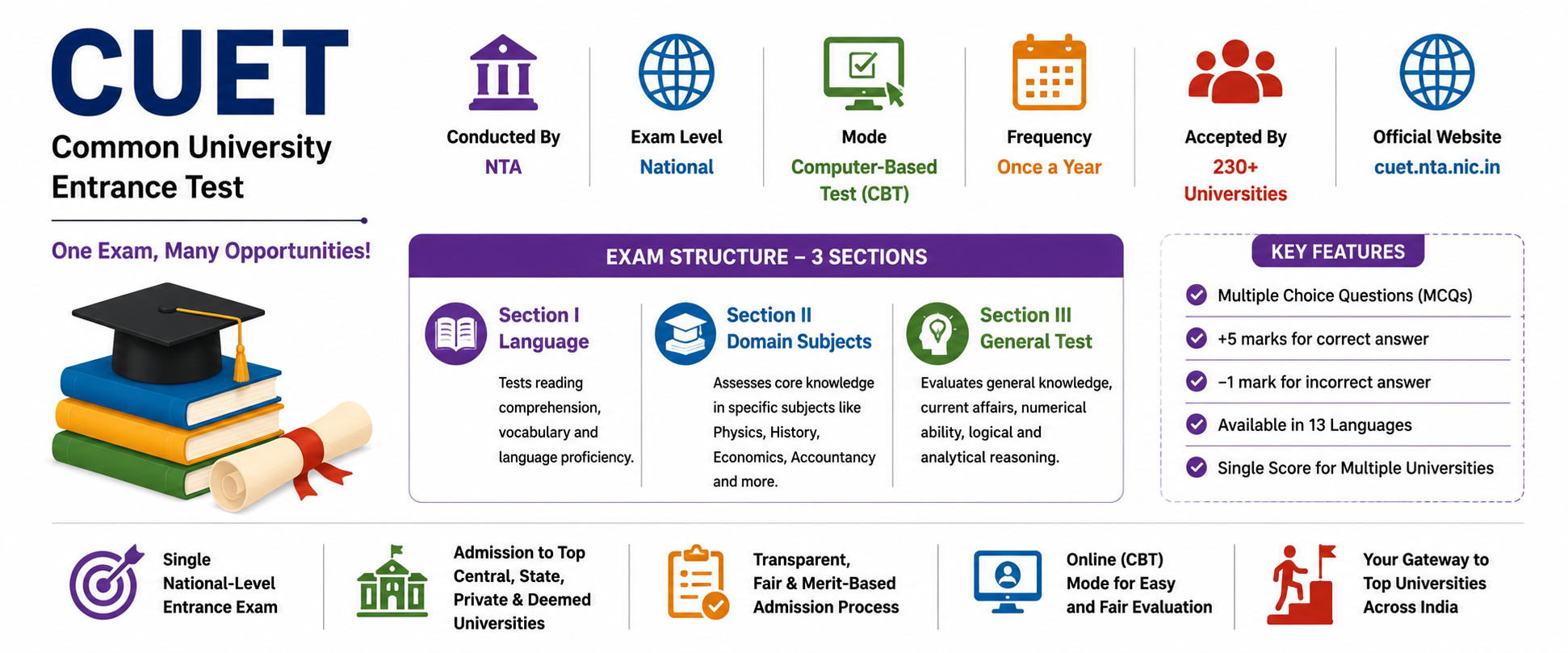
The Common University Entrance Test (CUET) is a standardized national-level entrance examination conducted by the National Testing Agency (NTA) for admission to various undergraduate, postgraduate, diploma, and research programs offered by central, state, deemed, and participating private universities across India. Introduced to create a common admission platform, CUET has simplified the university admission process by allowing students to apply to multiple institutions using a single examination score.
Instead of appearing for separate entrance tests conducted by different universities, candidates now have the opportunity to compete through one transparent, merit-based examination. Today, CUET is accepted by more than 230 participating universities, with more institutions joining every year, making it one of India's largest and most significant entrance examinations.
What is CUET?
CUET was introduced to bring uniformity and transparency to the university admission process. Before its implementation, students had to appear for multiple entrance examinations conducted by different universities such as Delhi University, Banaras Hindu University (BHU), Jawaharlal Nehru University (JNU), and several others.
With CUET, students can now secure admission to multiple universities through a single entrance examination. This centralized system reduces stress, minimizes examination costs, and ensures equal opportunities for candidates from different educational boards.
The examination is conducted in Computer-Based Test (CBT) mode using Multiple Choice Questions (MCQs), making the evaluation process objective and standardized.
Objectives of CUET
The primary purpose of CUET is to establish a fair, transparent, and standardized admission process across higher educational institutions.
The examination aims to:
- Provide a single national-level entrance examination for university admissions.
- Reduce the need for multiple university-specific entrance tests.
- Ensure merit-based admissions through a common evaluation system.
- Offer equal opportunities to students from different education boards.
- Simplify the admission process across central, state, private, and deemed universities.
Key Features of CUET
Some of the major highlights of the examination include:
- Conducted by the National Testing Agency (NTA)
- National-level entrance examination
- Computer-Based Test (CBT)
- Multiple Choice Question (MCQ) format
- Conducted once every year
- Accepted by over 230 universities
- Available in multiple languages, including English, Hindi, Malayalam, Tamil, Telugu, Kannada, Bengali, Marathi, Gujarati, Punjabi, Urdu, Assamese, and Odia
- Single examination for admission to numerous universities and programs
Courses Offered Through CUET
CUET serves as the gateway for admission into a wide variety of academic programs.
These include:
Undergraduate Courses
Students can apply for numerous undergraduate programs such as:
- Bachelor of Arts (BA)
- Bachelor of Science (BSc)
- Bachelor of Commerce (BCom)
- Bachelor of Business Administration (BBA)
- Bachelor of Management Studies (BMS)
- Bachelor of Laws (BA LLB/BBA LLB in participating institutions)
- Bachelor of Vocational Studies (B.Voc)
- Liberal Arts
- Education Programs
- Social Science Programs
Postgraduate Courses
Many universities also use CUET scores for admission into postgraduate programs across Arts, Science, Commerce, Management, Law, and Social Sciences.
Diploma and Research Programs
Several participating universities accept CUET scores for diploma, certificate, and research-based programs depending on institutional policies.
Participating Universities
CUET scores are accepted by various higher education institutions across India, including:
- Central Universities
- State Universities
- Private Universities
- Deemed Universities
- Specialized Institutions
Some of the well-known participating institutions include:
- Delhi University
- Banaras Hindu University
- Jawaharlal Nehru University
- Jamia Millia Islamia
- Aligarh Muslim University
- University of Hyderabad
- Tata Institute of Social Sciences (for select programs)
- Indian Institute of Mass Communication (for selected courses)
Each university determines its own eligibility criteria, subject combinations, and admission cut-offs based on CUET scores.
CUET Exam Structure
The examination is divided into three major sections that assess language proficiency, subject knowledge, and general aptitude.
Language Section
This section evaluates candidates' language skills through:
- Reading Comprehension
- Vocabulary
- Grammar
- Literary Understanding
- Language Proficiency
Candidates can choose from several Indian and foreign languages depending on university requirements.
Domain-Specific Subjects
This section assesses subject knowledge based on the chosen discipline.
Popular domain subjects include:
- Physics
- Chemistry
- Mathematics
- Biology
- Computer Science
- Economics
- Business Studies
- Accountancy
- History
- Political Science
- Geography
- Psychology
- Sociology
- Legal Studies
- Agriculture
- Fine Arts
- Environmental Science
- Entrepreneurship
- Physical Education
- Mass Communication
- Engineering Graphics
Students select subjects according to the eligibility requirements of their desired course and university.
General Test
The General Test measures:
- General Knowledge
- Current Affairs
- Logical Reasoning
- Analytical Ability
- Numerical Ability
- Quantitative Aptitude
Many universities require this section for admission into management, humanities, and multidisciplinary programs.
Exam Pattern
CUET is conducted entirely in Computer-Based Test (CBT) mode.
The examination consists of objective-type Multiple Choice Questions (MCQs). Depending on the selected subjects and university requirements, candidates appear for language papers, domain-specific subjects, and the General Test.
The examination follows standardized instructions regarding the number of questions, duration, and subject combinations, ensuring fairness and consistency across all candidates.
Marking Scheme
CUET follows a simple and transparent marking system:
- +5 marks for every correct answer.
- –1 mark for every incorrect answer.
- No marks awarded for unanswered questions.
The negative marking system encourages students to answer carefully rather than guessing.
Eligibility Criteria
Eligibility requirements vary depending on the course and university.
For undergraduate programs, candidates should have successfully completed Class 12 (10+2) or an equivalent examination from a recognized board. Most universities require a minimum aggregate of 50% to 60%, although the exact requirement differs by institution and program.
For postgraduate programs, applicants should possess a relevant bachelor's degree from a recognized university with the required minimum percentage.
Candidates are advised to verify the specific eligibility criteria prescribed by their preferred university before applying.
Age and Nationality Criteria
Generally, there is no upper age limit for appearing in the CUET examination. However, certain universities or specialized programs may prescribe age-related eligibility conditions.
Indian citizens are eligible to apply, while some universities may also permit foreign nationals according to their individual admission regulations.
Benefits of NTA Conducting CUET
The National Testing Agency has introduced several improvements that have transformed the university admission process.
These include:
- Standardized examination format
- Transparent and merit-based evaluation
- Efficient online Computer-Based Testing
- Uniform examination pattern
- Better use of technology
- Centralized admission process
- Multiple language options
- Reduced examination burden on students
Earlier, different universities conducted separate entrance examinations with varying patterns and difficulty levels. CUET has eliminated these inconsistencies by introducing a common examination for all participating institutions.
Importance of Class 12 Marks
A common misconception is that Class 12 marks are no longer relevant after the introduction of CUET. However, this is not entirely correct.
The CUET syllabus is largely based on the Class 12 curriculum, making school education highly relevant for exam preparation. In addition, several universities may use Class 12 marks as a tie-breaker when two candidates obtain identical CUET scores while applying for the same course.
Conclusion
CUET has revolutionized the higher education admission system in India by providing students with a single, standardized entrance examination accepted by hundreds of universities. Conducted by the National Testing Agency, the examination promotes fairness, transparency, and equal opportunity while reducing the burden of multiple entrance tests. With its comprehensive structure covering language proficiency, domain knowledge, and general aptitude, CUET enables students to pursue a wide range of undergraduate, postgraduate, diploma, and research programs through a unified admission process. Understanding the exam pattern, eligibility criteria, subject selection, and university requirements is essential for candidates aiming to secure admission to their preferred institution and course.