





Introduction
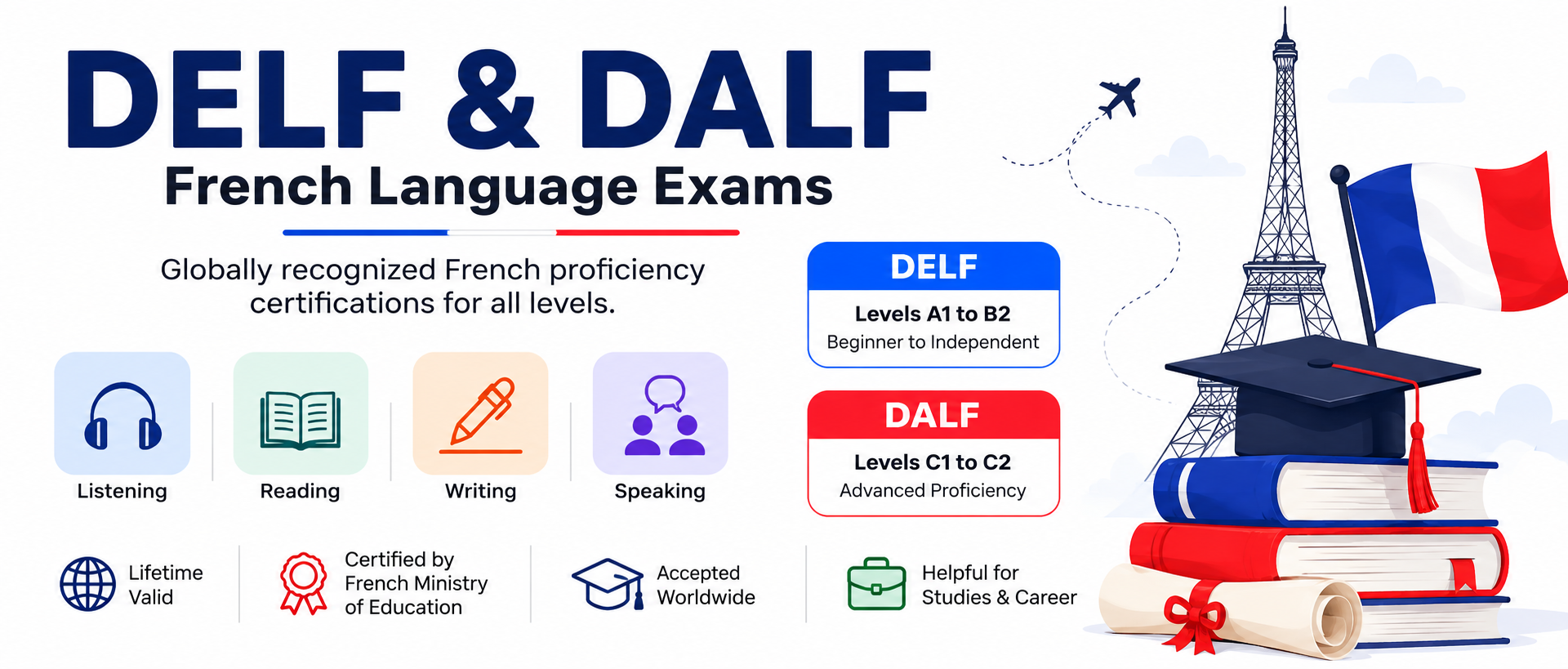
The DELF (Diplôme d'Études en Langue Française) and DALF (Diplôme Approfondi de Langue Française) are official French language proficiency diplomas awarded by the French Ministry of Education. These internationally recognized certifications assess the French language skills of non-native speakers and are accepted by universities, employers, immigration authorities, and government institutions across the world.
Unlike many language proficiency tests that require periodic renewal, DELF and DALF diplomas are valid for life, making them valuable long-term qualifications for students and professionals.
Both examinations are aligned with the Common European Framework of Reference for Languages (CEFR) and evaluate four core language skills:
- Listening
- Reading
- Writing
- Speaking
Whether your goal is studying in France, working in a French-speaking country, applying for immigration, or improving your career prospects, obtaining a DELF or DALF diploma demonstrates your ability to communicate effectively in French.
What are DELF and DALF?
The French Ministry of Education certifies French language proficiency through two official diplomas:
DELF (Diplôme d'Études en Langue Française)
DELF is designed for beginner and intermediate learners. It certifies French language proficiency from CEFR levels A1 to B2.
These levels include:
- A1 – Beginner
- A2 – Elementary
- B1 – Intermediate
- B2 – Upper Intermediate / Independent User
DALF (Diplôme Approfondi de Langue Française)
DALF is intended for advanced learners and certifies proficiency at:
- C1 – Advanced
- C2 – Mastery
DALF demonstrates that candidates can communicate confidently in academic, professional, and complex social situations.
Why Choose DELF or DALF?
DELF and DALF certifications offer several advantages:
- Officially issued by the French Ministry of Education
- Valid for life
- Globally recognized
- Accepted by universities worldwide
- Recognized by employers
- Useful for immigration and visa purposes
- Demonstrates internationally accepted French language proficiency
- Supports admission to French-taught degree programmes
Many universities in France require DELF B2 for undergraduate admissions, while several postgraduate programmes and research institutions may require DALF C1 or C2.
DELF vs DALF: Key Differences
DELF
- Suitable for beginner and intermediate learners
- Covers CEFR levels A1 to B2
- Focuses on building communication skills
- Reading, Listening, Writing, and Speaking are assessed separately
- Duration ranges from approximately 1.5 to 2.5 hours
- B1 and B2 are widely accepted for studies and employment
DALF
- Designed for advanced learners
- Covers CEFR levels C1 and C2
- Focuses on academic and professional proficiency
- C2 combines Listening and Speaking into one section and Reading and Writing into another
- Duration ranges between approximately 3.5 and 4 hours
- Often required for French-medium higher education and specialized careers
DELF and DALF Levels
DELF A1
Candidates can:
- Understand familiar everyday expressions
- Introduce themselves
- Ask and answer simple questions
- Write short messages
- Participate in basic conversations
DELF A2
Candidates can:
- Communicate about daily routines
- Describe family, work, and surroundings
- Understand simple texts
- Write short paragraphs
- Handle routine conversations
DELF B1
Candidates can:
- Understand conversations on familiar topics
- Read newspapers and everyday articles
- Express opinions
- Write connected texts
- Manage travel and daily communication independently
DELF B2
Candidates can:
- Understand complex spoken and written French
- Participate confidently in discussions
- Present arguments
- Write detailed essays and reports
- Communicate fluently in academic and workplace environments
DALF C1
Candidates demonstrate:
- Advanced academic French
- Professional communication skills
- Ability to analyse and present complex ideas
- High-level writing and speaking abilities
DALF C2
Candidates demonstrate near-native proficiency and can:
- Understand virtually all spoken and written French
- Communicate effortlessly
- Debate complex subjects
- Produce sophisticated written texts
DELF Exam Versions
The examinations are available in different versions depending on age.
DELF Tout Public
- Adults aged 17 years and above
- Levels A1–B2
- DALF C1–C2
DELF Junior / Scolaire
- Students aged 11–17 years
- Same certification value as DELF Tout Public
- Topics adapted to school-aged learners
DELF Prim
- Children aged 7–11 years
- Beginner levels designed specifically for young learners
DELF Prim Levels
A1.1
Children can:
- Understand familiar words
- Introduce themselves
- Participate in simple conversations
Exam Structure
Every DELF and DALF examination assesses four language skills:
Listening
Candidates listen to recordings such as:
- Conversations
- Interviews
- Announcements
- Discussions
Reading
Candidates answer questions based on:
- Notices
- Advertisements
- Articles
- Letters
- Reports
- Literary passages (higher levels)
Writing
Tasks include:
- Filling forms
- Writing messages
- Emails
- Letters
- Essays
- Reports
Speaking
Candidates participate in:
- Guided conversations
- Role plays
- Presentations
- Discussions with examiners
Example Format (DELF A1)
-
Listening
- 3–4 recordings
- Approximately 20 minutes
-
Reading
- 4–5 short texts
- 30 minutes
-
Writing
- Simple forms and short written tasks
- Around 20 minutes
-
Speaking
- Guided interview
- Information exchange
- Role play
- 5–7 minutes speaking
- Around 10 minutes preparation
-
Higher levels include longer texts, more complex listening passages, formal writing tasks, presentations, and debates.
DELF & DALF Scoring System
-
Each examination carries 100 marks.
For DELF A1 to B2 and DALF C1:
- Listening – 25 marks
- Reading – 25 marks
- Writing – 25 marks
- Speaking – 25 marks
-
Passing Criteria
Candidates must:
- Score at least 50/100 overall
- Obtain a minimum of 5/25 in each individual skill
DALF C2 Scoring
-
DALF C2 uses a different evaluation system.
The exam consists of:
- Listening + Speaking = 50 marks
- Reading + Writing = 50 marks
-
Candidates must score:
- Minimum 10/50 in each section
- Minimum 50/100 overall
Registration and Exam Sessions in India
-
In India, DELF and DALF examinations are conducted through the Alliance Française network.
Popular centres include:
- Ahmedabad
- Bengaluru
- Bhopal
- Chandigarh
- Chennai
- Coimbatore
- Hyderabad
- Jaipur
- Kolkata
- Mumbai
- New Delhi
- Panjim
- Pondicherry
- Pune
- Trivandrum
-
Nearby centres for many South Indian candidates include:
- Alliance Française Trivandrum
- Alliance Française Madras
- Alliance Française Bangalore
Exam Sessions
-
DELF and DALF examinations are generally conducted four times a year:
- March
- June
- September
- December
Registration usually opens approximately one month before the examination.
Exam Fees in India
-
The examination fee varies depending on:
- Level
- Examination centre
- Alliance Française membership status
-
Generally, fees range between:
₹7,000 to ₹14,500
Candidates should verify the latest fee structure with their chosen Alliance Française centre.
How to Prepare for DELF and DALF
Effective preparation requires consistent practice across all four language skills.
Recommended strategies include:
- Understand the exam pattern thoroughly.
- Follow a structured study schedule.
- Study at least one hour daily.
- Use official DELF and DALF preparation books.
- Listen to French podcasts, radio, and news.
- Watch French films and documentaries.
- Read newspapers, books, blogs, and magazines in French.
- Write daily journals, essays, and emails in French.
- Practise speaking with native speakers or language partners.
- Join conversation clubs or online language exchange platforms.
- Solve previous years' question papers.
- Take full-length mock tests under timed conditions.
- Review grammar and vocabulary regularly.
Who Should Take DELF or DALF?
These certifications are ideal for:
- School students
- College students
- Professionals
- Job seekers
- Study abroad aspirants
- Immigration applicants
- Researchers
- Anyone wishing to validate their French proficiency
Final Thoughts
DELF and DALF are among the world's most respected French language certifications. Backed by the French Ministry of Education, these lifetime-valid diplomas provide internationally recognized proof of language proficiency across all CEFR levels, from A1 to C2. Whether you are beginning your French learning journey or aiming for advanced academic or professional opportunities, earning a DELF or DALF diploma can significantly enhance your educational, career, and global mobility prospects. With consistent preparation, regular practice, and a clear understanding of the exam format, candidates can confidently achieve their target level and open doors to opportunities across the French-speaking world.