





Introduction
The Goethe-Zertifikat is one of the world's most respected German language proficiency certifications offered by the Goethe-Institut. Recognized by universities, employers, and government authorities worldwide, the certificate serves as proof of German language proficiency for higher education, employment, visa applications, immigration, and professional recognition.
The Goethe-Institut offers examinations for learners of German as a foreign language (Deutsch als Fremdsprache – DaF) across six CEFR levels, from A1 to C2. These examinations are conducted both in Germany and internationally through Goethe-Instituts and authorized examination centres.
Applying for the Goethe Exam is a straightforward online process. However, candidates must carefully follow the registration guidelines, upload the correct documents, pay the examination fee within the specified deadline, and comply with all examination regulations. This guide explains the complete Goethe Exam application process, registration procedure, fees, required documents, exam centres, and important instructions for candidates.
Goethe Exam Levels Available
The Goethe-Institut conducts examinations based on the Common European Framework of Reference for Languages (CEFR) at the following levels:
- A1 – Beginner
- A2 – Elementary
- B1 – Intermediate
- B2 – Upper Intermediate
- C1 – Advanced
- C2 – Proficient
Some authorized partner centres, such as Goethe-Zentrum Coimbatore, currently conduct examinations from A1 to C1.
Candidates should select the appropriate level based on their language proficiency and the purpose of certification.
Step 1: Choose the Appropriate Exam Level
Before beginning the registration process, determine which Goethe examination best suits your needs.
Generally:
- A1 – Suitable for beginners and commonly required for German spouse or family reunion visas.
- A2 – Demonstrates elementary communication skills.
- B1 – Often required for permanent residency, citizenship, and intermediate communication.
- B2 – Suitable for employment and higher education in Germany.
- C1 – Required by many universities and professional organizations.
- C2 – Demonstrates near-native German proficiency.
If you are unsure which level to choose, consult your German language trainer or institution before registering.
Step 2: Choose an Authorized Goethe Exam Centre
Candidates should select their preferred Goethe-Institut or authorized Goethe examination centre before registration.
In India, examinations are conducted through Goethe-Institut centres and partner institutes located in major cities, including:
- Delhi
- Mumbai
- Pune
- Bengaluru
- Chennai
- Kolkata
- Hyderabad
Authorized partner centres, including Goethe-Zentrum Coimbatore, also conduct Goethe examinations for selected levels.
Always register only through the official Goethe-Institut website or the authorized examination centre.
Step 3: Check Registration Dates
Registration for Goethe examinations is available only during specific registration windows.
Most examination centres:
- Publish examination schedules approximately one month before the examination.
- Open online registration around 6–8 weeks before the exam date.
- Activate the registration link only on the announced registration date.
Popular examination levels, especially A1 and B1, often fill quickly. Candidates are advised to monitor the official website regularly and complete registration as soon as it opens.
Step 4: Create Your Online Account
Candidates must create an account on the official Goethe-Institut examination portal (such as "my go.de") or the authorized examination centre's registration portal.
During account creation, candidates should:
- Enter a valid email address.
- Create a secure password.
- Verify their email address using the OTP or confirmation email.
The registered email address will be used for all future examination communication.
Step 5: Complete the Online Registration Form
After creating an account, candidates must log in and complete the online application form.
Applicants should provide:
- Full name (exactly as it appears on the passport)
- Date of birth
- Contact details
- Email address
- Mobile number
- Selected examination level
- Preferred examination date
- Examination centre
Candidates are responsible for ensuring that all information entered during registration is accurate. Incorrect personal details may appear on the final certificate and generally cannot be corrected later.
Step 6: Upload Required Documents
Candidates must upload the required documents during registration.
Typically required documents include:
- Scanned copy of a valid passport
- Recent passport-size photograph (if required)
- Signature (where applicable)
The uploaded documents should be clear and match the candidate's personal information entered during registration.
Step 7: Pay the Examination Fee
Once the registration is completed, candidates receive payment instructions via their registered email address.
Payment must be completed within the specified deadline through the official payment portal provided by the examination centre.
Some centres require candidates to upload their photograph and signature again after successful payment through the candidate portal.
It is important to note that receiving an Order ID does not guarantee an examination seat. The registration is confirmed only after candidates receive an official confirmation email from the examination centre.
Many centres also require that payment be made only from:
- The candidate's bank account, or
- The parent's bank account.
Goethe Exam Fee Structure (India)
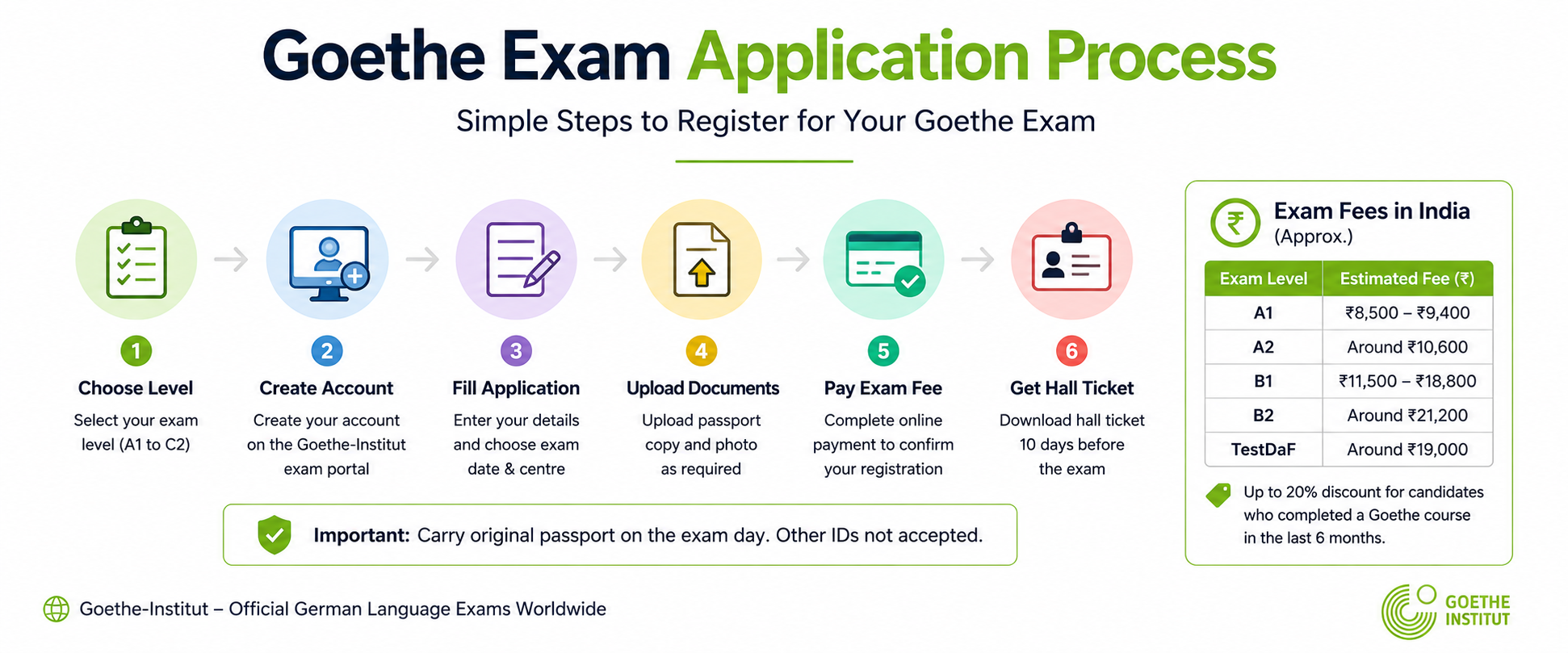
The Goethe Exam fee in India varies depending on the examination level, the test centre, and the city where the exam is conducted. For external candidates, the A1 examination fee generally ranges from ₹8,500 to ₹9,400, while the A2 exam costs approximately ₹10,600. The B1 examination fee typically falls between ₹11,500 and ₹18,800, depending on the centre, whereas the B2 exam is priced at around ₹21,200. Candidates appearing for the TestDaF can expect to pay approximately ₹19,000.
Candidates who have successfully completed a Goethe language course within the previous six months may be eligible for a discount of up to 20% on the examination fee, subject to the policies of the respective Goethe-Institut or authorized examination centre. Since examination fees may differ slightly across cities and centres and are subject to periodic revisions, candidates are strongly advised to check the latest fee structure on the official Goethe-Institut or authorized Goethe-Zentrum website before completing their registration.
Hall Ticket and Reporting Instructions
Approximately 10 days before the examination, candidates receive an email containing:
- Reporting time
- Examination instructions
- Hall ticket download link
Candidates must log in using their registered account credentials to download the hall ticket.
They should carefully review all examination instructions before the exam day.
Identification Requirements
Candidates must carry the following on the examination day:
- Original valid passport
The passport serves as the only accepted proof of identity for Goethe examinations.
The following documents are generally not accepted:
- Aadhaar Card
- PAN Card
- Driving Licence
- Voter ID
- Digital passport copies
- Photocopies of passports
Failure to produce the original passport may result in denial of entry to the examination.
Examination Results and Certificate Delivery
After successfully completing the examination, results are announced according to the examination centre's schedule.
Certificates are generally dispatched by courier and may take approximately 30 working days after the examination.
Candidates should ensure that the postal address provided during registration is accurate.
Important Guidelines for Candidates
Before registering for the Goethe examination, candidates should keep the following points in mind:
- Register only through official Goethe-Institut or authorized Goethe-Zentrum websites.
- Fill in all personal details exactly as they appear on your passport.
- Incorrect information may lead to certificate errors that cannot be corrected later.
- Registration alone does not guarantee an examination seat.
- Wait for the official confirmation email before considering your registration complete.
- Complete the fee payment within the prescribed deadline.
- Carry the original passport on the examination day.
- Keep your registered email active throughout the registration and examination process.
- Contact the examination centre only through official email communication, as many centres do not entertain examination-related phone enquiries.
Tips for a Smooth Application Process
To avoid delays or registration issues, candidates should:
- Decide their exam level in advance.
- Monitor the official website regularly for registration announcements.
- Keep scanned documents ready before registration opens.
- Register as early as possible, especially for popular levels.
- Verify all personal information before submitting the application.
- Complete the payment immediately after receiving payment instructions.
- Download the hall ticket well before the examination date.
- Read all examination guidelines carefully before reporting to the test centre.
Conclusion
The Goethe Exam Application Process 2026 is designed to be simple, secure, and completely online. By selecting the appropriate CEFR level, registering through the official Goethe-Institut or an authorized examination centre, uploading the required documents, completing the fee payment, and following all examination guidelines, candidates can complete their registration smoothly. Since examination seats are limited and registrations often fill quickly, applying early is highly recommended. With proper planning and careful preparation, candidates can confidently complete the application process and take an important step toward achieving an internationally recognized German language certification.