





Introduction
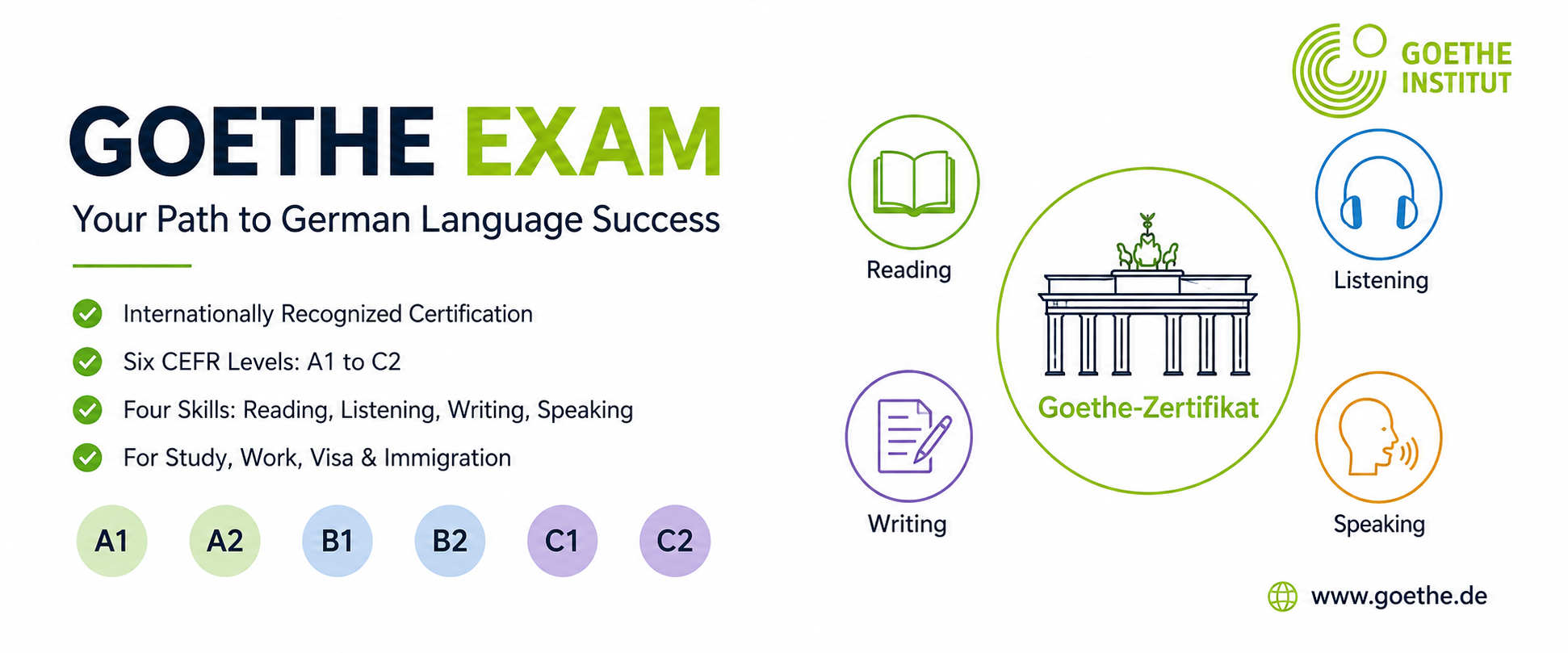
The Goethe Exam, officially known as the Goethe-Zertifikat, is one of the world's most respected German language proficiency examinations. Conducted by the Goethe-Institut, a non-profit German cultural organization, the exam serves as an internationally recognized certification of German language skills for non-native speakers. With more than 159 institutes and numerous partner examination centres worldwide, the Goethe-Institut promotes German language learning and cultural exchange while maintaining high international standards in exam development, administration, and evaluation.
Goethe certificates are widely accepted by universities, employers, government authorities, and professional organizations across Germany and many other countries. They are commonly used for higher education admissions, employment opportunities, visa applications, professional recognition, immigration purposes, and personal achievement. Whether you are planning to study in Germany, work in a German-speaking country, or simply demonstrate your German language proficiency, the Goethe Exam provides a reliable and globally recognized qualification.
What is the Goethe Exam?
The Goethe Exam is based on the Common European Framework of Reference for Languages (CEFR), which classifies language proficiency into six internationally accepted levels: A1, A2, B1, B2, C1, and C2. These levels range from beginner to near-native proficiency and assess a candidate's ability to communicate effectively in real-life situations.
The examination evaluates four essential language skills:
- Reading
- Listening
- Writing
- Speaking
Each skill is designed to measure practical communication abilities appropriate to the selected CEFR level.
Key Features of the Goethe Exam
One of the unique features of the Goethe Exam is its modular format for the B1, B2, C1, and C2 levels. Unlike A1 and A2, where candidates take all sections together, higher-level exams allow learners to take Reading, Listening, Writing, and Speaking either as a complete examination or as individual modules. This flexible system recognizes that learners often develop different language skills at different rates. Candidates may choose only the modules they need or retake only the sections they did not pass, making the certification process more convenient and efficient.
The Goethe-Institut also offers digital examinations at selected examination centres. In the digital format, candidates complete the Reading, Listening, and Writing modules on Goethe-Institut laptops equipped with German keyboards. The Listening section is completed using headphones to ensure clear audio quality. The Speaking module continues to be conducted face-to-face with experienced Goethe examiners, similar to the traditional paper-based examination. Currently, the Goethe-Institut does not offer remote or online-at-home examinations, and all candidates must appear in person at an authorized test centre.
Goethe Exam Levels (A1–C2)
A1 (Start Deutsch 1)
A1 is intended for complete beginners. Candidates demonstrate the ability to understand and use familiar everyday expressions and simple phrases. Reading tasks include short notices, advertisements, forms, and emails. Listening exercises contain slow and clear conversations, announcements, and simple instructions. Writing involves completing forms or writing short personal messages, while the speaking test focuses on introducing oneself, answering basic personal questions, and participating in simple conversations. The A1 certificate is widely required for German family reunion or spouse visa applications.
A2
A2 represents elementary language proficiency. Candidates are expected to communicate independently in familiar everyday situations. Reading passages become slightly longer and include practical texts related to travel, work, and daily routines. Listening tasks include conversations, announcements, and public information. Writing requires short emails or descriptions, while speaking involves exchanging information and handling simple conversations confidently.
B1
B1 demonstrates independent language use in everyday social and professional situations. Reading includes articles, reports, advertisements, emails, and instructions. Listening sections feature interviews, discussions, workplace conversations, and announcements. Writing tasks require structured emails, letters, or forum posts expressing opinions. The speaking examination is usually conducted in pairs, where candidates interact, exchange ideas, and complete communication tasks together.
B2
B2 reflects upper-intermediate proficiency suitable for academic and professional environments. Reading tasks involve more complex texts requiring candidates to understand arguments, opinions, and implied meanings. Listening includes interviews, debates, presentations, and discussions delivered at a faster pace. Writing focuses on structured argumentation and formal communication, while speaking evaluates the ability to present ideas clearly, defend opinions, and participate in fluent discussions.
C1
C1 assesses advanced language proficiency. Candidates are expected to understand analytical texts, academic articles, lectures, and formal discussions. Writing tasks require well-organized and coherent texts with advanced vocabulary and precise grammar. During the speaking examination, candidates express complex ideas fluently, respond spontaneously, and actively participate in detailed discussions.
C2
C2, the highest level, demonstrates near-native language proficiency. Reading and listening sections include sophisticated texts, expert interviews, reports, academic materials, and abstract discussions. Writing requires advanced argumentation, stylistic accuracy, and precise language control. The speaking examination evaluates the ability to communicate naturally, discuss complex topics, and respond confidently in demanding formal and professional situations.
Goethe Exam Structure
Every Goethe Exam consists of four sections:
- Reading
- Listening
- Writing
- Speaking
The examination becomes more challenging and longer as candidates progress to higher CEFR levels. The speaking examination is generally scheduled separately on the same day and is conducted individually or in pairs depending on the examination level. From A1 to C1, speaking tests are usually held in pairs or small groups, whereas the C2 speaking examination is conducted individually.
Goethe Exam Duration
The duration varies according to the CEFR level. The A1 examination requires approximately 80 minutes for the written sections, while higher-level examinations include longer reading passages, detailed listening exercises, and extensive writing tasks. The speaking examination is conducted separately and may include preparation time for higher levels.
Registration Process
Candidates must register through the official Goethe-Institut website or an authorized examination centre. Registration involves creating an account, selecting the desired CEFR level, choosing the examination date and location, completing personal details, and paying the examination fee online. Candidates taking B1 to C2 may also select individual modules during registration.
Goethe Exam Fees
The examination fee varies depending on the country, examination level, and test centre. In India, fees generally range from ₹8,000 to ₹15,000, although the exact amount may vary by examination centre and level.
Identification Requirements
Candidates must carry a valid original passport on the examination day. Since the Goethe certificate is an internationally recognized qualification, only passports are generally accepted as proof of identity. Aadhaar cards, voter identity cards, and driving licences are typically not accepted.
Passing Marks and Results
Candidates must score at least 60% to pass each module. A1 and A2 candidates receive one certificate upon successfully completing the examination. For B1 to C2, candidates receive certificates for each module they pass, while those completing all four modules receive a full Goethe certificate. Candidates who do not pass one or more modules can retake only the failed sections.
Results are generally released within one to four weeks, depending on the examination level and the test centre.
Certificate Validity
Goethe certificates are valid for a lifetime and do not expire. However, some universities, employers, and immigration authorities may require recently issued certificates depending on their admission or application policies.
Goethe-Test PRO
The Goethe-Institut also offers Goethe-Test PRO, an adaptive computer-based German language assessment designed primarily for workplace communication. The test adjusts its difficulty according to the candidate's performance and provides immediate results, making it suitable for employers and professionals.
Preparation Tips for the Goethe Exam
To perform well in the Goethe Exam, candidates should:
- Determine their CEFR level before registering.
- Practice using official Goethe-Institut sample papers.
- Join a structured German language course.
- Improve grammar and vocabulary regularly.
- Practice Reading, Listening, Writing, and Speaking equally.
- Watch German films and television programmes.
- Listen to German podcasts and news.
- Read German newspapers, magazines, and blogs.
- Speak regularly with native speakers or language partners.
- Practice under timed exam conditions and become familiar with the exam pattern.
Conclusion
The Goethe Exam is one of the most trusted and internationally recognized German language proficiency examinations. Its alignment with the CEFR, flexible modular format for higher levels, digital testing options, and lifelong certificate validity make it an excellent choice for students, professionals, and language learners. Accepted by universities, employers, and government authorities around the world, the Goethe-Zertifikat opens doors to higher education, career opportunities, visa applications, and professional recognition in German-speaking countries. With thorough preparation, regular practice, and a clear understanding of the exam format, candidates can confidently achieve their desired certification and demonstrate their German language proficiency on a global platform.