





What is the IELTS Exam?
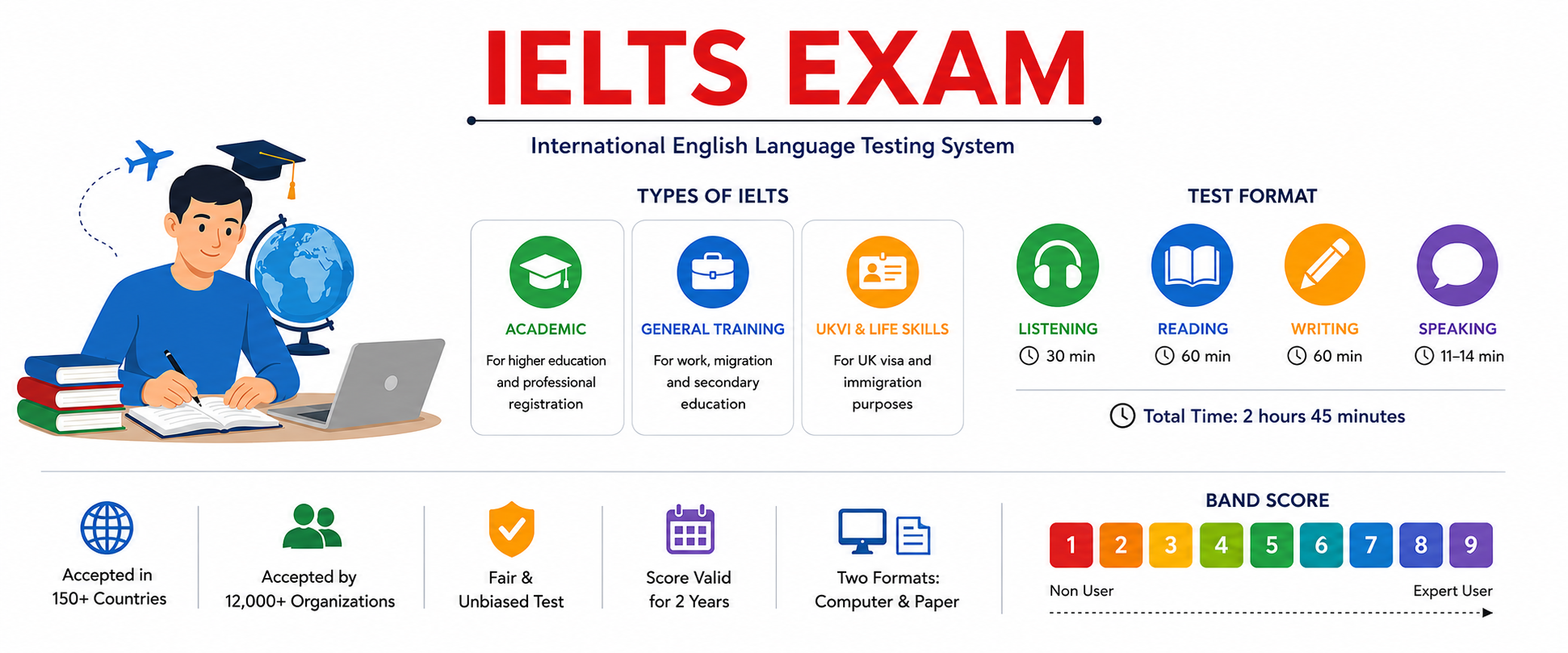
The International English Language Testing System (IELTS) is a globally recognized English language proficiency examination designed for individuals who wish to study, work, or migrate to English-speaking countries. It measures a candidate's ability to communicate effectively in English through four language skills: Listening, Reading, Writing, and Speaking.
Every year, millions of candidates take the IELTS exam to demonstrate their English proficiency. The exam is accepted by thousands of educational institutions, employers, professional organizations, and immigration authorities in more than 150 countries.
The test is designed to evaluate practical English communication skills used in academic environments, workplaces, and everyday life. It provides a fair and reliable assessment regardless of nationality, background, or profession.
Why Take the IELTS Exam?
IELTS is widely accepted for multiple purposes, including:
- Admission to undergraduate and postgraduate courses
- Professional registration in various fields
- Employment opportunities in English-speaking countries
- Student and work visa applications
- Permanent residency and immigration
- Career advancement in multinational organizations
A good IELTS score strengthens your academic and professional profile while improving your chances of obtaining visas and admissions.
Types of IELTS Exams
Choosing the correct IELTS module is important before registering.
IELTS Academic
This module is intended for students applying to universities, colleges, and higher education institutions. It is also required for professional registration in fields such as healthcare, engineering, education, and other regulated professions.
IELTS General Training
This module is suitable for candidates planning to migrate, work abroad, undertake vocational training, or pursue secondary education. The questions focus on practical English used in everyday and workplace situations.
IELTS for UK Visas and Immigration
This version is specifically designed for individuals applying for certain UK visa categories. Candidates should verify whether this version is required before booking the exam.
IELTS Life Skills
This test evaluates only Speaking and Listening skills and is intended for specific family and settlement visa applications.
IELTS Eligibility
The IELTS exam has very few eligibility requirements.
- Recommended minimum age is 16 years.
- There is no upper age limit.
- No minimum educational qualification is required.
- Candidates of any nationality can apply.
- A valid passport or accepted identification document is required during registration and on the test day.
IELTS Test Formats
Candidates can choose the test format according to their preference.
Computer-Based Test
Listening, Reading, and Writing are completed on a computer at an authorized test centre, while the Speaking test is conducted face-to-face with an examiner. Results are generally available within one to five days.
Paper-Based Test
Candidates complete the Listening, Reading, and Writing sections using paper and pencil. The Speaking test is conducted separately with an examiner. Results are generally available within thirteen days.
Online Test
In selected locations, candidates may have the option of taking the Academic version online, subject to local availability.
IELTS Exam Pattern
The total test duration is approximately 2 hours and 45 minutes.
Listening
Duration: Approximately 30 minutes
This section contains four recorded conversations and monologues. Candidates answer questions based on the recordings, testing comprehension, attention to detail, and understanding of opinions and ideas.
Reading
Duration: 60 minutes
The Reading section contains three passages.
The Academic module includes texts from books, journals, and research publications, while the General Training module includes workplace materials, notices, advertisements, and newspapers.
Writing
Duration: 60 minutes
Candidates complete two writing tasks.
Academic candidates interpret visual information such as charts or graphs and write an essay.
General Training candidates write a letter and an essay.
Assessment focuses on grammar, vocabulary, organization, coherence, and task achievement.
Speaking
Duration: 11–14 minutes
The Speaking test is conducted individually and consists of:
- Introduction and interview
- Individual speech on a given topic
- Discussion based on the topic
The examiner evaluates pronunciation, fluency, grammar, vocabulary, and communication skills.
IELTS Band Score
IELTS uses a nine-band scoring system.
- Band 9 – Expert User
- Band 8 – Very Good User
- Band 7 – Good User
- Band 6 – Competent User
- Band 5 – Modest User
- Band 4 – Limited User
- Band 3 – Extremely Limited User
- Band 2 – Intermittent User
- Band 1 – Non-User
Each section receives an individual score, and the average forms the overall band score.
Most universities and immigration programs specify minimum band score requirements depending on their criteria.
IELTS Application Process
Applying for the IELTS exam is simple and can be completed online by following these steps.
Step 1: Choose the Right Test
Select the appropriate module based on your objective:
- Academic
- General Training
- UK Visa-specific version
- Life Skills (if applicable)
Step 2: Select Your Test Format
Choose whether you want to take the exam on paper or computer, depending on availability and personal preference.
Step 3: Find a Test Centre
Search for an authorized IELTS test centre near your location and check the available examination dates.
Step 4: Create an Online Account
Visit the official IELTS registration portal and create your account using your personal details.
Step 5: Complete the Registration Form
Enter your full name, date of birth, passport details, contact information, and other required details exactly as they appear on your passport.
Step 6: Upload Required Documents
Upload a clear colour copy of your valid passport or the identification document accepted in your country.
Step 7: Choose Your Test Date
Select a convenient test date and available time slot. Book early to secure your preferred schedule.
Step 8: Pay the Examination Fee
Complete the payment using one of the available online payment methods. Once payment is successful, your registration will be confirmed.
Step 9: Receive Confirmation
You will receive a confirmation email containing your test venue, reporting time, and important instructions for exam day.
Step 10: Attend the Examination
Carry your original passport or approved identification document to the test centre. Arrive early and follow all examination guidelines.
IELTS Results and Validity
Results are generally available within:
- Computer-based test: 1–5 days
- Paper-based test: Around 13 days
Candidates receive an official Test Report Form showing individual section scores and the overall band score.
IELTS scores remain valid for two years from the test date.
Countries Where IELTS is Accepted
IELTS is accepted for study, work, and migration in many countries, including:
- United Kingdom
- Canada
- Australia
- United States
- New Zealand
- Ireland
Many universities and employers in other countries also recognize IELTS as proof of English language proficiency.
Benefits of IELTS
Some major advantages include:
- International recognition
- Widely accepted for education and employment
- Supports immigration and visa applications
- Fair assessment of practical English skills
- Flexible paper and computer test options
- Multiple test dates throughout the year
- Reliable and transparent scoring system
- Two-year score validity
- Suitable for academic, professional, and migration purposes
Conclusion
The IELTS exam is one of the most trusted English language proficiency tests for individuals planning to study, work, or migrate abroad. It evaluates practical communication skills through Listening, Reading, Writing, and Speaking assessments while offering multiple test formats and modules to suit different goals. Understanding the eligibility criteria, exam pattern, scoring system, and application process helps candidates prepare more effectively and avoid unnecessary mistakes during registration. With global recognition and acceptance by universities, employers, and immigration authorities, achieving a good IELTS band score can significantly improve educational, professional, and international career opportunities.