





Introduction
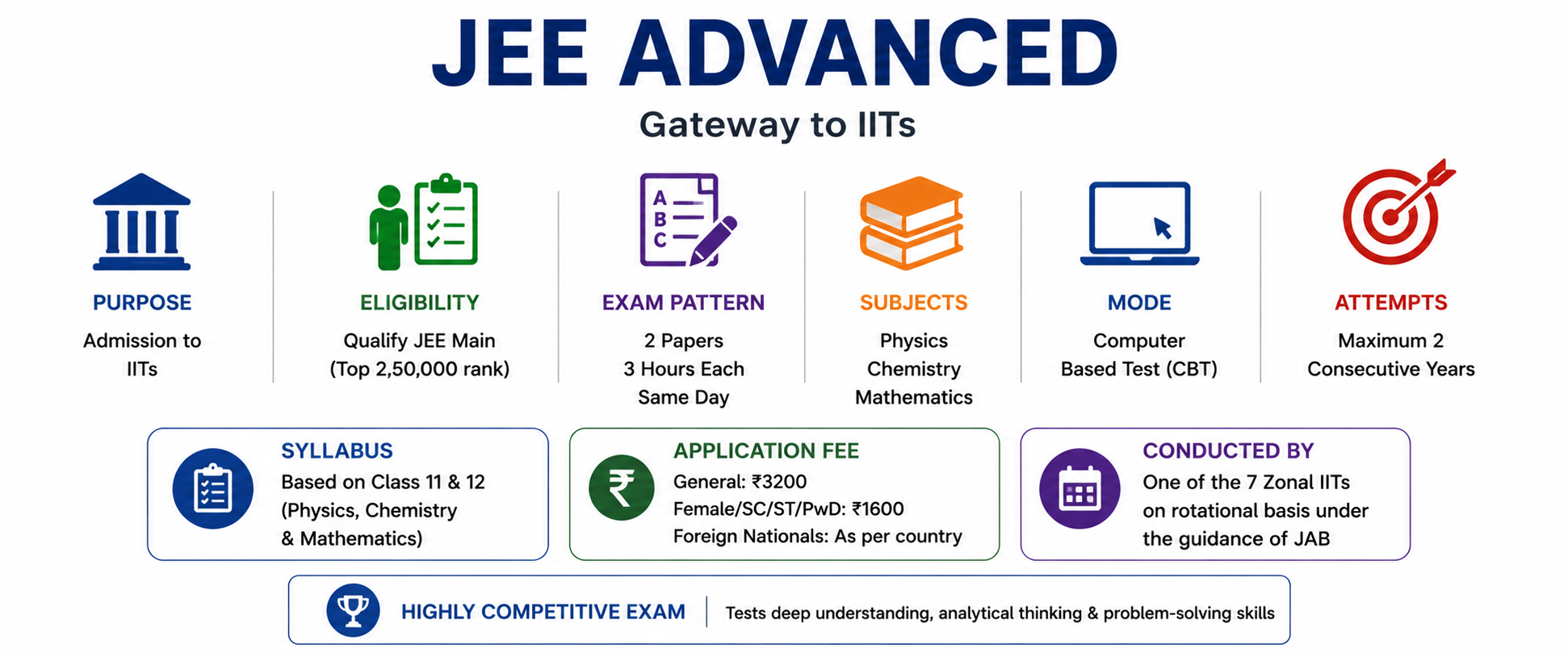
JEE Advanced is India's highest-level engineering entrance examination conducted for admission to undergraduate engineering programs at the prestigious Indian Institutes of Technology (IITs). It is the second stage of the Joint Entrance Examination (JEE) and is considered one of the most competitive entrance exams in the country. Every year, only candidates who qualify in JEE Main and secure the required rank are eligible to appear for JEE Advanced.
The examination evaluates a student's conceptual understanding, analytical thinking, logical reasoning, and problem-solving abilities in Physics, Chemistry, and Mathematics. Success in JEE Advanced opens the door to Bachelor's, Integrated Master's, and Dual Degree programs offered by the IITs and is also recognized by a few other prestigious institutions.
What is JEE Advanced?
JEE Advanced is the entrance examination conducted for admission to the Indian Institutes of Technology (IITs), which are regarded as India's premier engineering institutions.
Unlike JEE Main, which serves as the qualifying examination for several engineering colleges including NITs and IIITs, JEE Advanced is exclusively meant for admission into IITs. It is designed to test students' in-depth understanding of scientific concepts rather than rote memorization.
The examination is organized annually by one of the seven zonal IITs under the guidance of the Joint Admission Board (JAB) on a rotational basis.
Purpose of JEE Advanced
The primary objective of JEE Advanced is to select deserving candidates for undergraduate engineering and science programs offered by IITs.
The examination serves as the admission gateway for:
- Bachelor of Technology (B.Tech)
- Bachelor of Engineering (B.E.)
- Integrated Master's Programs
- Dual Degree Programs
JEE Advanced scores are also accepted by a few reputed institutions for specific academic programs.
Who Conducts JEE Advanced?
JEE Advanced is conducted by one of the seven zonal IITs on behalf of the Joint Admission Board.
The organizing institutes rotate every year among:
- IIT Bombay
- IIT Delhi
- IIT Kanpur
- IIT Kharagpur
- IIT Madras
- IIT Guwahati
- IIT Roorkee
All participating IITs contribute to designing and maintaining the examination standards.
Eligibility Criteria
Candidates must satisfy specific eligibility requirements before appearing for JEE Advanced.
Qualification through JEE Main
Only candidates who rank among the top qualifying candidates in the JEE Main B.E./B.Tech examination are eligible to appear for JEE Advanced.
Educational Qualification
Applicants should have passed or be appearing for the Class 12 (or equivalent) examination with Physics, Chemistry, and Mathematics as compulsory subjects.
Many participating institutes also prescribe minimum qualifying marks in the Class 12 examination as part of the admission process.
Age Criteria
Candidates should satisfy the age requirements specified in the official information brochure. Reserved category candidates are generally provided age relaxation according to government regulations.
Number of Attempts
Candidates are normally permitted to appear for JEE Advanced a maximum of two times in two consecutive years.
JEE Advanced Exam Pattern
JEE Advanced follows a unique examination pattern designed to evaluate conceptual understanding rather than memorization.
The examination generally consists of:
- Two compulsory papers
- Paper 1
- Paper 2
Both papers are conducted on the same day.
Each paper has a duration of three hours, while eligible PwD candidates may receive additional time according to official guidelines.
The examination is conducted in Computer-Based Test (CBT) mode.
Subjects Covered
Both examination papers include questions from:
- Physics
- Chemistry
- Mathematics
The questions often integrate concepts from multiple chapters, making analytical thinking and application skills essential.
Question Types
JEE Advanced is known for its diverse and challenging question formats.
Candidates may encounter:
- Multiple Choice Questions (MCQs)
- Multiple Correct Answer Questions
- Numerical Value Questions
- Match the Following Questions
- Paragraph-based Questions
- Matrix Match Questions
The exact pattern may vary each year depending on the official examination guidelines.
Marking Scheme
The marking pattern differs according to the question type.
Typically:
- Correct answers receive positive marks.
- Certain questions carry partial marking.
- Incorrect answers may attract negative marking.
- Some numerical questions may not have negative marking.
Candidates should carefully read the instructions before attempting each section.
JEE Advanced Syllabus
The syllabus primarily covers advanced topics from Class 11 and Class 12 Physics, Chemistry, and Mathematics.
Physics
Major topics include:
- Mechanics
- Thermodynamics
- Electricity and Magnetism
- Optics
- Waves
- Modern Physics
- Electromagnetic Induction
- Fluid Mechanics
Chemistry
The Chemistry syllabus includes:
- Physical Chemistry
- Organic Chemistry
- Inorganic Chemistry
- Chemical Bonding
- Atomic Structure
- Thermodynamics
- Chemical Kinetics
- Coordination Compounds
Mathematics
Important Mathematics topics include:
- Algebra
- Calculus
- Coordinate Geometry
- Trigonometry
- Vectors
- Matrices
- Probability
- Differential Equations
Students should always refer to the latest official syllabus while preparing.
Application Process
Eligible candidates can submit their applications through the official JEE Advanced portal.
The application process generally involves:
- Logging in using JEE Main credentials.
- Filling personal and academic details.
- Uploading required documents.
- Paying the application fee online.
- Verifying all information.
- Submitting the application.
- Downloading the confirmation page.
Candidates should carefully review all entered information before final submission.
Documents Required
Applicants usually need the following documents:
- Passport-size photograph
- Candidate's signature
- Class 10 certificate
- Class 12 certificate or marksheet (where applicable)
- Category certificate (if applicable)
- PwD certificate (if applicable)
- Valid identity proof
Documents should be uploaded according to the prescribed specifications.
Participating Institutes
JEE Advanced primarily provides admission to all Indian Institutes of Technology (IITs).
The examination also serves as an admission criterion for a few other prestigious institutions offering specialized science and engineering programs.
Importance of JEE Advanced
Qualifying JEE Advanced offers students access to some of India's finest engineering education and research opportunities.
Advantages include:
- Admission to IITs
- World-class faculty
- Advanced research facilities
- International academic collaborations
- Strong placement opportunities
- Entrepreneurship support
- Global recognition of IIT degrees
Graduates from IITs are highly sought after by multinational companies, research organizations, government institutions, and universities worldwide.
Preparation Tips
Success in JEE Advanced requires consistent preparation and conceptual clarity.
Students should:
- Build strong fundamentals in Physics, Chemistry, and Mathematics.
- Follow the official syllabus carefully.
- Practice previous years' question papers.
- Attempt mock tests regularly.
- Improve speed and accuracy.
- Strengthen analytical and problem-solving skills.
- Revise important concepts frequently.
- Develop effective time-management strategies.
Maintaining a disciplined study schedule and practicing application-based questions can significantly improve performance.
Conclusion
JEE Advanced is one of the most prestigious and competitive engineering entrance examinations in India. It serves as the gateway to the Indian Institutes of Technology, where students receive world-class technical education and research opportunities. The examination demands strong conceptual knowledge, analytical thinking, and consistent preparation across Physics, Chemistry, and Mathematics. Understanding the eligibility criteria, syllabus, exam pattern, application process, and marking scheme allows candidates to prepare strategically and maximize their chances of securing admission to one of India's premier engineering institutions.