





Introduction
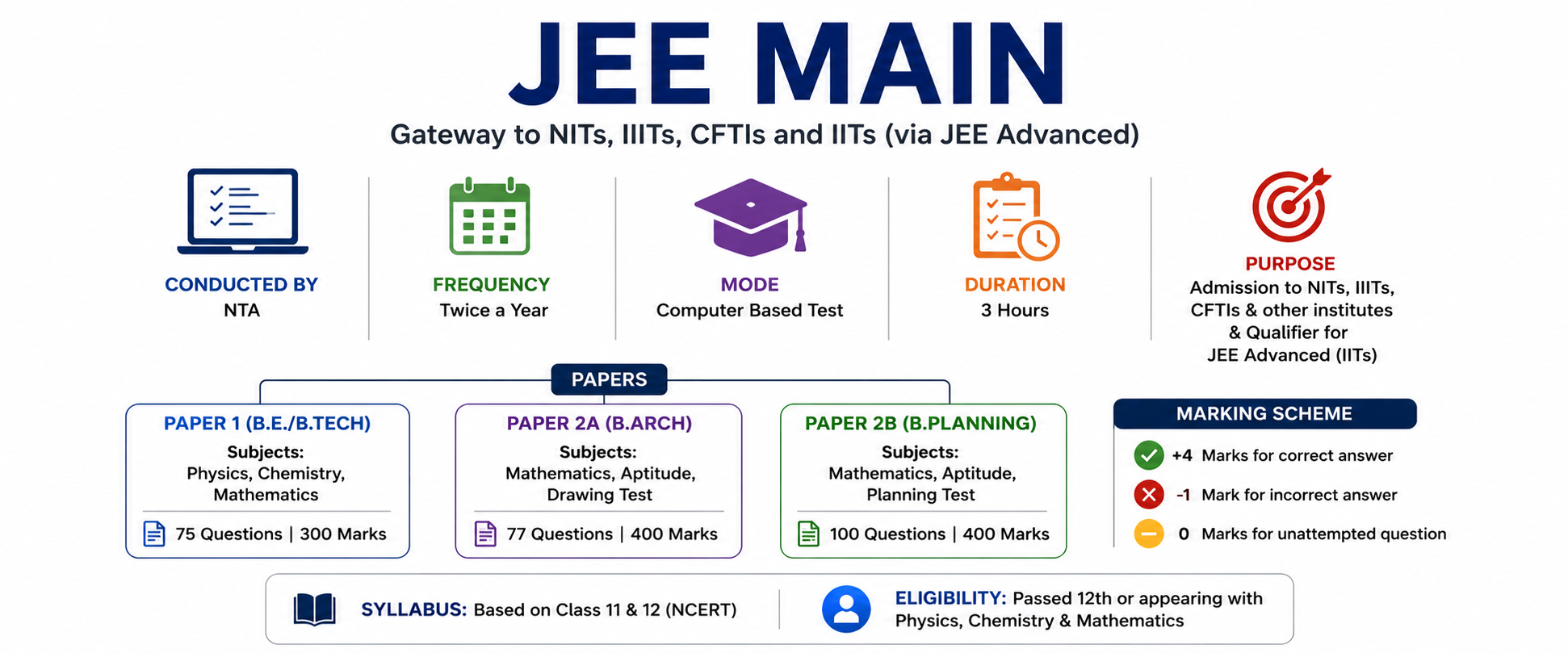
JEE Main (Joint Entrance Examination – Main) is one of India's most prestigious national-level engineering entrance examinations conducted by the National Testing Agency (NTA). It is the primary gateway for admission to undergraduate engineering, architecture, and planning programmes offered by the National Institutes of Technology (NITs), Indian Institutes of Information Technology (IIITs), Centrally Funded Technical Institutions (CFTIs), and several other government and private colleges across the country.
Apart from providing admission to top engineering institutions, JEE Main also serves as the qualifying examination for JEE Advanced, which is required for admission into the Indian Institutes of Technology (IITs). Every year, lakhs of students appear for the examination, making it one of the most competitive entrance tests in India.
What is JEE Main?
JEE Main is a standardized national-level entrance examination designed to evaluate candidates' understanding of Physics, Chemistry, Mathematics, Aptitude, Drawing, and Planning concepts, depending on the course selected.
The examination has two major objectives:
- Admission to undergraduate engineering, architecture, and planning programmes.
- Selection of eligible candidates for JEE Advanced and IIT admissions.
The examination is conducted in Computer-Based Test (CBT) mode and is usually held twice every year, allowing candidates to improve their scores by appearing in multiple sessions.
Why is JEE Main Important?
JEE Main is considered one of the most important engineering entrance examinations because it offers admission to some of India's finest technical institutions.
A good JEE Main score can help candidates secure admission to:
- National Institutes of Technology (NITs)
- Indian Institutes of Information Technology (IIITs)
- Centrally Funded Technical Institutions (CFTIs)
- State Government Engineering Colleges
- Participating Private Engineering Universities
Only candidates who qualify in JEE Main are eligible to appear for JEE Advanced for admission into the IITs.
JEE Main Papers
JEE Main consists of different papers based on the programme a candidate wishes to pursue.
Paper 1 – B.E./B.Tech
This paper is for engineering aspirants seeking admission to Bachelor of Engineering (B.E.) and Bachelor of Technology (B.Tech.) programmes.
Subjects include:
- Physics
- Chemistry
- Mathematics
Paper 2A – B.Arch
This paper is designed for candidates seeking admission to Bachelor of Architecture programmes.
Subjects include:
- Mathematics
- Aptitude Test
- Drawing Test
Paper 2B – B.Planning
This paper is meant for Bachelor of Planning programmes.
Subjects include:
- Mathematics
- Aptitude Test
- Planning-Based Questions
JEE Main Exam Pattern
Understanding the exam pattern helps candidates prepare more effectively.
Paper 1 (B.E./B.Tech)
- Mode of Examination: Computer-Based Test (CBT)
- Duration: 3 Hours (4 Hours for PwD candidates)
- Total Questions: 75
- Total Marks: 300
- Subjects:
- Physics
- Chemistry
- Mathematics
Each subject contains:
- Multiple Choice Questions (MCQs)
- Numerical Value Questions
Paper 2A (B.Arch)
- Total Questions: 77
- Subjects:
- Mathematics
- Aptitude
- Drawing
- Total Marks: 400
Paper 2B (B.Planning)
- Total Questions: 100
- Subjects:
- Mathematics
- Aptitude
- Planning
- Total Marks: 400
Marking Scheme
The marking scheme for JEE Main is straightforward.
- +4 marks for every correct answer
- -1 mark for every incorrect MCQ answer
- No marks for unanswered questions
Since negative marking is applicable, candidates should answer carefully and avoid unnecessary guesses.
Eligibility Criteria
Candidates must satisfy the basic eligibility requirements before applying.
Educational Qualification
Applicants should have passed or be appearing in Class 12 (or an equivalent examination) with:
- Physics
- Chemistry
- Mathematics
These subjects are compulsory for engineering admissions.
Age Limit
There is no upper age limit for appearing in JEE Main. However, candidates must meet the admission criteria prescribed by their preferred institutions.
Qualifying Marks
For admission into several central institutions, candidates generally need the minimum qualifying marks specified by the respective institutes. Some institutions may require around 75% marks in Class 12 or equivalent, while relaxation is available for reserved categories as per government norms.
JEE Main Syllabus
The syllabus is mainly based on the NCERT curriculum of Classes 11 and 12.
Physics
Important topics include:
- Mechanics
- Laws of Motion
- Work, Energy and Power
- Rotational Motion
- Thermodynamics
- Electrostatics
- Current Electricity
- Magnetism
- Electromagnetic Induction
- Optics
- Modern Physics
Chemistry
Key topics include:
- Physical Chemistry
- Organic Chemistry
- Inorganic Chemistry
- Chemical Bonding
- Thermodynamics
- Equilibrium
- Periodic Table
- Chemical Kinetics
- Coordination Compounds
- Organic Reactions
Mathematics
Major topics include:
- Algebra
- Calculus
- Coordinate Geometry
- Trigonometry
- Probability
- Functions
- Limits and Derivatives
- Vectors
- Three-Dimensional Geometry
The examination tests both conceptual understanding and problem-solving ability.
Key Features of JEE Main
Some important features of the examination include:
- Conducted by the National Testing Agency (NTA)
- National-level engineering entrance examination
- Computer-Based Test (CBT)
- Usually conducted twice every year
- Questions based on the Class 11 and 12 syllabus
- Gateway to NITs, IIITs, and CFTIs
- Qualifying examination for JEE Advanced
- Multiple attempts help candidates improve their scores
- Best score among attempts is generally considered
Preparation Tips
A well-planned preparation strategy can significantly improve performance.
- Understand the latest syllabus and exam pattern.
- Build strong conceptual knowledge using NCERT textbooks.
- Practice previous years' question papers.
- Take regular mock tests.
- Revise important formulas and concepts frequently.
- Strengthen time management skills.
- Focus equally on Physics, Chemistry, and Mathematics.
- Analyse mistakes after every mock test.
- Maintain a consistent study schedule.
Conclusion
JEE Main is one of India's most important engineering entrance examinations and serves as the gateway to some of the country's best engineering institutions. It also acts as the qualifying examination for JEE Advanced, opening the path to IIT admissions. Understanding the eligibility criteria, exam pattern, syllabus, marking scheme, and preparation strategy is essential for success. With consistent preparation, conceptual clarity, and regular practice, aspirants can maximize their performance and secure admission to leading engineering colleges across India.