





Introduction
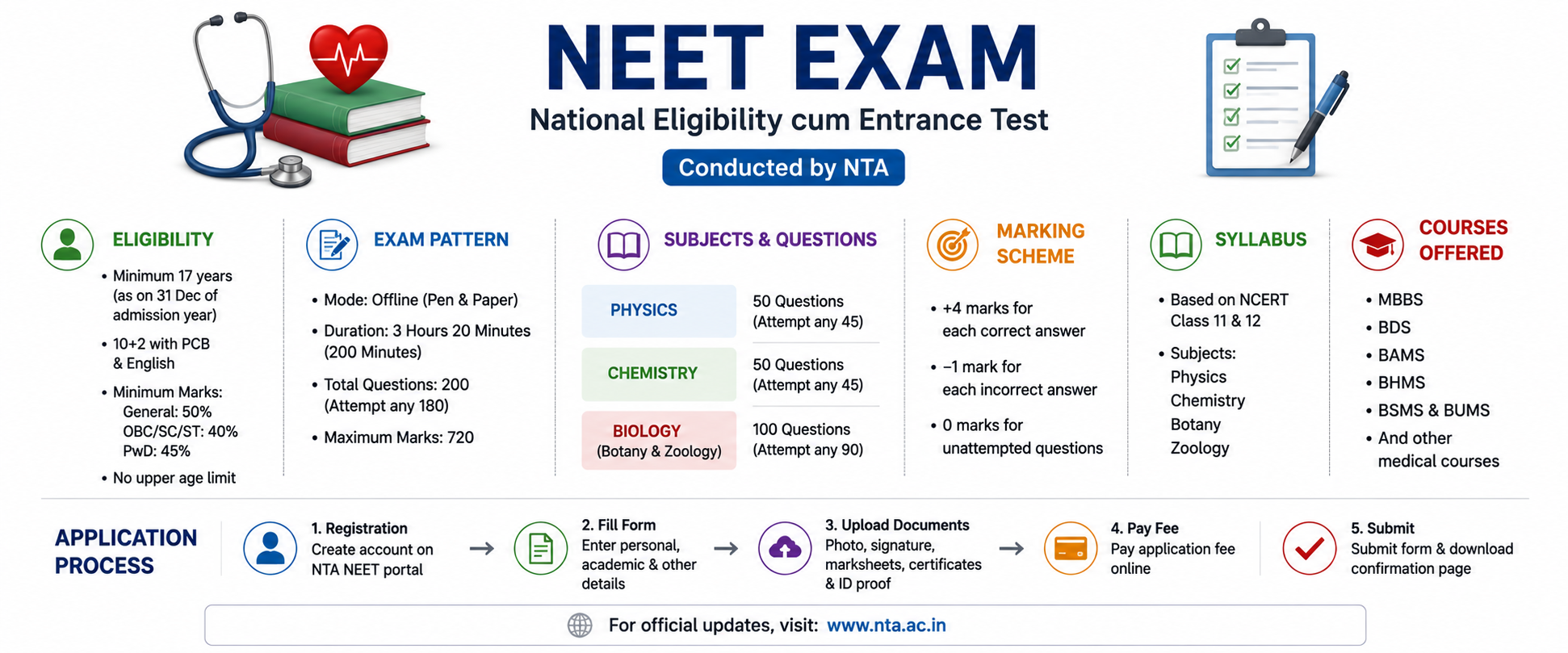
The National Eligibility cum Entrance Test (NEET) is India's premier medical entrance examination conducted by the National Testing Agency (NTA) for admission to undergraduate medical courses such as MBBS, BDS, BAMS, BHMS, BSMS, BUMS, and several other allied medical programs. NEET serves as the single entrance examination for medical admissions in government and private colleges across the country, ensuring a transparent and standardized selection process.
The examination is conducted in offline (pen-and-paper) mode and consists of Multiple Choice Questions (MCQs) from Physics, Chemistry, Botany, and Zoology based primarily on the NCERT Class 11 and Class 12 curriculum.
What is NEET?
NEET is a national-level medical entrance examination that provides a common platform for students seeking admission to undergraduate medical and dental programs in India. Conducted by the National Testing Agency (NTA), the examination evaluates candidates' understanding of Physics, Chemistry, and Biology through objective-type questions.
A NEET score is accepted by government medical colleges, private medical colleges, deemed universities, and several institutions offering AYUSH courses across India.
NEET Eligibility Criteria
Candidates must satisfy the eligibility requirements prescribed by the National Medical Commission (NMC) before applying for the examination.
Educational Qualification
Applicants should have passed or be appearing for the Class 12 (10+2) examination or its equivalent from a recognized board.
The qualifying examination must include:
- Physics
- Chemistry
- Biology/Biotechnology
- English
Minimum Qualifying Marks
Candidates must obtain the following minimum aggregate marks in Physics, Chemistry, and Biology (PCB):
- General/EWS: 50%
- OBC/SC/ST: 40%
- PwD: 45%
Age Limit
Candidates should have completed 17 years of age on or before 31 December of the admission year.
Currently, there is no upper age limit for appearing in the NEET examination.
Nationality
The examination is open to:
- Indian Citizens
- Non-Resident Indians (NRIs)
- Overseas Citizens of India (OCIs)
- Persons of Indian Origin (PIOs)
- Foreign Nationals
Candidates must submit the required nationality and identity documents during the application process.
Number of Attempts
There is no restriction on the number of attempts. Candidates can appear for the examination multiple times as long as they continue to satisfy the eligibility criteria.
Identity Proof
Applicants must possess a valid government-issued identity proof while completing the application process and appearing for the examination.
NEET Exam Pattern
Understanding the examination pattern is essential for effective preparation.
The NEET examination is conducted in offline mode using pen and paper.
Important features include:
- Examination Duration: 3 Hours 20 Minutes (200 Minutes)
- Question Type: Multiple Choice Questions (MCQs)
- Total Questions: 200
- Questions to Attempt: 180
- Maximum Marks: 720
The paper is divided into three subjects:
Physics
- 50 Questions
- Attempt any 45
Chemistry
- 50 Questions
- Attempt any 45
Biology
Biology is further divided into:
- Botany
- Zoology
Total Biology Questions:
- 100 Questions
- Attempt any 90
NEET Marking Scheme
The examination follows a straightforward marking pattern:
- +4 marks for every correct answer
- –1 mark for every incorrect answer
- 0 marks for unanswered questions
The maximum obtainable score is 720 marks.
NEET Syllabus
The syllabus is based primarily on the NCERT Class 11 and Class 12 curriculum. Since a majority of questions are directly derived from NCERT textbooks, they remain the most important study resource for candidates.
Biology Topics
Major topics include:
- Diversity in the Living World
- Structural Organisation in Animals and Plants
- Cell Structure and Function
- Plant Physiology
- Human Physiology
- Reproduction
- Genetics and Evolution
- Biology and Human Welfare
- Biotechnology and Its Applications
- Ecology and Environment
Chemistry Topics
Important topics include:
- Basic Concepts of Chemistry
- Atomic Structure
- Chemical Bonding
- Thermodynamics
- Equilibrium
- Solutions
- Electrochemistry
- Chemical Kinetics
- Coordination Compounds
- Organic Chemistry
- Hydrocarbons
- Biomolecules
- Periodic Classification
- p-Block Elements
- d and f Block Elements
- Practical Chemistry
Physics Topics
Key topics include:
- Physics and Measurement
- Kinematics
- Laws of Motion
- Work, Energy and Power
- Rotational Motion
- Gravitation
- Thermodynamics
- Oscillations and Waves
- Current Electricity
- Magnetism
- Electromagnetic Induction
- Electromagnetic Waves
- Optics
- Dual Nature of Matter
- Atoms and Nuclei
- Electronic Devices
NEET Application Process
The application process is conducted online through the official NTA portal.
Step 1: Registration
Candidates must:
- Visit the official NEET website.
- Click on the registration link.
- Enter personal details.
- Register using a valid email ID and mobile number.
- Generate login credentials.
Step 2: Fill the Application Form
After registration, applicants should complete the application form by providing:
- Personal details
- Educational qualifications
- Communication address
- Category information
- Examination city preferences
All information should exactly match official documents.
Step 3: Upload Documents
Candidates need to upload scanned copies of:
- Passport-size photograph
- Signature
- Left-hand thumb impression (if required)
- Category certificate (if applicable)
- Class 10 marksheet
- Class 12 marksheet
- Other supporting documents as specified
The uploaded files must comply with the prescribed size and format requirements.
Step 4: Fee Payment
The application fee must be paid online through approved payment methods.
After successful payment, candidates should download and save the confirmation page for future reference.
NEET Exam Centres
The NEET examination is conducted across more than 550 cities in India along with 14+ international examination centres.
Candidates can select their preferred examination city while filling out the application form, although the final allotment depends on seat availability.
Major examination cities include:
- Delhi
- Mumbai
- Chennai
- Bengaluru
- Hyderabad
- Kolkata
- Ahmedabad
- Coimbatore
- Thiruvananthapuram
- Vijayawada
- Visakhapatnam
- Surat
- Gurugram
- Ghaziabad
- Jammu
- Srinagar
- Prayagraj
- Nashik
- Mangalore
- Ujjain
International examination centres include cities such as:
- Dubai
- Abu Dhabi
- Doha
- Muscat
- Riyadh
- Kuwait City
- Singapore
- Kathmandu
Important Documents Required
Before beginning the application process, candidates should keep the following documents ready:
- Passport-size photograph
- Signature
- Government-issued photo identity proof
- Class 10 marksheet
- Class 12 marksheet
- Category certificate (if applicable)
- PwD certificate (if applicable)
- Left-hand thumb impression (if required)
Keeping these documents prepared helps ensure a smooth application process.
Preparation Tips for NEET
A well-planned preparation strategy is essential for success.
Some effective preparation tips include:
- Study the NCERT Class 11 and 12 textbooks thoroughly.
- Build strong conceptual understanding in Physics, Chemistry, and Biology.
- Practice previous years' question papers.
- Attempt regular mock tests to improve speed and accuracy.
- Revise important formulas, diagrams, and biological concepts consistently.
- Maintain a structured study schedule with regular revision.
Conclusion
The NEET examination serves as the gateway to undergraduate medical education in India. Conducted by the National Testing Agency, it provides a fair and standardized admission process for aspiring medical students. Understanding the eligibility criteria, exam pattern, syllabus, application process, marking scheme, and test centre selection is crucial for successful preparation. With consistent study, thorough knowledge of the NCERT curriculum, and regular practice, candidates can improve their performance and enhance their chances of securing admission to their preferred medical college.