





Introduction
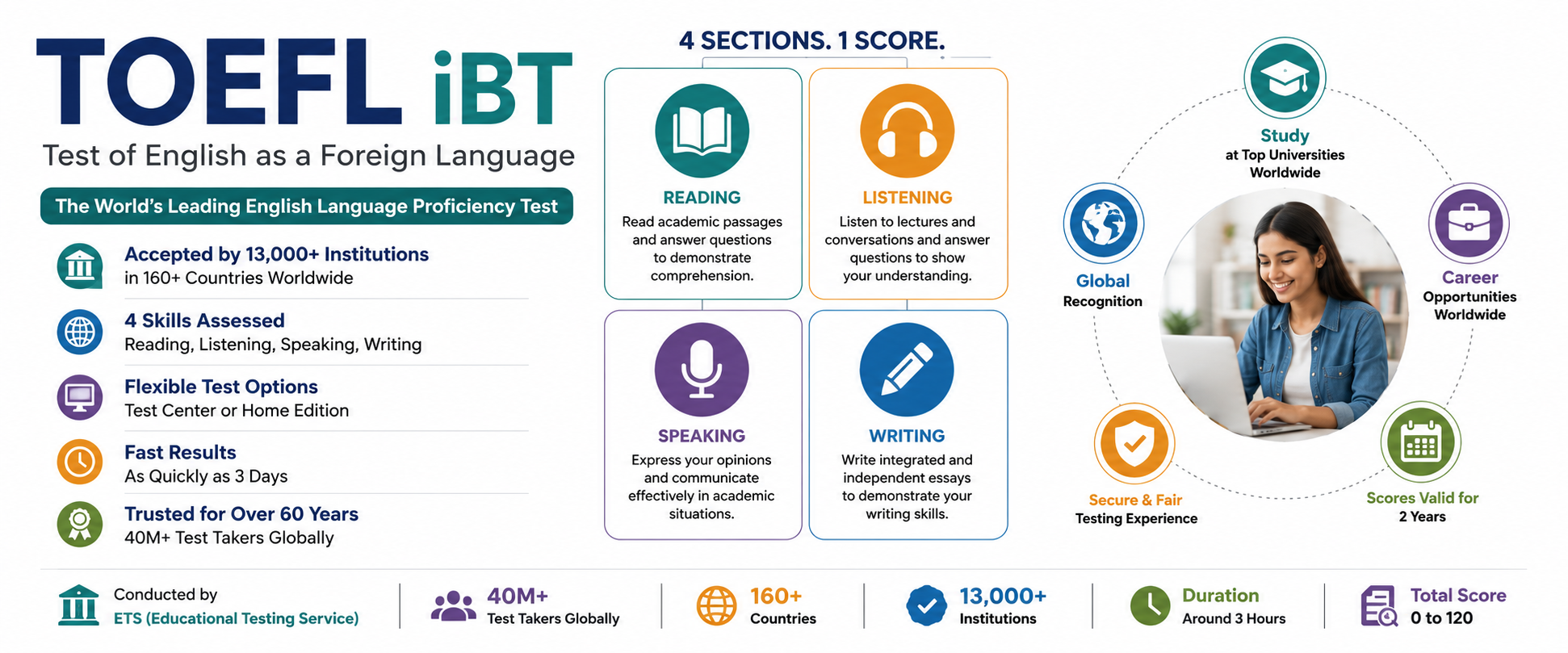
The TOEFL iBT (Test of English as a Foreign Language Internet-Based Test) is one of the most widely recognized English language proficiency examinations for students who wish to study, work, or migrate to English-speaking countries. Conducted by the Educational Testing Service (ETS), the TOEFL exam measures a candidate's ability to understand and use English effectively in an academic environment. It evaluates the communication skills that universities expect students to demonstrate in classrooms, lectures, assignments, presentations, group discussions, and research activities.
Global Recognition of TOEFL
For more than six decades, TOEFL has earned a reputation as one of the most trusted English proficiency tests in the world. Over 40 million candidates have taken the exam, and its scores are accepted by more than 13,000 universities and institutions across 160 countries, including the United States, Canada, the United Kingdom, Australia, Germany, Ireland, New Zealand, and several European and Asian destinations. The exam provides students with the flexibility to apply to institutions worldwide using a single, globally recognized English language qualification.
Why Choose the TOEFL iBT?
Unlike many language tests that focus primarily on everyday communication, the TOEFL iBT emphasizes academic English. Every section of the exam reflects real-life university situations, ensuring that candidates are prepared for higher education in English-medium institutions. The exam measures four essential language skills—Reading, Listening, Speaking, and Writing—which are integrated throughout the test to assess how well students can communicate in an academic setting.
TOEFL Test Formats
The TOEFL iBT is available in two formats:
- TOEFL iBT Test Center Edition
- TOEFL iBT Home Edition
Both versions follow the same exam pattern, use the same scoring system, and are accepted equally by universities worldwide. Students who prefer taking the test from home can choose the Home Edition, which is conducted online under live remote supervision by certified proctors. This flexibility allows candidates to take the exam in a secure environment while receiving the same global recognition as those testing at an authorized center.
Conducting Body
The exam is administered by ETS (Educational Testing Service), a globally respected non-profit organization specializing in educational assessments. ETS continuously updates the TOEFL to reflect the communication skills required in modern universities, making it one of the most reliable indicators of academic English proficiency.
TOEFL Exam Sections
The TOEFL iBT is designed to measure four core language skills.
Reading Section
The Reading section evaluates a candidate's ability to understand academic passages, identify key ideas, interpret vocabulary in context, recognize the author's purpose, and analyze arguments. Questions include multiple-choice items, sentence insertion tasks, vocabulary-based questions, and passages requiring multiple correct answers.
Listening Section
The Listening section assesses how effectively candidates understand spoken English in academic situations. Test takers listen to classroom lectures, campus conversations, and discussions before answering questions related to the main idea, supporting details, speaker attitude, organization, and inference. The section may include multiple-choice questions, matching tasks, and sequencing activities that evaluate careful listening and comprehension.
Speaking Section
The Speaking section measures a candidate's ability to communicate clearly and confidently in English. Responses are recorded using a computer microphone and assessed by certified evaluators. Candidates complete independent speaking tasks where they express personal opinions, as well as integrated speaking tasks that combine reading, listening, and speaking skills to simulate real university communication.
Writing Section
The Writing section evaluates academic writing ability. Candidates complete an integrated writing task that requires them to read a passage, listen to a lecture, and produce a well-organized written response combining both sources. They also complete an academic discussion task where they present and support their opinions using clear, coherent English with appropriate grammar and vocabulary.
TOEFL Scoring System
One of the reasons TOEFL remains highly respected is its scoring system. Each section is scored on a scale of 0 to 30, resulting in a maximum total score of 120. Universities establish their own minimum score requirements depending on the program and level of study. Higher-ranked institutions generally expect stronger overall scores, particularly in graduate and professional programs where advanced English proficiency is essential.
TOEFL score reports also provide performance levels for each skill, allowing universities and students to understand strengths and areas requiring improvement. Reading, Listening, Speaking, and Writing scores are individually reported, giving institutions a comprehensive overview of a candidate's English language abilities.
TOEFL Results and Score Validity
Candidates can usually receive their TOEFL results within a few days after the examination, making it one of the fastest international English proficiency tests. Official score reports can be viewed online and sent directly to selected universities during the application process. TOEFL scores remain valid for two years, enabling students to use the same results for multiple university applications within the validity period.
TOEFL Eligibility
There are no strict eligibility requirements for taking the TOEFL exam. ETS has not prescribed a minimum age or educational qualification. Generally, students who have completed or are pursuing secondary education and intend to study in an English-speaking academic environment choose to appear for the test. Working professionals seeking international employment or migration opportunities may also take the TOEFL if required by employers or immigration authorities.
TOEFL Registration Process
Registering for the TOEFL exam is straightforward. Candidates can create an account on the official ETS website, select a preferred test date, choose between a test center or Home Edition, complete the registration process, and pay the examination fee online. Registration is also available through telephone or mail in selected regions. Since popular test dates fill quickly, candidates are advised to register well in advance of university application deadlines.
TOEFL Exam Fees
The TOEFL exam fee varies by country, and additional charges may apply for services such as late registration, rescheduling, score review, additional score reports, or score reinstatement. Applicants should always verify the latest fee structure on the official ETS website before booking their examination.
TOEFL Home Edition
The TOEFL iBT offers exceptional flexibility for students worldwide. The Home Edition allows candidates in eligible countries to take the exam from their own computer under secure online monitoring. The test center edition is available at thousands of authorized testing centers across the globe, providing multiple testing dates throughout the year.
TOEFL Preparation Tips
Preparing for the TOEFL requires consistent practice across all four language skills. Candidates should regularly read academic articles, listen to English lectures and podcasts, practice speaking within time limits, and improve academic writing through structured essays and discussions. Familiarity with the exam format, time management, and regular mock tests can significantly improve performance and confidence on test day.
Why Universities Accept TOEFL Scores
One of the strongest advantages of the TOEFL iBT is its universal acceptance. It is recognized by leading universities, scholarship providers, licensing bodies, and government agencies around the world. Many institutions specifically prefer TOEFL scores because the exam closely reflects the communication skills students need in higher education, including understanding lectures, participating in seminars, writing research assignments, and presenting ideas effectively.
Conclusion
For students planning to pursue undergraduate, postgraduate, doctoral, or professional education abroad, the TOEFL iBT serves as a gateway to international academic opportunities. Its emphasis on real-world academic communication, reliable scoring system, flexible testing options, and global recognition make it one of the most trusted English language proficiency examinations available today.
Whether your goal is to study at a prestigious university, apply for scholarships, or strengthen your international academic profile, achieving a competitive TOEFL score can significantly enhance your application. With thorough preparation, a clear understanding of the exam pattern, and consistent practice in Reading, Listening, Speaking, and Writing, candidates can confidently demonstrate their English language proficiency and take an important step toward achieving their global education and career aspirations.