





Introduction
The VIT Engineering Entrance Examination (VITEEE) is one of India's leading university-level engineering entrance examinations conducted annually by the Vellore Institute of Technology (VIT). It serves as the gateway for admission into undergraduate B.Tech programs offered at VIT campuses located in Vellore, Chennai, Bhopal, and Amaravati.
Every year, thousands of engineering aspirants appear for VITEEE because of VIT's excellent academic reputation, modern infrastructure, industry-oriented curriculum, and strong placement opportunities. The examination evaluates candidates' knowledge in Physics, Chemistry, Mathematics or Biology, Aptitude, and English through a computer-based test.
What is VITEEE?
VITEEE is a university-level entrance examination organized by the Vellore Institute of Technology for admission into various Bachelor of Technology (B.Tech) programs.
Students securing good ranks in the examination become eligible for admission to VIT's campuses based on their performance and counseling process. The examination provides an excellent alternative for students seeking quality engineering education outside the national-level entrance examinations.
Why is VITEEE Important?
VITEEE has become one of the most preferred engineering entrance examinations due to several advantages.
Students gain admission into one of India's leading private engineering universities with excellent placement records, experienced faculty, international collaborations, research opportunities, and state-of-the-art laboratories.
The examination follows a transparent merit-based counseling process where admissions are allotted according to candidates' ranks rather than donations or management quotas.
VITEEE Exam Pattern
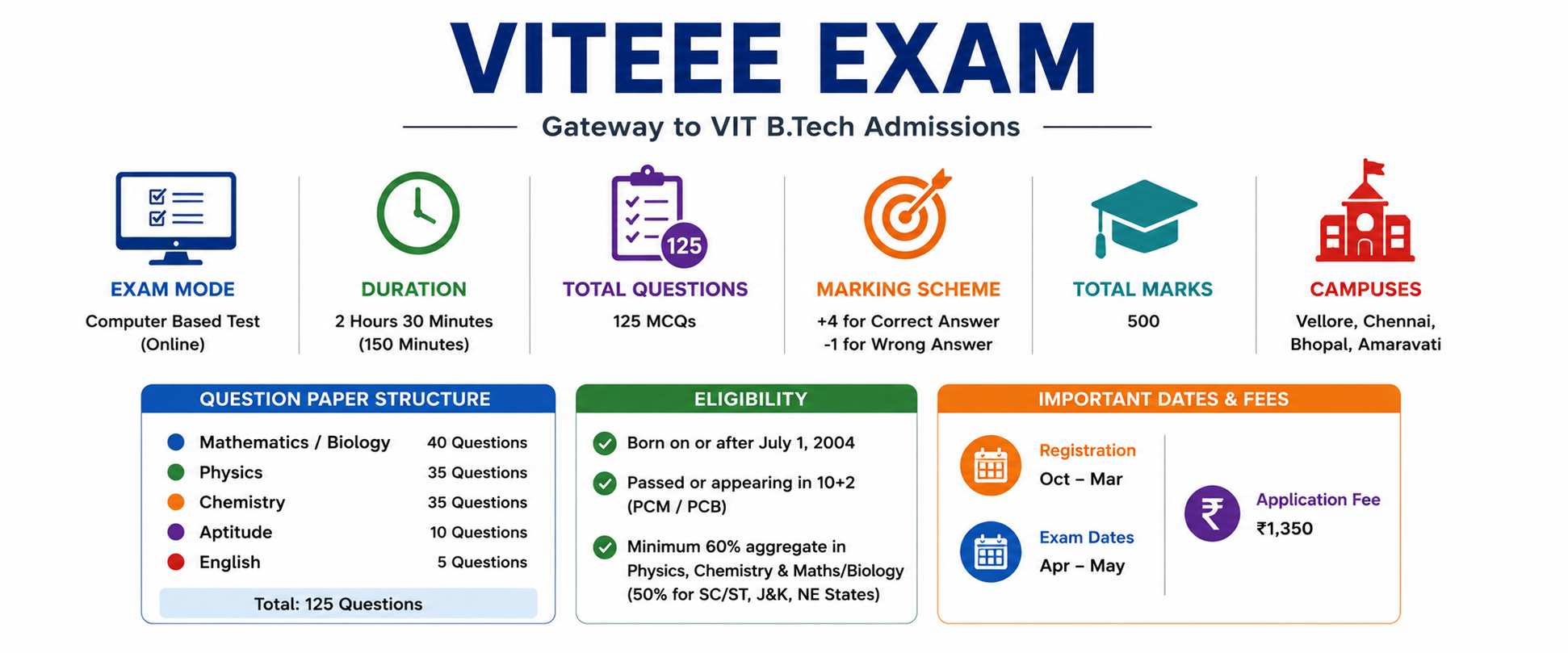
The examination is conducted entirely in Computer-Based Test (CBT) mode.
The total duration of the examination is 2 hours and 30 minutes, during which candidates answer 125 Multiple Choice Questions (MCQs).
The paper consists of five sections:
- Physics
- Chemistry
- Mathematics or Biology
- Aptitude
- English
Students from the Mathematics stream attempt Mathematics, while Biology students answer Biology instead of Mathematics.
The examination follows the marking scheme below:
- +4 marks for every correct answer
- -1 mark for every incorrect answer
- Maximum score: 500 marks
Since negative marking applies, candidates should focus on both accuracy and speed while attempting questions.
VITEEE Eligibility Criteria
Before applying, candidates should carefully verify that they satisfy all eligibility requirements.
Candidates must have passed or be appearing for the Class 12 (10+2) examination from a recognized board.
Students should have studied:
- Physics
- Chemistry
- Mathematics or Biology
PCM students are eligible for all B.Tech programs, whereas PCB students can apply only for selected bio-related engineering courses offered by VIT.
Candidates generally require a minimum aggregate of 60% marks in Physics, Chemistry, and Mathematics/Biology. Reserved category candidates and applicants from specific regions may receive relaxation according to university guidelines.
Candidates should also satisfy the prescribed age criteria announced by the university before applying.
VITEEE Syllabus
The syllabus is primarily based on the NCERT Class 11 and Class 12 curriculum.
Physics
Important topics include:
- Laws of Motion
- Work, Energy and Power
- Electrostatics
- Current Electricity
- Magnetism
- Electromagnetic Induction
- Optics
- Modern Physics
- Semiconductors
- Thermodynamics
Chemistry
Major topics include:
- Atomic Structure
- Chemical Bonding
- Thermodynamics
- Chemical Equilibrium
- Electrochemistry
- Chemical Kinetics
- Organic Chemistry
- Coordination Compounds
- Biomolecules
- Environmental Chemistry
Mathematics
Candidates choosing Mathematics should prepare topics such as:
- Algebra
- Matrices
- Determinants
- Calculus
- Coordinate Geometry
- Three-Dimensional Geometry
- Trigonometry
- Probability
- Vector Algebra
Biology
Biology applicants should prepare:
- Cell Structure
- Human Physiology
- Genetics
- Evolution
- Biotechnology
- Ecology
- Plant Physiology
Aptitude
The Aptitude section generally covers:
- Logical Reasoning
- Numerical Ability
- Data Interpretation
- Pattern Recognition
English
The English section evaluates:
- Grammar
- Vocabulary
- Reading Comprehension
- Sentence Correction
VITEEE Application Process
The VITEEE application process is conducted completely online through the official VIT admission portal.
Candidates first register using a valid email address and mobile number.
After registration, applicants complete the online application form by entering their personal details, academic qualifications, preferred examination city, and subject combination.
Candidates must then upload scanned copies of:
- Passport-size photograph
- Signature
The application fee is paid online using debit card, credit card, net banking, or other approved digital payment methods.
After successful submission, applicants should download and keep the confirmation page for future reference.
Slot Booking
Once the application process is completed, candidates must participate in the slot booking process.
Students can choose their preferred:
- Examination date
- Time slot
- Examination centre
Since slots are allotted on a first-come, first-served basis, early booking is recommended.
Preparation Strategy for VITEEE
A well-planned preparation strategy significantly improves performance in VITEEE.
Understand the Exam Pattern
Candidates should first become familiar with the examination structure, marking scheme, and syllabus before beginning preparation.
Build Strong Concepts
Most questions are concept-based and follow the NCERT curriculum. Building strong fundamentals in Physics, Chemistry, Mathematics, or Biology is essential.
Practice Regularly
Daily practice of MCQs improves both speed and accuracy. Candidates should solve topic-wise questions and gradually move to full-length practice papers.
Attempt Mock Tests
Mock tests help students become comfortable with the computer-based examination format while improving time management.
Analyzing mistakes after every mock test is equally important.
Revise Frequently
Regular revision strengthens conceptual understanding and improves retention. Short notes, important formulas, and quick revision sheets are especially useful during the final weeks of preparation.
Common Mistakes to Avoid
Many students lose valuable marks because of avoidable errors.
Some common mistakes include:
- Ignoring the official syllabus
- Not practicing mock tests
- Poor time management
- Guessing too many answers despite negative marking
- Delaying revision until the final days
Avoiding these mistakes can significantly improve overall performance
Why Choose VIT?
VIT has established itself as one of India's top private engineering institutions.
Some major advantages include:
- High placement records
- Industry-focused curriculum
- Modern laboratories
- International collaborations
- Experienced faculty
- Excellent research facilities
- Merit-based counseling process
- Multiple campus options
These factors make VIT an attractive destination for engineering aspirants.
Conclusion
The VITEEE exam offers an excellent opportunity for students aspiring to pursue engineering at one of India's leading private universities. With a well-defined syllabus, transparent admission process, and strong career prospects, VITEEE continues to attract thousands of candidates every year.
Success in the examination depends on understanding the exam pattern, meeting the eligibility criteria, following a disciplined preparation strategy, practicing regularly, and revising consistently. With proper planning and focused preparation, candidates can secure a good rank and gain admission to their preferred engineering program at VIT.